The Tower Tarot Card Meaning
המגדל
The Tower is the tarot card of sudden change: a truth, an event or a realization that shakes a structure you were relying on. It is one of the most feared cards in the deck, yet its message is honesty, because what falls was not built on solid ground.
- Upright
- sudden changerevelationupheavaltruthreleasebreakthrough
- Reversed
- avoiding changedelayed collapseinner upheavalfear of lossnarrow escapeslow release
- Yes or no
- Strong No
- Arcana
- Major Arcana, card 16
- Astrology
- Mars
- Number
- 16
now to days
By Mars
Counts for timingSuddenness.
Timenow to days
By Mars
Counts for timingSuddenness.
Card Facts
פ = Peh · Double letter = Mars — so the path of The Tower runs from Netzach to Hod.
On the Tree of Life
Netzach to Hod
Path 27 of the 32 paths of wisdom
The letter Peh — double letter
How the card sits on the treeThe Tower Upright Meaning
The Tower describes an event, information, or realization that abruptly changes a familiar structure or confidence in it. Sometimes circumstances change; sometimes they prove different from what was assumed. Consider what has been shaken, what still exists, and what can be relied on going forward.
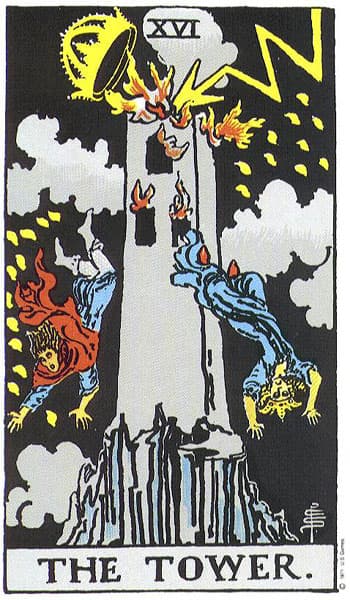
In the Rider-Waite image, lightning strikes a tall tower, knocking off its crown, while flames burst from the windows and two figures fall. Upright, The Tower describes the moment a situation can no longer be held together: a plan that fails, a secret that comes out, or a belief that stops making sense.
It is rarely comfortable, but it is clarifying. The Tower removes what was unstable so that something more honest can be built. Its practical question is what still stands after the shock, and what you can rely on as you rebuild.
The light in the card
Realization, disclosure, and the possibility of releasing a way of holding things together that no longer fits, while recognizing a more dependable foundation.
The shadow in the card
Shock, overwhelm, panic, rigid holding on, or quickly rebuilding the same structure without understanding what changed.
Message
The Tower concerns sudden change that unsettles the familiar: a revelation, a loss of certainty or an event that interrupts ordinary life. Sometimes a weakness that was already there becomes visible; sometimes new circumstances damage something that had been dependable. As a Major Arcana card, it can raise questions about security, trust and the assumptions around which a life has been arranged. The shock may bring clarity, but also anger, loss and confusion. Understanding and rebuilding can take time, and there is no promise that every loss will quickly become an opportunity. Core qualities of The Tower: revelation, release, clarity, honesty and rebuilding.
The Tower Reversed Meaning
AGAT readings draw upright cards; the reversed meaning is here for reference.
Reversed, The Tower can describe a change you are trying to avoid, a collapse that is delayed, or an upheaval happening inside you rather than around you. Sometimes it shows a narrow escape, or a crisis that turns out smaller than you feared.
Its warning is that postponing a necessary change rarely makes it gentler. The reversed card invites you to dismantle the weak part yourself, step by step, before circumstances do it for you.
Use to study reversals or if reversed draws are actually enabled in the future. Do not present an upright card as reversed. Reversal readings may consider internal upheaval, delayed confrontation, resistance, prolonged dismantling, an avoided crisis, or the aftermath of a break. Methods differ. A challenging expression of an upright card is not identical to a reversed meaning.
The Tower in Love & Relationships
In relationships, the Tower may describe a conversation, discovery, argument, or change that disrupts an earlier understanding of the bond. Distinguish damage to the relationship from an expectation, agreement, or idealized picture that no longer holds. It does not require separation or prove betrayal. In a new connection it may reflect unexpected attraction or a rapid change in expectations. After a crisis, consider what remains of trust and reciprocity; repair depends on both people participating and changing their behavior. Intensity alone cannot establish this. The card does not determine what the other person feels or will choose. In a question about a new relationship, the Tower also raises the issue of foundations: do attraction, expectations and the way people meet support mutual building, or rest on an assumption that does not hold in practice? When repeated attempts without progress are reported, explore chemistry alongside availability, intention and commitment. In an intimate context, the Tower may symbolize intense arousal, accumulated tension and sudden release; sexual intensity alone is not a relationship foundation. Do not infer sexual activity, personal inadequacy or a fixed future from the card.
If you are single
If you are single, The Tower can mark a wake-up call: the end of an illusion about love, or a sudden meeting that changes your plans. It asks you to drop old patterns that kept you safe but stuck.
In a relationship
In a relationship, The Tower points to a revelation, an argument that brings everything into the open, or a sudden change. It does not automatically mean a breakup; sometimes the collapse of pretending allows a more honest bond.
As feelings: how someone feels about you
As feelings, The Tower describes intense, unsettled emotions: shock, strong attraction that feels disruptive, or a realization that has turned someone's view upside down. Things may feel unstable between you right now. Give the dust time to settle before drawing conclusions.
The Tower in Career & Money
At work, the Tower may describe changes in management, role, project, or the rules of the workplace. Layoffs, an incident, or deciding to leave are possibilities when the context supports them, rather than necessary conclusions. Sometimes an assumption fails and a plan needs to change. Experience, skills, professional relationships, and judgment may remain beyond the affected role or organization. Disruption can open another direction without promising an easy or rapid transition. In a professional conversation about change, the Tower may illuminate a gap between the role definition, expectations and actual work, or a need to revise a structure that limits contribution. A conversation may expose an existing gap; the Tower does not establish that raising the subject will cause a crisis. Also consider whether accumulated frustration creates an urge to act all at once. Possible questions: What needs to change: tasks, authority, treatment, management approach or team? What has actually been said or happened? Could a defined adjustment be explored before a wider decision? Distinguish revising a structure from dismantling it according to the position and supplied context.
At work, The Tower can describe a reorganization, a project that collapses or the exposure of a weak foundation. The useful response is to learn what failed and build on firmer ground, rather than rush to rebuild the same thing.
Money
With money, The Tower asks you to look honestly at what is not secure, such as a plan built on assumptions. Treat it as a prompt to review and prepare, not as a prediction or financial advice.
In money and partnerships, the Tower can expose a gap between feeling secure and the agreements or resources supporting that confidence. New information about income, obligations, dependency, or an asset may change the picture. After a crisis, distinguish what was lost, what was damaged, and what still exists. The card does not establish a loss, insolvency, or breach of contract.
The Tower as Yes or No
Strong No
The Tower is a strong no for continuing on the current path: something in the plan is unstable and needs to change before it can work.
The Tower as Advice
As advice, The Tower says: let what is false fall. Do not spend your energy propping up a structure that is already cracked. Focus on what is true and solid, take care of yourself through the shock, and build the next step on that.
The Tower in a Reading: Common Combinations
The Tower + The Star
Healing and hope after upheaval. The storm passes and a clearer path appears.
The Tower + Death
A real ending and a transformation. What changes now is unlikely to return to how it was.
The Tower + Three of Swords
A painful truth in love. Hurt that is real, and also a chance to stop pretending.
The Tower + Ace of Swords
A sudden insight that cuts through confusion. The truth is out, and it brings clarity.
Psychological layer
The card may describe an abrupt change in the understanding of self or the world, a previously contained feeling emerging, rigidity that no longer explains reality, shame, or loss of control. Defenses can protect at one time and restrict at another. In a fear position, upheaval may describe what is feared rather than what is happening. Damage to a self-image or role does not erase the whole person. In shadow, insistence on a particular picture of a relationship or on what should create attraction may meet a mismatch with reality. Reconsider the assumption without judging the person or declaring their preferences wrong.
Inherited fear
When the question concerns fear, consider whether the sense of disaster rests on facts, a learned expectation, or a past experience. These are possibilities, not knowledge of the reader’s history. Fear of collapse does not establish that collapse will happen, and it is not a reason to dismiss something already damaged.
A question for reflection: What will remain steady after an upheaval, and what supports that steadiness—a clear contract, agreements that are honored, or a relationship that can be relied on?
Personal growth
The Tower can illuminate the difference between identity, role, or image and the person who continues when these change. Adaptability may be a form of stability: preserving a value or purpose in another structure. Relief and grief can coexist. Distinguish the immediate shock from the longer process of finding your bearings.
Family
In home and family life, the Tower may describe changing roles, a discovery, or a disruption of the familiar family picture. Sometimes the structure changes; sometimes an expectation of never disagreeing changes. Consider the bonds, responsibilities, and support that continue through the upheaval. The image does not predict a fire, accident, or injury.
Spirituality
Spiritually, the Tower may describe a living experience confronting a belief or explanation that has hardened. Revelation may shake certainty, release a restriction, or bring confusion. Losing an explanation need not end a spiritual search. Pain need not be presented as punishment or a necessary condition for growth.
Mythic parallel
The story of Babel offers a parallel about seeking security and losing a shared language. In the biblical account, construction stops and people scatter; lightning destroying the tower is not described. As a parallel, two parties may use the same word with different meanings. Images of houses built on rock or sand add the question of foundations. Rapunzel can enrich the tension between shelter and confinement.
Symbols and their relationships
The displaced crown can symbolize authority, status, or a claim of invulnerability being shaken. The falling figures bring the human consequences back into the reading. Lightning can be read as both impact and illumination. The rocky height does not guarantee a foundation that withstands every change. Distinguish the body of the structure, damage at its top, and what may remain afterward without assuming that everything affected was false.
Place in the arcana sequence
The Tower follows the Devil and precedes the Star. As a developmental story, attachment or confinement meets a disruption of its structure, after which hope may become possible. The next card in the sequence does not guarantee healing or reconciliation in a particular reading; its position and the context determine what it contributes.
Intimacy and sexuality
Use when the question explicitly concerns sexuality, intimacy, desire, or attraction. The Ace of Wands, Knight of Wands, Lovers, or Devil may enrich an already relevant context; their presence alone is insufficient. The Tower can be read as a release of energy, unexpected attraction, or loosening control. In a particular sexual reading it may also evoke climax and bodily release. Intensity or relief does not establish lasting intimacy, commitment, or reciprocity. Do not infer a sexual act or betrayal from the card.
What remains after a crisis
What remains immediately after a break may differ from what can support the future. Distinguish the affected structure, continuing agreements, practical resources, supportive relationships, and values. Something real can be damaged, and something harmful can persist. Surviving may mean adapting to another form rather than preserving everything.
When this meaning applies: Use when upheaval is described or the question asks what remains after change. If a crisis is not established, present it as a possibility.
A relationship after a crisis
After a crisis, the Tower can name the break already experienced rather than announce another one. Consider what became clear, what remains of trust, and what needs a different agreement. Rebuilding depends on both parties participating, acknowledging events, and changing behavior. One person’s wish or outward calm does not establish reconciliation.
When this meaning applies: Use only when the reader describes a crisis that has already happened or the context establishes it. The Tower alone does not establish this situation.
A new relationship
The encounter may change expectations, stir attraction, or reveal a difference in what each person wants. Distinguish what is known about the person from what imagination supplied. Realization need not mean failure, and an intense beginning does not establish a shared foundation.
When this meaning applies: Use for a new connection or the possibility of a relationship not yet established.
Relationship conflict
A sharp statement can reveal accumulated tension. Sometimes what changes is the way disagreement was avoided or agreement was assumed. Speaking may clarify or hurt depending on the words and response. This emphasis does not establish constant conflict, violence, or the end of the relationship.
When this meaning applies: Use when tension, an argument, disagreement, or poor communication is described.
Agreements and legal context
The Tower can describe disruption of a familiar arrangement and invite examination of remaining agreements, documents, obligations, and resources. A legal context may provide a foundation before crisis, become a dispute, cause change, or regulate what follows. The card does not determine legal validity, liability, or an outcome.
When this meaning applies: Use when the question concerns a contract, asset, partnership, rights, divorce, dispute, or legal process. Justice and the Emperor may add an angle when this context is already relevant.
Professional identity
Role and status can change without erasing professional ability. Experience, judgment, and relationships may remain even when an organization or project is disrupted. Dependence on one person, unavailable information, or one resource can become visible during change. Another direction may open instead of immediate restoration of the old plan.
When this meaning applies: Use when the question concerns changes in role, organization, authority, or professional direction.
Fear and facts
Distinguish an established event, the explanation given to it, and a scenario added by fear. Fear of collapse can be part of the story without collapse occurring. Anxiety does not justify dismissing facts, constraints, or actual harm.
When this meaning applies: Use when the question expresses fear or the Tower occupies a fear position. The Nine of Swords and Moon may enrich the distinction if present.
Speech and shared language
In a Hermetic reading, Peh, the mouth, connects thought and speech. Words can create confidence that differs from the other party’s understanding. The Tower can symbolize an old explanation meeting tangible reality. Do not attribute every difficulty to using words incorrectly.
When this meaning applies: Use when the question concerns communication, agreement, a decisive statement, or spiritual understanding.
Number and the Chariot
In some numerological systems, 16 reduces to 7 and connects with the Chariot. Direction and concentrated will can be compared with meeting the limits of control. Consider which form of control fits reality and which must change, without reducing the pair to success versus failure.
When this meaning applies: Use when a numerological layer is requested or the Chariot is being compared. Do not use it to determine a date.
Readings across traditions
In Marseille, the House of God can be read as opening, emergence, and expression, alongside separation or forced change. Thoth includes war, changing order, an eye, fiery jaws, a dove, and a lion-serpent associated with impulses of life and death. Another French system maps the Tower to Ayin and Capricorn. Keep these distinct from the imagery and mapping of other decks.
When this meaning applies: Use when traditions are being compared or the relevant deck is used.
Construction and growth
Compare constructing a tower through will with growth from a seed, or dissolving mixed material with distinguishing its parts. In relationships, love can be distinguished from fear of being alone; at work, professionalism from pleasing others. These are reflective metaphors, not claims that every construction must fail or every change must hurt.
When this meaning applies: Use when the question concerns control, development, or the difference between forcing a structure and adapting.
Experiencing a health change
The Tower can give language to surprise, vulnerability, and changes in routine or security. Consider who or what supports coping with uncertainty. The card does not identify illness, surgery, a medical event, death, or a treatment outcome.
When this meaning applies: Use only when the question concerns the experience of a health change or support around it, within symbolic reflection.
Astrology, Qabalah and number
Use for symbolic or spiritual explanation within the Golden Dawn framework, rather than as prediction of a personal event. In the Hermetic framework, the Tower relates to Mars, Peh, and path 27 between Netzach and Hod, linking emotional force with intellectual processing. Palpable consciousness offers a reading of knowing becoming lived experience. Fire describes a symbolic relation to force and release; this does not establish an identical mapping in every Kabbalistic tradition.
More combinations with other cards
Possible readings depend on the question and the cards' actual positions.
| Card | Possible connection |
|---|---|
| Ten of Cups | With the Tower, the perfect picture of the home may be shaken, and what was hidden behind it comes to light. Emphasis: what holds the bonds when the picture cracks and what can be built on a more honest footing, without reading the two cards together as a prophecy of falling apart. The family or relationship picture is tested against reality. |
| Knight of Cups | A gesture or ideal meets sudden change; not every crisis proves love was false. |
| King of Cups | With the Tower, the storm is no longer only in the surrounding sea: something outside is shaken. Emphasis: the King's steadiness as the ability to choose a response inside the upheaval, not as suppression of the shock, and without reading the two cards together as a prophecy of collapse. Emotional steadiness and the ability to choose a response within upheaval without suppressing the shock. |
| Ace of Cups | Emotional opening alongside rupture; a new feeling does not erase pain. |
| Two of Cups | With the Tower the relationship is shaken, and the Two of Cups shows what is still worth building after the break. Emphasis: a renewed meeting on a more honest footing. Reciprocity is tested by upheaval; the capacity to meet one another, where that is present in practice. |
| Three of Cups | Friendship and the group within change; this does not establish the presence of a third party. |
| Five of Cups | Grief and disappointment; room for what has been lost and for what remains. |
| Six of Cups | A story from the past changes, or a familiar person offers support. |
| Eight of Cups | Leaving a structure that no longer meets a need. |
| The Fool | Leaving a familiar structure and opening a path; consider whether this is freedom or a leap made in shock. |
| Wheel of Fortune | Change can reveal a structural weakness; a disruptive turn is possible without assuming its source is external, predicting collapse or claiming it could all have been prevented. A wider change in circumstances affects the existing structure. |
| Justice | Reassess a framework that failed; truth may have consequences. Consider a decision made in shock, without treating the pair as proof of a particular revealed secret. Interpret through the question and both fixed positions; co-occurrence is not a chronology or evidence of an event. A crisis meets agreements, rights, responsibility or legal arrangements; examining what holds after change, without predicting a court ruling. |
| The Hanged Man | Consider which assumptions no longer hold and what remains possible, without assuming upheaval preceded or resulted from suspension. Tower and Hanged Man: examine an assumption or perspective that does not fit reality and leaves the relationship search suspended. A change in setting, approach or attachment to a type or person may matter more than further waiting. Do not declare preferences wrong or blame the reader for the delay. A pause after upheaval, or a change that makes it impossible to keep waiting in the usual way. |
| The Hanged Man + Five of Wands | Tower, Hanged Man and Five of Wands in a new-relationship question: explore many people or attempts without convergence, a foundation that does not hold, and a call to change perspective. The search setting may not fit actual needs, or attachment to a person or type may produce chemistry without availability and reciprocity. A sexual layer is possible only in relevant context, not established fact. Reflection: is there a person or type that strongly attracts you while encounters do not develop into the relationship you want? Respect fixed card roles; co-occurrence requires neither adjacency nor chronology and establishes neither a fixed future nor blame. |
| Death | An ending or transformation meets disruption of a structure or plan. Clarify what ends, on what scale, and what remains available within upheaval. |
| Temperance | Reorganizing after disruption and finding a pace and resources for rebuilding. The capacity to process, mediate or reconnect after an intense release; reconnection is not guaranteed. |
| The Devil | With the Tower, the card that follows it in the journey, a structure that rests on holding on may be shaken. Emphasis: release can begin quietly and from the inside, before something outside forces it, and this is an invitation, not a threat. Dependency, anger or attachment is unsettled; release from addiction or dependency may be painful, but an outburst within a binding situation may also occur without liberation. |
| The Star | Room for trust and renewal after a rupture; depending on the positions, the Star may describe a resource, a potential or another stage, and does not guarantee recovery. The Star after the Tower is the recovery after the break. Emphasis: the hope here rests on what the Tower exposed, and it is truer precisely because it comes after the old structure fell. |
| The Moon | Upheaval alongside fear or incomplete information; avoid turning suspicion into fact. |
| The Sun | Revelation and something becoming visible; sometimes release from a structure that obscured the picture. Disruption and clarity may appear together; relief can coexist with pain, and the pair predicts neither a disaster nor an order of events. |
| The High Priestess | Something unspoken becomes central; this does not establish a particular secret. |
| Judgement | A profound recognition and a decision about how to respond to change. |
| The World | The ending of a broad structure or a new arrangement; the meaning of completion depends on the position. |
| The Empress | A need for care and closeness while a structure becomes unstable; this is not a prediction of pregnancy. |
| The Emperor | A change in authority, order or boundaries; examining the stability beneath control. With the Tower, a rigid structure meets upheaval: what was built of stone that does not bend may crack. Emphasis: which part of the structure rests on control rather than on a true foundation, and what can be rebuilt with more flexibility. |
| The Hierophant | A rupture in convention, an institution or an accepted way of defining a relationship. |
| The Lovers | A truth calls for a choice about relationships and values; this does not establish a romantic triangle. Revelation or a shattered expectation unsettles the bond; exposure of concealment is one possibility in a trust question, alongside changes unrelated to infidelity. |
| The Chariot | Plans and willpower meet change; finding a new direction instead of holding rigidly to the old one. A disrupted plan can reveal the limits of control. Focus on what has actually changed and what needs a new approach, without predicting an accident or collapse. What becomes visible when the route does not continue as expected? |
| Strength | Intensity and emotional response; the possibility of meeting upheaval without escalating it. |
| The Hermit | Distance and reflection after a revelation, or information that changes an inner understanding. |
| Ace of Pentacles | The possibility of a new practical foundation; a beginning that needs development. |
| Ten of Pentacles | A home, assets, tradition or a family structure is reconsidered. |
| Knight of Pentacles | Continuity, consistency and practical order within a sudden change. Practical order meets sudden change; rebuilding is a contextual possibility, not an established event. |
| Queen of Pentacles | With the Tower, nurturing can provide support within disruption: body, space and practical help according to what is available. Do not assume a family crisis, secrets or completed healing; read the difference between holding from fear and a livable foundation through the context. |
| Three of Pentacles | The ability to work together and build on shared knowledge. |
| Four of Pentacles | Holding on to security or possessions as the structure changes. |
| Five of Pentacles | Material vulnerability or a feeling of lacking support. |
| Six of Pentacles | Help, reciprocity or unequal dependency within a changing situation. |
| Eight of Pentacles | Rebuilding through skill and consistent work. |
| Ace of Swords | A clear statement or understanding breaks an assumption. |
| Ten of Swords | A strong sense of ending alongside dissolution; clarify what has actually ended. |
| Knight of Swords | Sharp words or action meet disruption; establish no revelation, explosion or event sequence. |
| Three of Swords | Pain associated with a revelation or conversation; this is not evidence of infidelity. |
| Four of Swords | A need for space and regrouping after disruption. |
| Five of Swords | A hurtful response or a struggle deepens the crisis. |
| Six of Swords | Moving away from upheaval and making a gradual transition; this does not necessarily mean reconciliation. |
| Seven of Swords | Concern about missing information or an indirect approach; this still does not establish a lie. |
| Eight of Swords | An experience of confinement or its explanation is unsettled; alternatively, upheaval increases helplessness. Consider external limitations alongside inner ones, without assuming the confinement existed only in the mind. |
| Nine of Swords | Anxiety about what happened or about what might happen. |
| Ace of Wands | A breakthrough, attraction or new energy; intensity is not stability. |
| Ten of Wands | A burden that the existing structure can no longer bear. |
| Knight of Wands | An impulsive response or a compelling encounter; examining what can endure. A rapid response meets sudden change; consider whether action helps or adds disruption. |
| Five of Wands | Friction develops into a change in the rules of the situation. Tower and Five of Wands: many people, stimuli or efforts may not converge into a relationship foundation. In an intimate context only, sexual tension and intense chemistry may create excitement or release without compatibility and reciprocity. Infer neither actual sexual activity nor a number of participants. |
| Eight of Wands | News or rapid movement accelerates a change. |
| The Magician | A promise or presentation meets reality; alternatively, the capacity to act within change. |
Meaning by spread position
| Position | Possible meaning |
|---|---|
| present situation | Something familiar changes, or new information disrupts an earlier picture. |
| central card | Upheaval and examining the structure lie at the heart of the question. |
| past | A crisis may have changed circumstances; consider its effects and what remains afterward. |
| root | A structure, assumption, or gap has become increasingly difficult to maintain. |
| challenge | Difficulty tolerating change, or a response that worsens the crisis. |
| potential | The possibility of breaking through a barrier or changing an unsuitable structure. |
| lesson | Distinguish security from invulnerability, and appearances of stability from the capacity to survive change. |
| resource or strength | The ability to recognize a failure, speak clearly, or change direction quickly. |
| advice | Examine the foundation and what cannot continue; this is not an instruction to destroy everything. |
| feelings | Overwhelm, surprise, anger, or a changed perception; distinguish between these possibilities. |
| intentions | A wish to break an existing pattern or say something decisive; this does not establish a future action. |
| environment | External change beyond the reader’s control. |
| hope | Longing for a breakthrough that ends a stuck situation. |
| fear | Anxiety about lost security or collapse, rather than confirmation that the feared event will happen. |
| future or outcome | A possibility of abrupt change if circumstances develop along the dynamics described in the spread. |
| yes or no | For preserving stability, upheaval may weaken approval of continuing unchanged; for breaking a stuck situation, change may fit the request. |
Questions for clarification
Relevant only when a missing detail changes the reading; these are optional.
- Has the upheaval already happened, or is the question about fearing it?
Only if the question does not make clear whether an event has happened or is feared, and the distinction would change the reading.
- What has actually changed: an event, new information, or the way the situation is understood?
Only if a change is stated but its nature is unclear and necessary for understanding the question.
- Is this an existing relationship, a new connection, or a relationship that has ended?
Only for a relationship question when the relationship stage is missing and would change the answer.
- Does the change concern your role, the organization, or a particular project?
Only when a work change is stated but the affected structure is unclear and matters to the answer.
- Is the agreement clear to both parties, and is it documented or based on a verbal understanding?
Only for a question about an agreement when the distinction between verbal understanding and documentation would change the reading.
- If the question is about timing, what period should the change be considered within?
Only when timing is asked, no time window is stated and it is needed for the answer; do not introduce a new clarification gate.
Questions for reflection
- What will remain steady after an upheaval, and what supports that steadiness—a clear contract, agreements that are honored, or a relationship that can be relied on?
- What here is grounded in reality, and what rests mainly on an assumption?
- What can be relied on when the familiar form changes?
- What holds beyond a first impression?
- What looks different when its foundation is examined?
- What is being shaken: the circumstances themselves or the picture held of them?
- Which assumption no longer explains what is happening?
- What became visible after certainty cracked?
- What remains present in these relationships even when there is disagreement?
- What can no longer remain agreed upon only through silence?
- What supports the sense of commitment: words, actions, or expectations?
- What becomes visible between the parties when the image changes?
- What in the plan depends on one thing taken for granted?
- What sustains the work when the person, management, or plan relied upon changes, and when the rules change?
- Which ability remains beyond the current role?
- What in the agreement is clear to the other party as well?
- What in this agreement exists beyond the impression, goodwill, or promise?
- What has not yet had room within the surprise?
- What remains that can be leaned on?
- What has actually ended, and what is still unclear?
- What possibility appears when the old form is no longer binding?
- What remains after the crisis, and which parts can support what comes next?
- What is damaged but still exists, and what has truly been destroyed?
- Which bond, value, or ability might survive even a drastic change?
- Which agreements still hold when the relationship between the parties changes?
- What supported the feeling of security, and which parts are still grounded now?
- What remains of the shared structure after the familiar arrangement breaks?
Moment for reflection: Sit quietly and ask: What step today expresses the message “A truth breaking through and dismantling an unstable structure”?
The image
A tall stone tower stands on a rocky height. Lightning strikes its top, the crown is displaced, fire appears at the top and in the openings, and two figures fall from its sides. Flame-like drops descend against a dark sky and clouds.
Two figures move headfirst downward, their arms reaching down or forward according to the figure.
The Tower FAQ
Is The Tower a yes or no card?
The Tower is a strong no card for the plan as it stands. It warns that something important is unstable and will not hold. That is not a final verdict on your wishes: it says the current structure needs to change first. Ask what needs rebuilding before you try again.
What does The Tower mean in love?
In love, The Tower points to a revelation, a crisis or a sudden change that exposes the truth of a relationship. It does not always mean a breakup. Sometimes it ends an illusion so that a more honest connection becomes possible. For singles it can be a wake-up call about old patterns.
What does The Tower mean as feelings?
As feelings, The Tower describes strong, unsettled emotions: shock, disruption, or an attraction that turned things upside down. The person may not yet know what they feel. It is a time to let things settle, communicate honestly and avoid big decisions in the heat of the moment.
Is The Tower a bad card?
The Tower is a challenging card, but not a bad omen. It describes change that feels sudden and uncomfortable, and it also clears away what was false or unstable. Many readers see it as a turning point: painful in the moment, and often the start of something more honest.