The Devil Tarot Card Meaning
השטן
- attachment
- temptation
- shadow
- slow
months to years
By Capricorn
Counts for timingBeing stuck, and duration.
Timemonths to years
By Capricorn
Counts for timingBeing stuck, and duration.
Card Facts
ע = Ayin · Simple letter = Capricorn — so the path of The Devil runs from Tiferet to Hod.
On the Tree of Life
Tiferet to Hod
Path 26 of the 32 paths of wisdom
The letter Ayin — simple letter
How the card sits on the treeThe Devil tarot card stands for attachment, temptation and shadow.
The Devil brings desire, attraction and the force of attachment, alongside the possibility that a bond, habit or need restricts choice. What draws someone in may also hold them there: pleasure, security or comfort can coexist with difficulty changing. The card invites a look at what is freely chosen and what continues through habit, fear or dependence. Intensity alone is not evidence of a harmful relationship.
Message
The Devil asks you to notice where desire, fear, habit, or attachment has begun to limit freedom. The chain may be looser than it appears, and awareness is the beginning of another choice. As a Major Arcana card, the Devil points to a meaningful life lesson: meet the shadow honestly and reclaim personal power surrendered to dependency, shame, or denial. Do not turn the struggle against yourself. Look honestly at what holds you, understand the need beneath it, and gradually restore room for choice. Core qualities of The Devil: desire, personal power, honesty, awareness and freedom of choice.
The light in the card
Awareness of desire and needs, an honest relationship with personal power and conscious choice within a bond or habit. In an intimate context it can express lively sexuality and attraction held with consent and freedom.
The shadow in the card
Dependence, clinging, obsession or fear that narrows choice. Depending on the context, jealousy and possessiveness may arise when a bond becomes a need to ensure that another person stays; anger and frustration may arise when desire meets restricted freedom or change feels impossible. The card does not establish these feelings or patterns in a particular person.
Psychological layer
Recognition of attachment patterns and habits that keep operating as choice narrows. Someone may stay through desire or a real need, and also through habit, comfort, material security, fear of loss or dependence. The tension between “I want this” and “I do not feel free” may sometimes appear as jealousy, anger or frustration. Do not assume the reader feels this way or automatically attribute the pattern to trauma or childhood. Distinguish a bond that allows desire, consent and a voice for both parties from a grip that makes choosing differently difficult; difficulty changing alone does not imply weakness or blame.
Personal growth
Notice where you have more choice than it seems
Love & relationships
The Devil in relationships brings powerful attraction, dependency, taboo, jealousy, control, or a bond that feels difficult to leave even when it hurts. It does not necessarily mean the relationship is 'bad'; sometimes it reveals living sexuality, desire, and needs that have been repressed. The question is whether freedom exists inside that intensity. Its shadow appears when fear, shame, power, or addiction narrows choice more and more. The card asks for honest attention to what is holding both people and to the real need hidden beneath the grip. Jealousy, anger or frustration may sometimes accompany a gap between strong attraction and freedom, security or room to speak. Staying may also come from habit or comfort, rather than desire alone. These are possibilities to examine through the question and the other cards; do not infer violence, infidelity or a partner’s unreported feelings.
Career
In career matters, the Devil can reveal a trap built from salary, status, power, workload, or organizational culture that keeps you in place despite a high cost. It can also represent fierce ambition and business charisma; the question is what that power serves. Its shadow is work addiction, toxic politics, exploitation, financial fear, or the conviction that there is no way out. Often the chain is looser than it looks: examining numbers, boundaries, and alternatives can restore choice where there was only compulsion.
Money & security
In financial matters, this card reflects recognizing bonds and habits that restrict freedom, and recommends choosing with awareness, stability and a long-term view.
Family
In a family context, the Devil can illuminate a connection between belonging and security and dependence, expectations or roles that are hard to change. Material help, loyalty and habit may hold a household together, and may sometimes make an individual voice and choice harder to maintain. Consider jealousy, anger or frustration only when the account and the other cards support them. The card does not establish a harmful family, a controlling parent or past trauma; the context determines whether attachment provides support, restricts freedom or contains both.
Spirituality
On a spiritual level, this card teaches: Notice where you have more choice than it seems.
Mythic parallel
Pan, god of wild nature, desire, and instinct, is a useful mythic lens for the Devil — especially because later Western imagery of the devil borrowed features associated with him. Pan is not evil; he is living, bodily, untamed force. Fear of him illustrates the way culture can exile natural drives into shadow. The card asks neither to repress instinct nor become enslaved by it, but to bring it back into awareness and choice.
Symbols and their relationships
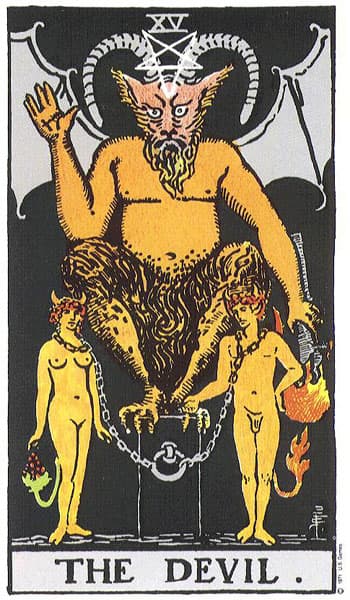
The two figures are chained to the same base beneath the Devil. This is an image of a shared grip, desire and a force organizing a bond, not proof of who controls whom. The chains described as loose permit a question about where choice may still be possible; they do not mean that changing or leaving is easy in real life. Horns and tails emphasize instinct and impulse, which may be integrated with awareness or dominate as choice narrows. Depending on the context, the figures can represent a relationship between people or a relationship to a habit or need; do not automatically identify them as a particular couple.
Connections with other cards
Possible readings depend on the question and the cards' actual positions.
| Card | Possible connection |
|---|---|
| Knight of Cups | Emotional charm meets possible attachment or dependency; establish neither manipulation nor addiction. |
| Nine of Cups | With the Devil, the question of measure sharpens: enjoyment that stays present, versus one more cup needed to feel that something exists. Emphasis: where enjoyment is a choice and where it becomes a hold, without turning pleasure into guilt. |
| Wheel of Fortune | Possible dependence or a pattern worth examining; excitement, gambling or a binding cycle are hypotheses, not an addiction diagnosis. Distinguish a felt lack of choice from actual limits. |
| Justice | Recognize dependence, unequal power or a burdensome commitment when the context supports it. Coercion, scorekeeping or an agreement restricting freedom are possibilities to examine, not diagnoses or accusations. Interpret through the question and both fixed positions; co-occurrence is not a chronology or evidence of an event. |
| The Hanged Man | Attachment or dependence may prolong a costly situation; examine choice without diagnosing abuse or addiction. |
| Death | Transformation meets strong attachment: release from dependence is possible, while holding on may preserve a burdensome situation. Explore what connects and what constrains. |
| Temperance | Examining habits, dependence and power struggles, seeking a more balanced relationship. |
| The Tower | With the Tower, the card that follows it in the journey, a structure that rests on holding on may be shaken. Emphasis: release can begin quietly and from the inside, before something outside forces it, and this is an invitation, not a threat. Dependency, anger or attachment is unsettled; release from addiction or dependency may be painful, but an outburst within a binding situation may also occur without liberation. |
| The Sun | Desire or dependence becomes more visible; enjoyment should leave room for freedom, and no hidden fact is proven. |
| The Hierophant | With the Devil, a frame can turn into a bond: in both cards two figures are placed before a central figure, but in the Devil they are held by loose chains. Emphasis: look at which rules, habits or loyalties are kept out of fear rather than value, and where there is more choice than it seems. |
| The Lovers | With the Lovers, the question is the difference between choice and bondage: attraction and connection chosen out of shared values, as against a grip that goes on out of habit or fear. Emphasis: what in the bond is chosen again and again, and what merely continues by itself. Strong desire meets freedom, attachment and cost. Explore consent and dependence without pathologizing sexuality. A trust question may raise a concealed bond as a hypothesis, not an established affair. |
| The Chariot | Strong will can meet attachment, dependence or a binding pattern. Consider whether persistence is still freely chosen and what it costs, without diagnosing addiction or labeling a person. Is another choice available? |
| Knight of Pentacles | Persistence may become subservience to duty; do not diagnose work addiction. |
| Knight of Swords | Determination meets attachment or a struggle to disengage; infer neither an abusive bond nor coercion. |
| Six of Swords | With the Devil, the question of reliance sharpens: beside the ferryman steering the boat, the question arises whether the help leaves room for choice. Emphasis: who steers and who has a say in the direction; reliance in itself is not a loss of freedom. |
| Eight of Swords | With the Eight of Swords, both cards speak of feeling trapped where part of the trap rests on perception: the binding looks tighter than it is. Emphasis: check what truly blocks the way and what only seems to, without dismissing what is felt. With the Devil, both cards speak of a binding that partly rests on perception. Emphasis: check what truly blocks the way and what only seems to, without dismissing what is felt and without declaring the binding a choice. |
| Knight of Wands | Desire may meet habit or attachment. Infer no coercion, addiction or sexual intention without context. |
Moment for reflection: Sit quietly and ask: What step today expresses the message “Recognizing bonds and habits that restrict freedom”?
The image
A horned devil sits on a stone pedestal while a man and woman are loosely chained below; horns and tails suggest their untamed nature.
Seated on a stone pedestal with one hand raised in an inverted gesture; two chained figures stand below