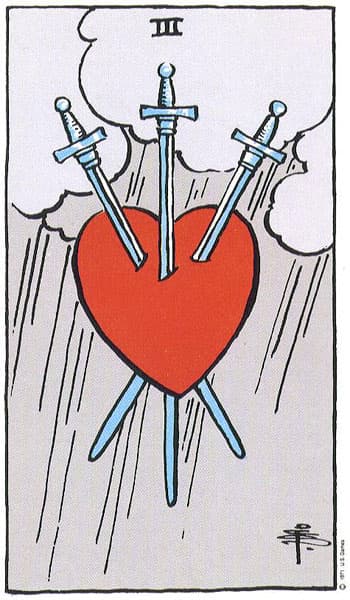
Three of Swords Tarot Card Meaning
שלוש חרבות
Also called: 3 of Swords
- heartbreak
- sorrow
- pain
- fast
days to weeks
By its element: Air
Not a timing cardAbout pain.
Timedays to weeks
By its element: Air
Not a timing cardAbout pain.
Card Facts
3 = Binah · Swords = air · Libra = Cardinal air — so the decans of Libra are the 2, 3 and 4 of Swords.
Golden Dawn title: The Lord of Sorrow
On the Tree of Life
3 · Binah
Formation: the force takes shape, limit and understanding.
Air · Yetzirah, the world of thought
How the card sits on the treeThe Three of Swords tarot card stands for heartbreak, sorrow and pain.
Sharp pain that needs honest acknowledgment before it can heal. This card invites you to examine how this message is operating within thoughts, communication and decisions. The emphasis is the cutting moment: words, a discovery, rejection or an outcome that hurts in a sudden blow, sometimes unexpectedly. The pain may persist; a sharp impact does not promise a quick passing storm. Air connects thought, understanding and words with emotional hurt, while rain can suggest tears and release. Unlike the Five of Pentacles, which emphasizes living within lack and vulnerability, this card highlights what pierced trust, expectation or an existing story. Three is not evidence of a third party or infidelity.
Message
The Three of Swords gives a name to pain, disappointment, or a truth that has wounded the heart. Acknowledging the hurt does not weaken you; it prevents the wound from shaping the story unnoticed. Let emotion be present without turning it into a permanent identity or rushing toward forgiveness before the pain has been heard. Separate what happened from the conclusions built around it. Healing begins when truth is spoken gently, boundaries become clear, and the heart is given time to mend. Core qualities of Three of Swords: acknowledging pain, emotional honesty, grief, healing and courage.
The light in the card
Courage to acknowledge pain and give it space
The shadow in the card
Continued identification with the wound
Psychological layer
Psychologically, this card reflects sharp pain that needs honest acknowledgment before it can heal. In a health-related question, the card can reflect the person's experience: disappointment, insecurity, a gap between wishes and capacity, or impact on daily life, only where they recognize that experience. Ask openly which changes or sensations are affecting everyday life. Do not infer illness, menopause or a symptom from the pictured heart or crutches, or lead someone toward chest pain because a heart is depicted. Feeling 'let down by my body' is an optional metaphor the reader can accept or reject, not a physical finding or a claim that thoughts caused the condition.
Personal growth
Let the tears flow so healing can begin
Love & relationships
In Swords, relationship is examined through thought, words, truth, boundaries, and the way fear or interpretation shapes connection. The Three of Swords in love names pain: separation, rejection, betrayal, difficult truth, or an old wound reopening. It does not say pain lasts forever; it says healing begins when we stop arguing with the fact that it hurts. The number 3 moves relationship beyond potential into shared space where something third can be born: experience, creation, community, or future. Swords ask for truth spoken in a form that can be heard, and for a distinction between fact, inner story, and an old wound seeking protection again. The hurt may affect trust, expectations or one's understanding of the bond. Betrayal or another person's involvement are contextual possibilities, not conclusions drawn from the number of swords.
Career
At work, Swords concern decisions, communication, information, conflict, strategy, and the cost of mental overload. At work, it can mark harsh criticism, disappointment, dismissal, or a decision that touches self-worth. Separate the professional event from the conclusion 'I am not good enough' so pain does not become identity. The number 3 is an expansion stage: an idea or effort begins to meet people, feedback from reality, and first results. The direction is to sharpen facts and goals without turning the workplace into a battlefield or the mind into a place that no longer knows how to rest.
Money & security
In financial matters, this card reflects sharp pain that needs honest acknowledgment before it can heal, and recommends choosing with awareness, stability and a long-term view.
Family
Within family life, this card brings forward the theme of sharp pain that needs honest acknowledgment before it can heal, and invites awareness of roles, needs and patterns within the household.
Spirituality
On a spiritual level, this card teaches: Let the tears flow so healing can begin.
Mythic parallel
Orestes pursued by the Furies after killing his mother is a story of pain and guilt that cannot simply be reasoned away. Change begins only when the conflict receives a new container of judgment and acknowledgment. The Three of Swords reminds us that pain needs processing, witness, and meaning, not only an attempt to stop feeling it. This is an interpretive parallel intended to deepen the reading, not a claim that the myth is a fixed historical source of the card.
Connections with other cards
Possible readings depend on the question and the cards' actual positions.
| Card | Possible connection |
|---|---|
| Two of Cups | With the Three of Swords, connection and hurt sit together: a real bond that was hurt, or closeness trying to exist beside pain. Emphasis: acknowledging the pain is part of the conversation, not an obstacle to clear away before coming closer. With the Two of Cups, the pain touches the relationship itself: a hurt between two people who are still connected. Emphasis: talking about the pain is part of the relationship, not a threat to it. |
| Three of Cups | With the Three of Swords, celebration and heartbreak sit in the same spread, and two Threes can be misread as a triangle. Emphasis: the circle as a place that holds the pain too, not evidence of a third party. |
| Justice | Acknowledge pain and what needs repair. Consider judgment made from hurt or truth delivered painfully. Interpret through the question and both fixed positions; co-occurrence is not a chronology or evidence of an event. |
| The Tower | Pain associated with a revelation or conversation; this is not evidence of infidelity. |
| The Star | With the Three of Swords, pain and healing are in the same picture. Emphasis: the wounded heart does not vanish, but it is no longer the whole story. With the Star, the pain is in the process of healing. Emphasis: the wounded heart can recover, and recovering is not forgetting. |
| The Sun | Pain becomes clearer or easier to name; the Sun does not cancel the wound, and appearance may differ from experience. |
| The Lovers | Sharp hurt, disappointment or painful truth in a bond. In a fidelity question, consider a triangle or choosing another alongside breakup or an old wound without a third party; neither this pair nor a reversal proves infidelity. |
| The Chariot + Seven of Pentacles | With the Seven of Pentacles and Chariot: effort and waiting for results, a wish for direction and progress, and disappointment at the gap between investment and what is possible. In a lesson position, allow painful recognition without making all pain an obligation to learn. The Chariot as potential may suggest coordinating wishes, circumstances and capacity, not working harder or declaring a physical limitation mental. Ask what the effort concerns; do not invent treatment or medical failure. |
| Five of Pentacles | Together the Three of Swords and Five of Pentacles can describe disappointment or separation that also unsettles security, resources and belonging. Distinguish the moment of hurt from the resulting circumstances; do not invent a breakup or material hardship without context. |
| Knight of Swords | Words meet pain; identify neither the person causing hurt nor the recipient from the pair alone. |
| Queen of Swords | With the Three of Swords, the Queen's clarity rests on real pain. Emphasis: does the boundary born of the hurt protect something of value, or only keep away whatever recalls an old injury. |
| Ace of Swords | With the Three of Swords, the clarity may be the recognition of the pain itself: a truth that lands and touches the heart. Emphasis: name the pain without turning it into an explanation of who caused it, and without using the truth to wound again. |
| Four of Swords | With the Three of Swords, the rest comes after a hurt: after pain, what follows is not at once a solution or the next move, but a halt. Emphasis: a quiet time in which the wound can begin to heal, before looking for an explanation or a decision. |
| Nine of Swords | With the Nine of Swords, the pain goes on at night and in thought, the hurt replayed again and again. Emphasis: tell the wound itself apart from the loop of thoughts around it. With the Three of Swords, the anxiety rests on a real hurt that happened. Emphasis: tending the wound, not only calming the thoughts. |
Moment for reflection: Sit quietly and ask: What step today expresses the message “Sharp pain that needs honest acknowledgment before it can heal”?
The image
A red heart is pierced by three swords beneath storm clouds and falling rain.
No human figure is shown; the pierced heart is the central symbol