Ten of Swords Tarot Card Meaning
עשר חרבות
Also called: 10 of Swords
- painful ending
- rock bottom
- finality
- fast
now to days
By its element: Air
Only when asked whenRelevant when the question concerns time; the pace describes the ending or its recognition and does not determine how long healing takes.
Timenow to days
By its element: Air
Only when asked whenRelevant when the question concerns time; the pace describes the ending or its recognition and does not determine how long healing takes.
Card Facts
10 = Malchut · Swords = air · Gemini = Mutable air — so the decans of Gemini are the 8, 9 and 10 of Swords.
Golden Dawn title: The Lord of Ruin
On the Tree of Life
10 · Malchut
Realisation: embodiment, the world, what already exists in fact.
Air · Yetzirah, the world of thought
How the card sits on the treeThe Ten of Swords tarot card stands for painful ending, rock bottom and finality.
The Ten of Swords points to a painful ending, a sense of defeat or exhaustion after a struggle has reached its limit. Something in the current approach cannot continue in the same form. Depending on the question and spread position, this may be the end of a relationship or role, or the end of a pattern, expectation or story we have told ourselves. Acknowledge the pain and examine what has actually ended. Rest, support and setting down the struggle can make gradual recovery possible.
Message
The Ten of Swords marks a painful ending where the old way can no longer continue. The situation may feel absolute, yet acknowledging the ending stops the struggle against what is already complete. Let the difficult story reach its conclusion without turning it into proof that no other future exists. Make room for exhaustion and seek support when needed. Once reality is accepted, energy can gradually return. Dawn does not erase the night, but it reminds you that the night does not last forever. Core qualities of Ten of Swords: acknowledgment, acceptance, rest, gradual recovery and release.
The light in the card
Recognizing what has ended can release energy held in a prolonged struggle. Make room for the pain, accept support and rebuild through small steps. The light on the horizon offers a possibility of moving forward; healing needs time and supportive conditions.
The shadow in the card
Deep hurt can color the whole future with a sense that everything is ruined and no other possibility remains. Sometimes we keep holding on to what hurts or return repeatedly to the story of the injury. Acknowledge the experience, identify boundaries and accept support without demanding immediate recovery.
Psychological layer
The swords can represent thoughts and words accumulating until they feel overwhelming: self-criticism, replaying an injury or statements such as 'this always happens to me'. Examine what is known about the situation and what thinking adds to it. The pain deserves attention, while rest, support and a new response can gradually restore a sense of agency and choice.
Inherited fear
Sometimes a painful situation in the present awakens an old fear: that hardship will continue, that everything will get worse, or that anything good will eventually end in pain. This fear may be familiar from earlier experiences or from how parents and other significant caregivers dealt with crises, loss and uncertainty.
The Ten of Swords invites you to explore what is awakening the fear now and the story it carries from the past. Recognizing the pattern can open up a different response: make room for the pain, seek support and examine what is possible in the current situation. A fear learned at home does not have to dictate what happens next.
A question for reflection: Does the fear arising around this question feel familiar from earlier situations? Have you seen a similar fear in your parents or the people who raised you?
Personal growth
Recognize what has ended and what can still be nurtured. Acknowledge the hurt, ease self-criticism and choose one small step that restores agency: rest, a boundary, asking for help or a different beginning. Even after a painful ending, the future remains open to new choices.
Love & relationships
In relationships the Ten of Swords can express damaged trust, exhaustion from a prolonged struggle or a painful ending. Examine what has reached its limit: the relationship itself, the way you communicate or an expectation that no longer fits reality. Feeling betrayed or abandoned may be part of the experience; this card alone does not establish infidelity or reveal what another person has done. When asking about a new relationship, it may reflect hurt from a previous connection and fear of being hurt again. For reconciliation, look for acknowledgment of the injury and a real change in the pattern. If a separation has already happened, the direction may be accepting the ending, setting boundaries and finding support for gradual recovery.
Career
At work the Ten of Swords can describe the end of a role or project, professional disappointment or burnout that has reached its limit. It may be time to close an approach that no longer works, stop an exhausting struggle or reconsider expectations. Identify what has ended and examine the facts, your rights and the options ahead. Rest, help and an orderly closure can provide a basis for a gradual return to activity.
Money & security
For money this card may reflect a loss, the end of an income source or recognition that a financial plan cannot continue as it stands. Assess the actual situation, address commitments that deepen the difficulty and seek appropriate help with priorities. Stability depends on concrete steps and conditions; the card does not promise that losses are over or that an imminent gain will cover them.
Family
In family matters the Ten of Swords may reflect accumulated pain around blame, hurtful words, silence or a role that has become difficult to carry. Examine which pattern has reached its limit, what is needed to stop recurring hurt and what boundaries or support could help. When a familiar fear that everything will fall apart arises, gently explore messages learned at home while listening to the person's own experience.
Spirituality
Spiritually this card invites you to set down the struggle around what has ended and meet the pain honestly. Sometimes an old story about yourself or life has exhausted its usefulness, making room for new meaning. Allowing yourself to stop, rest and accept help can be part of release. The light on the horizon offers a possible direction that opens gradually.
Mythic parallel
The death of Baldr in Norse mythology represents a loss so great it seems to extinguish light itself, yet it also belongs to a larger cycle leading toward a renewed world after Ragnarok. The Ten of Swords holds the same paradox: a real and painful ending can also be the point that stops a struggle that cannot continue. This is an interpretive parallel intended to deepen the reading, not a claim that the myth is a fixed historical source of the card.
Symbols and their relationships
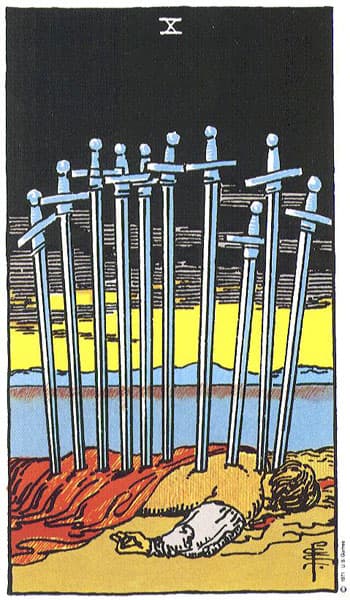
The ten swords in the back create an image of defeat and a burden reaching its limit. In the Swords suit they can also be read as thoughts and words that accumulate and hurt. The black sky expresses the weight of the experience, while the bright horizon offers a possibility of moving forward without promising that the difficulty has passed. The calm water can invite a pause and inward attention. The hand resembles a blessing gesture and may be read as acceptance or release. These are interpretive possibilities; the image is not a prediction of death, injury or attack.
Place in the arcana sequence
Ten closes the suit's numbered sequence: a process has reached completion and sometimes excess. The Eight of Swords emphasizes feeling restricted, the Nine distress and fear, and the Ten a sense of ending or defeat. The sequence can be read as a symbolic story about thought, fear and reaching a limit; it does not establish that fears will come true. An ending may make room for a new beginning when the pattern is allowed to change.
Connections with other cards
Possible readings depend on the question and the cards' actual positions.
| Card | Possible connection |
|---|---|
| Wheel of Fortune | Acknowledging an ending and the need for another way; fear of recurrence does not make every turn a disaster or imply physical harm. |
| Death | With Death, two cards of ending appear together, and the risk of a literal reading grows. Here both speak of the end of a form, a pattern or a period, never of physical death. Emphasis: what has completed its course, and how the Ten of Swords adds to that ending the pain and exhaustion of the road to it. |
| The Tower | A strong sense of ending alongside dissolution; clarify what has actually ended. |
| The Sun | A difficult ending with the possibility of life beyond it; immediate recovery is not guaranteed. |
| The Lovers | A rupture or ending of an old picture; clarify whether a phase, trust or a relationship is ending. |
| Four of Swords | With the Four of Swords, the ending is followed by a deliberate pause: rest before facing things again. Emphasis: rest as the next stage after the ending, before any rebuilding, with no demand to recover at once. |
| Nine of Swords | With the Nine of Swords, the night of fear and the ending after it sit in the same spread, and they are easy to read as a story in which the anxiety came true. The sequence describes thinking that goes all the way to its edge; it does not establish that fears will come true. Emphasis: what has truly ended, and what still lives only in the thoughts of the night. |
Moment for reflection: Sit quietly and ask: What step today expresses the message “A painful ending that also shows there is nowhere further to fall”?
The image
A figure lies face down on the ground with ten swords in their back. Red cloth covers part of the body, and the right hand rests near the head with fingers extended. Above is a black sky; along the horizon are a yellow band, calm water and distant hills.
Lying face down, with the right hand near the head and some fingers extended.