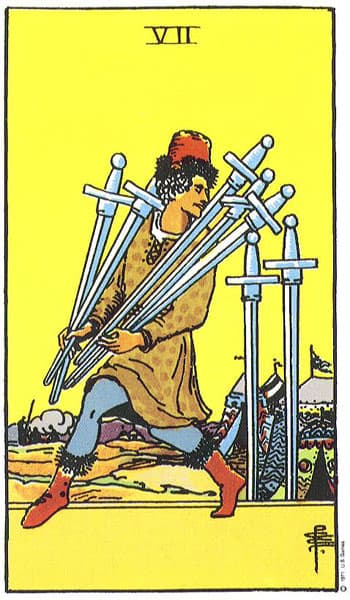
Seven of Swords Tarot Card Meaning
שבע חרבות
Also called: 7 of Swords
- strategy
- evasion
- cunning
- fast
days to weeks
By its element: Air
Not a timing cardAbout a ruse.
Timedays to weeks
By its element: Air
Not a timing cardAbout a ruse.
Card Facts
7 = Netzach · Swords = air · Aquarius = Fixed air — so the decans of Aquarius are the 5, 6 and 7 of Swords.
Golden Dawn title: The Lord of Unstable Effort
On the Tree of Life
7 · Netzach
Desire: feeling, drive, a victory not yet decided.
Air · Yetzirah, the world of thought
How the card sits on the treeThe Seven of Swords tarot card stands for strategy, evasion and cunning.
A strategic choice to act quietly rather than through direct confrontation. This card invites you to examine how this message is operating within thoughts, communication and decisions.
Message
The Seven of Swords speaks of strategy, privacy, and thinking several steps ahead, while also warning against concealment or avoidance of responsibility. Not every plan must be revealed before it is ready, yet ask whether silence protects a process or hides an important truth. Act intelligently, check details, and avoid shortcuts that could damage trust. Cleverness serves the path when it remains connected to integrity. Anything that cannot be spoken openly may deserve a closer examination. Core qualities of Seven of Swords: resourcefulness, strategy, discretion, ingenuity and integrity.
The light in the card
Resourcefulness and intelligent strategy
The shadow in the card
Avoiding responsibility or dishonesty
Psychological layer
Psychologically, this card reflects a strategic choice to act quietly rather than through direct confrontation. Indirect action can protect privacy, delay premature disclosure or express fear of confrontation; it can also conceal material information or avoid responsibility. One person's caution may respond to ambiguity arising in the relationship. Explore both possibilities without automatically assigning blame.
Personal growth
Choose a strategy that does not compromise your integrity
Love & relationships
In Swords, relationship is examined through thought, words, truth, boundaries, and the way fear or interpretation shapes connection. The Seven of Swords in love concerns privacy, strategy, and concealment. Not everything must be disclosed immediately, but there is a difference between protecting personal space and building a bond around material information hidden from the other person. The number 7 turns attention inward: less automatic reaction and more inquiry into desire, boundary, and meaning. Swords ask for truth spoken in a form that can be heard, and for a distinction between fact, inner story, and an old wound seeking protection again. In questions of trust, do not automatically soften this card into helpful caution: evasion, concealment, partial information and a gap between stated and intended aims remain interpretive possibilities. In the querent's position, careful observation and weighing the next move may respond to ambiguity in the bond, rather than merely describe a personal trait. In the other person's position, consider tentative approaches, testing availability or interest that is not fully disclosed. Infidelity is only a contextual hypothesis where an existing relationship or exclusivity is relevant, never proof supplied by the card. Do not switch the owners of positions to fit a story.
Career
At work, Swords concern decisions, communication, information, conflict, strategy, and the cost of mental overload. At work, it supports quiet planning, negotiation, thinking several moves ahead, or sensitive work. Its shadow is shortcutting, taking credit, hiding information, or a strategy that wins short term and destroys trust long term. The number 7 is a stage of assessment and strategy; not every forward movement is progress, and energy must be invested selectively. The direction is to sharpen facts and goals without turning the workplace into a battlefield or the mind into a place that no longer knows how to rest.
Money & security
In financial matters, this card reflects a strategic choice to act quietly rather than through direct confrontation, and recommends choosing with awareness, stability and a long-term view.
Family
Within family life, this card brings forward the theme of a strategic choice to act quietly rather than through direct confrontation, and invites awareness of roles, needs and patterns within the household.
Spirituality
On a spiritual level, this card teaches: Choose a strategy that does not compromise your integrity.
Mythic parallel
The Trojan Horse and Odysseus behind its strategy are the classic parallel for the Seven of Swords: victory through cunning rather than frontal force. The myth also raises the card's ethical question — not everything clever is honest, and not everything successful builds a future we would want to inhabit. This is an interpretive parallel intended to deepen the reading, not a claim that the myth is a fixed historical source of the card.
Connections with other cards
Possible readings depend on the question and the cards' actual positions.
| Card | Possible connection |
|---|---|
| Two of Cups + The Fool | With the Two of Cups and Seven of Swords, a desire for closeness or continued contact may coexist with an undefined or free-flowing bond and caution or incomplete transparency. Integrate attraction, relationship structure and communication into one account while preserving position ownership. Do not infer commitment, agreed non-monogamy or infidelity without context. |
| The Fool | With the Seven of Swords, lightness and freedom may coexist with caution, tentative approaches, evasion or undisclosed information. Do not erase attraction because of ambiguity or turn ambiguity into proof of infidelity. Depending on positions, one person may be carefully assessing a bond whose terms remain unclear. |
| Justice | Distinguish privacy, strategy and concealment. Partial information or evasion may merit examination, but the pair does not establish fraud. Interpret through the question and both fixed positions; co-occurrence is not a chronology or evidence of an event. With Justice, the card's ethical question sharpens: not everything clever is honest. Emphasis: check whether what was done could be fully revealed and explained simply, without becoming defensive. |
| The Tower | Concern about missing information or an indirect approach; this still does not establish a lie. |
| The Moon | With the Moon, concealment meets uncertainty and imagination, and suspicion can grow without any new fact. Emphasis: do not decide from inside the suspicion; look for information and open clarification before a conclusion. |
| The Sun | Visibility meets privacy or avoidance; this is not evidence of deceit or infidelity. |
| The Lovers | Concealment, evasion, indirect action or caution around choice. In trust questions do not automatically soften lying into caution; consider a concealed bond or a words-actions gap as a hypothesis. Respect position ownership: the querent's card may describe investigation or response to ambiguity, not the partner's act. With the Lovers, the question of honesty enters the choice of the relationship itself: a shared choice needs material information both sides can see. Emphasis: openness about what matters to the shared choice, without demanding that every thought be disclosed and without deciding who hides what. |
| The Chariot | Strategy, independence and quick thinking may serve a goal or avoid a direct conversation. A Hermes reading is not proof of dishonesty. Does the approach allow trust and clarity? |
| Knight of Pentacles | Method meets strategy or a shortcut; establish neither deception nor dishonesty. |
| Page of Swords | With the Seven of Swords, the Page's alertness meets a card of strategy and concealment, and the two are easily read as a secret being uncovered. Emphasis: the ethics of information, meaning what to check, what to pass on and what to keep until it is understood, without turning suspicion into fact. |
Moment for reflection: Sit quietly and ask: What step today expresses the message “A strategic choice to act quietly rather than through direct confrontation”?
The image
A figure tiptoes away from a camp carrying five swords while two remain planted behind.
Bent, stealthy walking posture with head turned back toward the camp