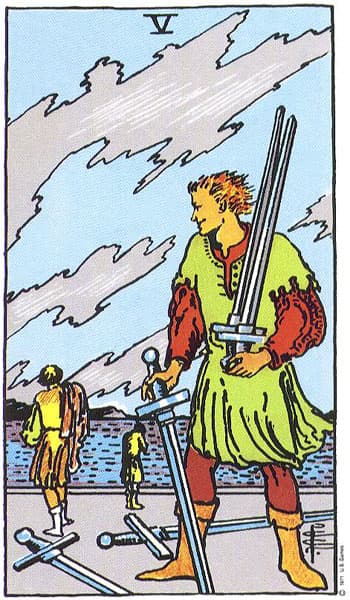
Five of Swords Tarot Card Meaning
חמש חרבות
Also called: 5 of Swords
- hollow victory
- conflict
- cost
- fast
days to weeks
By its element: Air
Not a timing cardAbout conflict.
Timedays to weeks
By its element: Air
Not a timing cardAbout conflict.
Card Facts
5 = Gevurah · Swords = air · Aquarius = Fixed air — so the decans of Aquarius are the 5, 6 and 7 of Swords.
Golden Dawn title: The Lord of Defeat
On the Tree of Life
5 · Gevurah
The limit: friction, contraction, judgement, the break that sets things moving.
Air · Yetzirah, the world of thought
How the card sits on the treeThe Five of Swords tarot card stands for hollow victory, conflict and cost.
The Five of Swords points to conflict, defeat or a victory that leaves a bitter taste. Even getting the last word can cost trust, respect or cooperation. It invites consideration of whether the struggle serves something important or whether the need to prove a point and win has overtaken the wish to resolve it. Choosing battles, stopping escalation or leaving a harmful struggle can preserve boundaries. Where there is willingness, damage can also be acknowledged and repaired. The figures offer perspectives from both the person who remains and those who leave; do not automatically identify the reader or another person with one of them, or infer someone's character, feelings or actions from the symbol alone.
Message
The Five of Swords asks you to examine the cost of conflict and the difference between winning and truly resolving something. You can be right and still lose trust, connection, or inner peace. Notice whether the struggle still protects an important value or has become a need to prove, punish, or defend a wounded ego. Boundaries do not have to be abandoned, but the response can change. Strength may lie in leaving the fight, repairing harm, or choosing a conversation that respects everyone involved. Core qualities of Five of Swords: choosing battles, self-respect, accountability, repair and boundaries.
The light in the card
Recognizing the cost of conflict, choosing battles and preserving self-respect; willingness to learn, take responsibility and repair where possible.
The shadow in the card
Insisting on winning at any cost, power struggles and words that damage dignity and trust. A need for the last word, contempt or resentment can create distance even after an argument ends.
Psychological layer
Conflict can bring out defensiveness, wounded pride and a need to prove ourselves right. Sometimes the struggle continues internally after a conversation ends, through rehearsing arguments, resentment or self-criticism. Comparison with others and a sense of loss or unfairness may also be relevant to the question. Consider what needs protecting and choose a response that does not deepen the hurt. Reflecting on our part in a disagreement can enable change without making us responsible for the other person's behavior.
Personal growth
Choose which struggles are worth their cost and learn from their consequences. When the question concerns a difficult choice with no perfect option, consider each option's cost, act with incomplete understanding and adjust course as experience grows.
Love & relationships
In relationships, the Five of Swords may describe repeated arguments, a struggle over who is right or a need for the last word. Cutting remarks, defensiveness, contempt or keeping score can weaken trust and create emotional distance. The hurt can also take very familiar shapes: sarcasm, humiliation in front of others, an argument online, rumours, a quote taken out of context, or conduct that is 'technically' right and cruel in practice. Consider what happens between you during a disagreement and afterwards: is there room to hear a need or hurt, or does the conversation become a contest in which someone must lose? In an existing relationship, consider what could stop escalation and restore a conversation with listening and respect. Repair may involve acknowledging hurt, taking responsibility, apologizing and changing behavior. Stepping away can protect someone when a conversation becomes harmful; distinguish this from repeatedly avoiding a necessary conversation. Preserving the relationship does not require surrendering boundaries. In a new connection, consider how differences, refusal and disagreement are handled. If the question describes difficulty opening up after an earlier hurt, explore its effect on the present connection without assuming that the past is repeating. When reconnecting is asked about, focus on the unresolved conflict and what would need to change for a constructive meeting. A wish for reconciliation needs mutual willingness and different behavior; the card does not determine that the relationship will resume or end.
Career
At work, the Five of Swords may describe office politics, ego struggles, unfair competition or a dispute over credit. Personal success can cost trust and teamwork; even a negotiation that gains an advantage can damage a professional relationship. Clarify facts, aims and boundaries without making every difference a battleground. Sometimes the wise choice is to avoid a game in which even winning costs too much; sometimes an important right needs defending. After a loss, consider what can be learned and what calls for a different approach.
Money & security
In financial matters, the Five of Swords invites consideration of a loss, competition or a negotiation whose overall cost exceeds the advantage gained. Examine costs, terms and fairness, as well as what could be damaged in the relationship with the other party. A wish to prove a point or recover a loss can lead to another decision that does not serve you. When no option is perfect, compare the costs and choose a considered step; the card alone does not determine a financial outcome.
Family
In family matters, the Five of Swords may highlight repeated arguments, power struggles or someone's need to be right at any cost. Sharp words, comparisons and attempts to establish blame can damage belonging even after a fight ends. Consider roles and patterns within the disagreement, set a boundary around harmful conversation and return when listening is possible. Repair calls for room for the parties' needs and responsibility for hurt caused. Use the family lens according to the reader's account; it does not establish who in the household causes the conflict.
Spirituality
The Five of Swords invites reflection on the need to win and prove ourselves right, and its cost to connection and inner peace. Choose action that respects yourself and others without surrendering an important boundary for the sake of peace. Acknowledging and repairing damage, or leaving an unproductive struggle, can express strength and clarity.
Mythic parallel
The quarrel between Achilles and Agamemnon in the Iliad is a strong parallel: two leaders fight over personal honor while an entire army pays the price. The Five of Swords reminds us that ego conflict can feel justified to both sides and still damage the system on which both depend. This is an interpretive parallel intended to deepen the reading, not a claim that the myth is a fixed historical source of the card.
Connections with other cards
Possible readings depend on the question and the cards' actual positions.
| Card | Possible connection |
|---|---|
| Justice | Examine the cost of a struggle and reduce escalation. Winning may leave harm; consider whether being right is worth the cost to the relationship. Interpret through the question and both fixed positions; co-occurrence is not a chronology or evidence of an event. With Justice, fairness meets a struggle over who is right. Emphasis: technical rightness is not enough when it hides cruelty, and a fair decision holds the relationship too, not only the win in the argument. |
| The Tower | A hurtful response or a struggle deepens the crisis. |
| The Sun | A struggle over victory or credit becomes visible; consider who bears its cost without assigning unknown motives. |
| The Lovers | Connection meets a contest someone must win; consider the cost to partnership. |
| The Chariot | The wish to win may strain connection or cooperation. Competition is not inherently harmful, but consider what remains after the argument. What happens to the relationship when one person wins? |
| Three of Pentacles | With the Five of Swords, collaboration is tested against a win that comes at the cost of trust. Emphasis: whether the conversation around the plan improves the shared work, or only settles who won and leaves the others aside. |
| Knight of Swords | With the Five of Swords, the charge can lead to a victory that costs dearly: trust, respect or the possibility of conversation. Emphasis: ask whether the aim is resolution or the other side's defeat. |
| Four of Swords | With the Five of Swords, the quiet of the Four stands beside a conflict returning to the arena. Emphasis: use the pause so that the next conversation is better than the one that would have been said out of tiredness, not to prepare for the next round. |
| Six of Swords | With the Six of Swords, there is a way out of the conflict: a boat that carries away from the storm, and that way usually begins by setting one sword down. Emphasis: distance that protects and allows recovery, and checking whether a needed conversation is still being put off. With the Five of Swords, the boat leaves the conflict: after the argument and the swords left on the ground, someone gathers them up and sets out. Emphasis: distance that allows recovery, and an open question whether a conversation still needs to happen. |
| Nine of Swords | With the Nine of Swords, the argument goes on at night: arguments replayed in the mind, resentment and self-criticism. Emphasis: tell the hurt that happened apart from the loop of thoughts around it, and choose a response that does not sharpen it. |
| Five of Wands | With the Five of Swords, the card's shadow sharpens: the need to win can leave a victory with a bitter taste and a loss of trust and cooperation. Emphasis: check whether the struggle still serves something important, or whether having the last word already outweighs the wish to resolve it. |
Moment for reflection: Sit quietly and ask: What step today expresses the message “A victory that leaves a bitter taste and asks you to examine the price”?
The image
A foreground figure holds three swords and looks toward two figures walking away toward the water. Two more swords lie on the ground. Water and a blue sky with ragged gray clouds appear behind them.
The foreground figure stands upright, head turned sideways and mouth apparently smiling. The nearer background figure has their back turned; the more distant one lowers their head and raises a hand to their face.