Six of Swords Tarot Card Meaning
שש חרבות
Also called: 6 of Swords
- transition
- distance
- recovery
- medium
weeks to months
By its element: Air
Only when asked whenTransition and travel.
Timeweeks to months
By its element: Air
Only when asked whenTransition and travel.
Card Facts
6 = Tiferet · Swords = air · Aquarius = Fixed air — so the decans of Aquarius are the 5, 6 and 7 of Swords.
Golden Dawn title: The Lord of Earned Success
On the Tree of Life
6 · Tiferet
The centre: balance, harmony, the heart that steadies what broke.
Air · Yetzirah, the world of thought
How the card sits on the treeThe Six of Swords tarot card stands for transition, distance and recovery.
A quiet passage away from turbulence toward calmer waters. This card invites you to examine how this message is operating within thoughts, communication and decisions. The transition may be a bounded pause, a change of surroundings or a holiday rather than a final departure. Sagi Mendelbaum emphasizes temporary distance from activity followed by re-engagement; this does not predict an actual trip.
Message
The Six of Swords points to a gradual transition from turbulence toward calmer, clearer ground. The journey may still carry memories, questions, or grief, so immediate relief is not required. Choose what reduces chaos and move one step at a time, even if the destination is not fully visible. Accept support, change the environment, or create distance from a draining pattern. Transition does not erase the past; it allows you to carry its wisdom without continuing to live inside the storm. Core qualities of Six of Swords: transition, distance, recovery, accepting help and quiet resolve.
The light in the card
A calm transition toward a safer place
The shadow in the card
Distance can offer perspective and rest, but avoiding conversation, postponing decisions or taking a pause without clarifying the next step can leave a problem unresolved. In a relationship, this may appear as lasting emotional distance or quiet created by avoidance. Context determines whether this is helpful rest, change or an ending; do not assume that every departure is avoidance or that returning to the relationship is the goal.
Psychological layer
Psychologically, this card reflects a quiet passage away from turbulence toward calmer waters. The ferryman works while the passengers accept passage: consider receiving help without surrendering all agency. The swords travel with them, so changing surroundings need not resolve what is carried along. Quiet transition does not promise immediate happiness or medical recovery. A person may keep functioning and moving forward with little vitality or emotional engagement. The withdrawn passengers can suggest weariness, sadness or a quiet in which genuine contact is still missing; this is an interpretive possibility, not a diagnosis. Depending on the context, the quiet may be needed rest or distance that leaves a relationship short of contact, even without an open quarrel.
Personal growth
Move forward even if you still carry some pain Distinguish a respite that supports renewed choice and activity from remaining indefinitely between stages. Help and unresolved questions can coexist without demanding an immediate solution.
Love & relationships
The Six of Swords in relationships describes an attempt to move out of tension toward a calmer way of relating. After arguments, hurt or an exhausting period, one or both partners may need space to settle and consider how to continue. Distance may take the form of fewer conversations, less emotional openness or an agreed pause. Sometimes it helps them regain strength and preserve the relationship; sometimes it marks the beginning of moving away from it. In its constructive expression, the partners leave a painful pattern behind, communicate more calmly and rebuild trust and closeness. Recovery is gradual, and caution or sadness may remain. The past continues to affect the present, so it matters whether there is real change or simply quiet because painful subjects are being avoided. In its challenging expression, the pause drags on, the necessary conversation is postponed and distance becomes established. When the question concerns separation, the card may describe leaving a burdensome relationship or moving forward after it has ended, even while feelings remain. In a new connection, it may suggest cautious openness while recovering from a previous relationship. When the context supports it, the connection may offer comfort or temporary refuge, while its commitment and continuity still need to become clear. In questions about sexuality and intimacy, and with supporting cards, the Six of Swords may describe a need for safety, gentle touch and a gradual return to closeness after tension or hurt. In questions involving geographical distance, travel or living arrangements, a physical change affecting the relationship may also be relevant.
Career
At work, Swords concern decisions, communication, information, conflict, strategy, and the cost of mental overload. At work, it marks moving teams, roles, locations, or methods in order to leave chaos. Not every problem can be solved in the place where it was created; sometimes environment change is part of the solution. The number 6 brings recovery or recognition; understand what worked so a momentary success can become repeatable capability. The direction is to sharpen facts and goals without turning the workplace into a battlefield or the mind into a place that no longer knows how to rest.
Money & security
In financial matters, this card reflects a quiet passage away from turbulence toward calmer waters, and recommends choosing with awareness, stability and a long-term view.
Family
In a family context, the boat can describe a transition affecting several people, receiving support or the responsibility of the person steering toward those carried along. If children or relatives are already part of the account, consider how their security and voice are maintained through change. At times the household keeps functioning and remains quiet while emotional contact is limited; at other times the quiet is a pause that allows recovery. The card does not establish the presence of children, a house move or a family crisis, and returning to the previous situation is not a necessary goal.
Spirituality
On a spiritual level, this card teaches: Move forward even if you still carry some pain.
Mythic parallel
Charon carrying souls across the Styx offers a powerful image for the Six of Swords: a crossing that cannot happen without leaving a former bank. The card is less final than the myth, but shares its threshold quality — you cannot arrive somewhere new while still standing fully on the old shore. This is an interpretive parallel intended to deepen the reading, not a claim that the myth is a fixed historical source of the card.
Symbols and their relationships
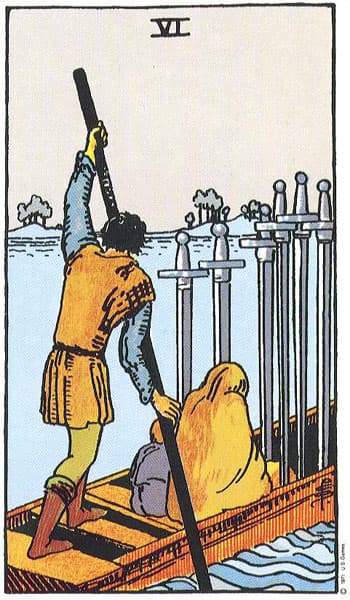
The ferryman moves the boat while the passengers sit and are carried with his help: an image of accepting support and relying on someone during a transition. Consider who leads, who has a say in the direction and whether support leaves room for choice. Reliance alone does not mean a loss of freedom. The turned back and enclosing cloak may suggest withdrawal, protection or limited engagement without establishing what the figures feel. The swords stay in the boat even as the water calms, so changed conditions do not necessarily resolve what is carried along. The presence of an adult and a child permits a lens of accompaniment, responsibility and care for someone who relies on others; it does not establish that the reader has a child or that the matter is about family.
Connections with other cards
Possible readings depend on the question and the cards' actual positions.
| Card | Possible connection |
|---|---|
| Wheel of Fortune | Passage and adaptation to different conditions; outward movement may leave an inner tension or pattern unchanged. |
| Justice | An orderly transition after clarification. An unresolved matter may be carried into the next stage. Interpret through the question and both fixed positions; co-occurrence is not a chronology or evidence of an event. |
| The Hanged Man | Transition and distance meet suspension. One’s relationship to the situation may change while practical movement remains limited. |
| Temperance | Gradual transition, distance from tension and processing what remains from an earlier period. |
| The Devil | With the Devil, the question of reliance sharpens: beside the ferryman steering the boat, the question arises whether the help leaves room for choice. Emphasis: who steers and who has a say in the direction; reliance in itself is not a loss of freedom. |
| The Tower | Moving away from upheaval and making a gradual transition; this does not necessarily mean reconciliation. |
| The Star | With the Star, the calm water further along takes on a direction of healing. Emphasis: gradual recovery that does not require leaving the swords on the shore; one can move forward while still carrying pain. |
| The Sun | Movement toward less tension and more openness; movement alone is not emotional engagement. |
| The Lovers | Distance or a move toward calmer conditions; are people moving away from difficulty together or from each other? |
| The Chariot | Two images of transition bring attention to who leads, what is carried and what allows adjustment. The change may be external or a different way of coping, depending on the question. What supports everyone involved in moving? |
| Five of Swords | With the Six of Swords, there is a way out of the conflict: a boat that carries away from the storm, and that way usually begins by setting one sword down. Emphasis: distance that protects and allows recovery, and checking whether a needed conversation is still being put off. With the Five of Swords, the boat leaves the conflict: after the argument and the swords left on the ground, someone gathers them up and sets out. Emphasis: distance that allows recovery, and an open question whether a conversation still needs to happen. |
Moment for reflection: Sit quietly and ask: What step today expresses the message “A quiet passage away from turbulence toward calmer waters”?
The image
A boatman stands at the stern and propels the boat with a pole. A cloaked woman and a child sit ahead of him, and six swords stand upright in the boat. Water is choppy on one side and calmer on the other; a shore is visible in the distance.
The boatman stands at the stern, leaning forward with his hands holding the pole. The woman sits wrapped in a cloak with her back to the viewer, and the child sits beside her.