Six of Cups Tarot Card Meaning
שישה גביעים
Also called: 6 of Cups
- nostalgia
- memory
- innocence
- medium
weeks to months
By its element: Water
Only when asked whenInterpret timing according to the question: closeness developing now, or reconnecting when that is asked about. The card alone does not establish that someone from the past will return or that an event will happen on a particular date.
Timeweeks to months
By its element: Water
Only when asked whenInterpret timing according to the question: closeness developing now, or reconnecting when that is asked about. The card alone does not establish that someone from the past will return or that an event will happen on a particular date.
Card Facts
6 = Tiferet · Cups = water · Scorpio = Fixed water — so the decans of Scorpio are the 5, 6 and 7 of Cups.
Golden Dawn title: The Lord of Pleasure
On the Tree of Life
6 · Tiferet
The centre: balance, harmony, the heart that steadies what broke.
Water · Briah, the world of feeling
How the card sits on the treeThe Six of Cups tarot card stands for nostalgia, memory and innocence.
The Six of Cups offers warmth, innocence and goodwill through simple gestures of giving and receiving. Childhood memories and past connections may recall what brings joy, where trust is possible and which abilities can be brought into the present. Pleasure can be real now even when a relationship or undertaking is still at an early stage. Alongside nostalgia, the card can concern previous experience, a neglected ability and familiar roles at home or in close relationships. The offering of a cup invites reflection on care and reciprocity. The question and spread position determine whether the emphasis is an earlier resource, present closeness or a pattern to reconsider; the card alone does not establish that the reader has children or has tried and failed before.
Message
The Six of Cups is a card of memory, of old connections and of the simple, tender part of ourselves. A reunion may bring comfort, and the card also suggests seeing the past as it was, not only through the softening light of longing. What it invites us to carry forward is the warmth, innocence and values that still nourish the present. At the same time, it can raise the question of whether nostalgia is holding back growth, or keeping alive a relationship that has already changed. Its suggestion is to honor what was, keep the gift it offered, and go on with more maturity. Core qualities of Six of Cups: tenderness, generosity, memory, innocence and playfulness.
The light in the card
Tenderness, generosity and simple joy; good memories and playfulness that nourish closeness in the present.
The shadow in the card
Overreliance on the past or childishness A possible challenging expression, including when upright, is idealizing the past, clinging to the familiar or giving with little room for oneself. Consider whether an earlier attempt needs adapting to new circumstances. Do not assert that such a pattern exists merely because the card appeared; examine its relevance to the question, position and other cards.
Psychological layer
A good memory may strengthen belonging, meaning and continuity between who we were and who we are today. Returning to a nourishing experience, childhood hobby or neglected ability can bring curiosity and playfulness into the present. Nostalgia can carry sweetness and pain together; consider what it evokes for the reader. The familiar may offer security and ability, or a habit that persists after circumstances change. Earlier experience can inform the present, with giving leaving room for personal needs. As an interpretive numerological layer, the number 6 invites reflection on harmony, responsibility, care and reciprocity; imbalance may involve difficulty setting a boundary or moving beyond a familiar role. This is a symbolic possibility, not a diagnosis of the reader’s personality.
Personal growth
Bring the good from the past forward without getting stuck there
Love & relationships
The Six of Cups brings tenderness, affection, goodwill and enjoyment of time together to a relationship. Small gestures, listening and playfulness can make it comfortable to give and receive love. Trust grows through consistent care and consideration, with room for both people’s needs and boundaries. In a question about new love, the card may describe an enjoyable connection that feels familiar, ease and emotional openness with someone new. In an existing relationship, it may suggest renewing affection through shared memories and creating good experiences now. Even when there is connection and enjoyment, the relationship may still be at an early stage; familiarity alone does not promise compatibility, stability or commitment. When the question concerns someone from the past, the card can involve longing, a renewed meeting or the possibility of reconciliation. Distinguish a wish to recover closeness from both people’s actual willingness to resume the relationship. Reconciliation calls for seeing the person as they are today, acknowledging what happened and considering what has changed between them. The card alone does not promise a return or establish the other person’s feelings.
Career
At work, Cups emphasize people, creativity, intuition, belonging, and the emotional cost of professional choices. At work, the card may indicate returning to a former field, collaborating with someone from the past, using a childhood talent, or entering a familiar environment. Take the past as a resource, not a ceiling. The number 6 brings recovery or recognition; understand what worked so a momentary success can become repeatable capability. Consider not only what succeeds on paper, but what nourishes you emotionally and what drains you over time. In a job search, consider previous skills, a former occupation or an earlier attempt to earn income as possibilities, without assuming they exist. When the reader connects work with home or family roles, explore how professional activity could fit their actual circumstances. The card alone does not prescribe working with children, self-employment or working from home. In a lesson position, consider what remains useful from the past, what needs adapting, and how personal development can coexist with giving to others.
Money & security
In financial matters, the gesture of giving may symbolize a gift, help or support from family and close connections when relevant to the question. An earlier skill or resource may also be worth using again. Distinguish generosity that can be freely given and received from help that creates obligation, dependence or over-giving; the card does not promise that money will arrive.
Family
The children, courtyard and gesture of giving offer lenses of home and belonging, care and relationships across generations. Shared memories and cherished traditions may offer continuity and joy, alongside the need to balance giving and receiving. A familiar role can provide security while leaving little room for personal needs. When family is a secondary context, use this layer only to understand the stated goal and constraints. The image does not establish that the reader has children, a partner, a particular division of responsibilities or an unreported burden.
Spirituality
On a spiritual level, this card teaches: Bring the good from the past forward without getting stuck there.
Mythic parallel
Mnemosyne, goddess of memory and mother of the Muses, offers a deep parallel: creation is born from memory, yet memory is not the past itself but the way the past lives within us. The Six of Cups asks which memories nourish identity and connection and which preserve a picture that no longer exists. This is an interpretive parallel intended to deepen the reading, not a claim that the myth is a fixed historical source of the card.
Connections with other cards
Possible readings depend on the question and the cards' actual positions.
| Card | Possible connection |
|---|---|
| Five of Cups | With the Six of Cups, after what was spilled the heart returns to what once nourished it: memory, tenderness and a gesture of giving. Emphasis: comfort that comes from a good memory, without idealising what was lost and without getting stuck in it. With the Five of Cups, memory comes after a loss: the heart returns to what once nourished it in order to gather strength. Emphasis: comfort from the past that leads back to the present, not a refuge in which to stay facing what was spilled. |
| Seven of Cups | With the Seven of Cups, the quiet courtyard meets the cloud of options. Emphasis: what truly nourished as a compass for choosing, not longing that adds one more vision to the cloud. With the Six of Cups, the memory of what truly nourished meets the cloud of options. Emphasis: know what really tastes good before choosing, so that the familiar serves as an anchor and not as one more vision in the cloud. |
| Wheel of Fortune | A past theme in a new context; examine nostalgia or an unchanged agreement without promising an ex will return. |
| Justice | Examine old agreements and habits. Loyalty to an old story or a debt not currently agreed may matter. Interpret through the question and both fixed positions; co-occurrence is not a chronology or evidence of an event. |
| Death | A changing relationship to the past, a childhood role or a familiar bond. Memory and affection can remain without recreating an old arrangement. |
| The Tower | A story from the past changes, or a familiar person offers support. |
| The Sun | Childhood, memory and a simpler warmth; familiarity does not prove a return. |
| Judgement | With Judgement, the past is present twice: the memory of the Six of Cups and the call of Judgement. Emphasis: returning to something old, a field or a person, when it comes from maturity and not only from nostalgia. With the Six of Cups, the past is present twice, and it is easy to confuse an inner call with longing. Emphasis: returning to something old, a field or a person, answers a call when it comes from maturity and not only from nostalgia. |
| The Lovers | Tenderness and familiarity; choose the actual person rather than only a memory. Children can matter when asked about, without predicting reunion or pregnancy. |
Moment for reflection: Sit quietly and ask: What step today expresses the message “A gentle return to moments or relationships from the past”?
The image
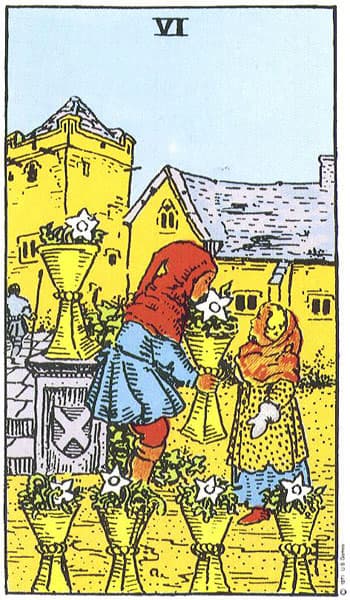
Two children stand in a village courtyard; one offers the other a cup filled with white flowers. Five more flower-filled cups stand in the courtyard, with houses in the background.
One child leans forward to offer a cup while the other receives it