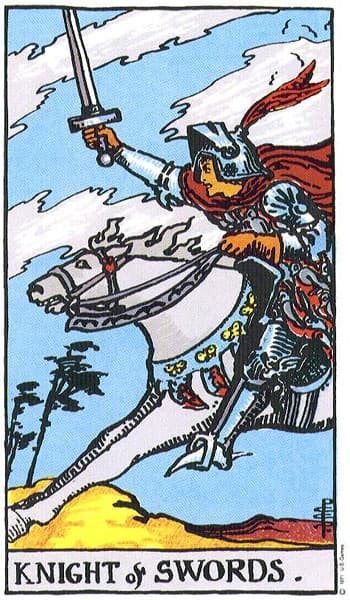
Knight of Swords Tarot Card Meaning
אביר חרבות
In brief
The Knight of Swords connects thought with direct, rapid action. It may defend a boundary or clarify a truth; the challenge is maintaining precision, listening and responsibility for words.
- directness
- speed
- determination
- fast
now to days
By its element: Air
Only when asked whenSymbolic pace; use timing only when asked. The attribution follows AGAT’s scheme and is not an event date.
Timenow to days
By its element: Air
Only when asked whenSymbolic pace; use timing only when asked. The attribution follows AGAT’s scheme and is not an event date.
Card Facts
Knight = ו (Vav) = air · Swords = air — so Knight of Swords is air of air.
Thirty degrees on the wheel, from 20° Capricorn to 20° Aquarius. The three numbered cards in that span:
On the Tree of Life
6 · Tiferet
The centre: balance, harmony, the heart that steadies what broke.
ו — the third letter of the Tetragrammaton
Air · Yetzirah, the world of thought
How the card sits on the treeThe Knight of Swords tarot card stands for directness, speed and determination.
The Knight of Swords brings incisiveness, determination and courage to act for an idea, truth or boundary. Speed can break hesitation but does not replace checking evidence and listening. Depending on the question it may describe conversation, a decision, a professional dispute or a way of responding; it does not establish who is right or another person’s response.
Message
The Knight of Swords brings speed, determination, and the urge to charge forward with a clear idea or truth. This energy can overcome hesitation, but it can also skip details or hurt people along the way. Pause briefly before acting to confirm that the goal, facts, and method belong together. There is courage in saying what must be said, yet not every situation is a battle. Decisive action becomes more effective when joined with timing, listening, and the ability to change direction. Core qualities of Knight of Swords: directness, determination, courage, speed and drive.
The light in the card
Clarity, courage, skill and an ability to defend what matters and voice what needs saying.
The shadow in the card
Haste, cutting words, rigid certainty or turning conversation into combat. Difficulty listening is a contextual possibility, not a fixed description of someone.
Psychological layer
Incisiveness, directness, courage to defend an idea and independence of thought. In shadow, certainty can become rigidity or a need to win, with analysis replacing attention to experience. Consider whether the aim is understanding and resolution or defeating another person. Alongside the charge is an alternative reading of waiting for someone else to direct or act. Select it only when the context supports a gap between knowing and doing, rather than asserting impulsiveness and passivity together. The galloping horse can suggest a body mobilized by an idea or a sense of urgency. Rapid action may briefly reduce uncertainty without resolving its underlying question. Explore whether the decision expresses a choice or an attempt to end tension; the image does not establish anxiety or a medical condition.
Personal growth
Connect decisiveness with listening, checking goals, evidence and consequences before acting. Not every disagreement needs a winner, and hesitation is not always weakness. When the context indicates waiting for outside initiative, consider what knowledge can become an independent action.
Love & relationships
In Swords, relationship is examined through thought, words, truth, boundaries, and the way fear or interpretation shapes connection. The Knight of Swords brings directness and speed to relationship, sometimes to the point of sharpness. He can break necessary silence, but can also enter conversation as battle and leave behind a truth delivered in a form that cannot easily be repaired. As a Knight, the energy moves outward seeking expression. The challenge is matching the intensity of movement to what the relationship can actually hold. Swords ask for truth spoken in a form that can be heard, and for a distinction between fact, inner story, and an old wound seeking protection again. Attraction may grow through conversation, wit and a sharp mind. Independence and honest discussion can support a bond; they do not establish an inability to commit. A quick decision calls for distinguishing a wish to develop the relationship from pressure to end uncertainty. Honesty becomes connecting when it includes curiosity about the other person’s answer. When sexuality is the subject, consider arousal through words, mental play or tension alongside the ability to slow down and listen. The charge may illuminate a difference between wanting to attain and wanting to meet. This is a contextual possibility, not evidence of sexual aggression or a particular preference.
Career
At work, Swords concern decisions, communication, information, conflict, strategy, and the cost of mental overload. At work, he marks rapid action, crisis, deadline, or the need to defend an idea. He is effective when facts are clear and dangerous when confidence and speed outrun verification and listening. As a Knight, the card brings execution and movement. The question is not whether to act, but at what pace, toward what target, and how closely action remains connected to reality. The direction is to sharpen facts and goals without turning the workplace into a battlefield or the mind into a place that no longer knows how to rest.
Money & security
The Knight may describe a financial decision prompted by information, negotiation or a need to resolve a lingering matter. Sharpness helps examine terms and ask questions; confidence in a conclusion may outrun checking evidence and consequences. Urgency does not prove an opportunity is sound, and the card establishes no financial action or outcome.
Family
In family life there may be a need for direct conversation, defence of a boundary or quick problem-solving. In parenting the Knight may encourage questions and independent thought; the challenge is leaving room for mistakes, feelings and another pace. Criticism intended to improve things can feel like a constant test. Distinguish clarifying help from an argument that leaves someone unheard.
Spirituality
Seeking truth can require courage to question an accepted idea and defend what matters. Commitment to truth also includes willingness to hear new evidence and revise a position. Distinguish inner clarity from a struggle that feeds only a sense of being right.
Mythic parallel
Achilles charging into battle is a fitting image for the Knight of Swords: speed, sharpness, and nearly unstoppable determination. His greatness and destruction are tied to the same force. The card reminds us that the ability to act quickly is a gift only when one also knows when to stop. This is an interpretive parallel intended to deepen the reading, not a claim that the myth is a fixed historical source of the card.
Symbols and their relationships
The galloping horse, forward-leaning body and raised sword depict force directed toward a goal. Wind and bent trees reinforce pressure and speed. The sword can be read as discernment or attack according to context. Armour invites reflection on the protection action needs and the possible cost of meeting others defensively.
Intimacy and sexuality
Conversation, wit and mental challenge can awaken attraction. A rapid pace may outrun attention to the body and the other person’s response. Infer no sexual preference or specific behaviour from the sword.
Person and approach
A Knight may describe a person, temporary behaviour or a process; rank alone establishes no age, gender or immaturity. Knight qualities can be useful and responsible.
Friendship
Friendship can include lively discussion, truthfulness and defence in difficulty; distinguish support from criticism that leaves someone unheard.
The defender and champion of an idea
The defender can stand beside someone in difficulty and voice an avoided truth. The champion of an idea invites checking whether dedication stays open to evidence. Achilles is AGAT’s existing parallel for force and its cost, not a fixed historical origin.
When this meaning applies: Only for an explicit archetypal inquiry
Pace and timing
The Knight’s pace describes a way of responding and working. A display span is no promised time for a person, answer or commitment to arrive. Distinguish initial movement from completion.
When this meaning applies: When timing is asked
Several Knights
Several Knights may describe people, drives or different approaches within one person. Co-occurrence establishes neither chronology, adjacency nor sexuality.
Body and energy
Mental urgency can be a metaphor for a pace that outruns attention to fatigue, hunger or respite. Ask about actual experience rather than inferring a sleep disorder, anxiety or burnout.
When this meaning applies: Only for an explicit body or health question; metaphor, not diagnosis
Doing and being
Consider whether doing allows feeling and closeness or replaces them. A phase of experimentation may recur throughout life; infer neither age nor developmental fixation.
When this meaning applies: For a question about a personal pattern or development
Speed and professional fit
The speed of a decision or job start differs from fit, quality and continuity. No Knight guarantees a better job; examine pace, due diligence and the needs actually stated.
When this meaning applies: For a question about decisions, job search or execution
The Grail quest as an analogy
Grail quests can serve as images of a search involving listening and questioning beyond achievement and prowess. Perceval’s unasked question invites reflection on presence. Do not claim the legends are the historical origin of Tarot Knights or that a journey promises purity or spiritual union.
When this meaning applies: For an explicit study of myth and symbol
The seeker on a path
Spiritual seeking can deepen through practice and engagement with life, or remain a search for the next experience. A change of teacher or method is not automatically avoidance; consider whether the current path nourishes and what allows depth.
When this meaning applies: When the question describes spiritual seeking or practice
Alternative timing systems — reference only
Some systems associate Knights with weeks to months, the start or middle of a season, or a season’s twelfth week. These are differing conventions, not measurements or promises; do not mix them with AGAT’s ranges or select an arbitrary number to answer. External conditions and reciprocity are not solely within the reader’s control.
Questions for studying a spread
Consider four questions: what drives movement, what protection does, what a pause allows and what appropriate responsibility looks like. Multi-card examples are illustrations only; infer no sequence without temporal positions and no condition based on an undrawn card.
Astrology, Qabalah and number
In AGAT’s scheme the Knight is Vav, Son and Air within the suit’s element. Knight and Page are distinct ranks. The site’s existing astrological ranges are retained. Do not substitute Thoth’s senior Knight or infer a birth sign or event date from a symbol.
Reversed meaning
In excess: certainty turning into a fight to win. When blocked there may be difficulty accessing clarity and courage to defend. These are contextual alternatives, not traits that must occur together. Reference material for reversals, not an instruction imposed on an upright draw.
Yes or no
The numeric supportive tendency is not an automatic yes to every question. Clarity and courage to defend can support a process, but the card establishes neither commitment, acceptance nor a date. Answer within the question and the whole spread.
Connections with other cards
Possible readings depend on the question and the cards' actual positions.
| Card | Possible connection |
|---|---|
| Knight of Cups | Emotional expression meets thought and words: conversation may clarify a feeling or argue with it. Keep each card’s fixed spread role. |
| Queen of Cups | Directness meets sensitivity: clarity need not invalidate experience. Within a relationship, a sharp, fast pace meets sensitivity. If attraction and conflict have been reported, ask whether tension finds expression in both desire and anger and whether the needs beneath it are discussed. Anger does not prove desire; do not assign roles by gender. |
| Two of Cups | Directness meets possible partnership; speed does not prove mutual attraction. |
| Eight of Cups | Determination meets distancing; infer neither permanent departure nor impossibility of return. |
| Justice | Sharpness meets fairness and responsibility to evidence; predict neither legal outcome nor procedural speed. |
| The Hanged Man | A wish to decide meets suspension; consider what needs a changed perspective before action. |
| Temperance | Speed meets patience and proportion; slowing may improve how a message is heard. |
| The Devil | Determination meets attachment or a struggle to disengage; infer neither an abusive bond nor coercion. |
| The Tower | Sharp words or action meet disruption; establish no revelation, explosion or event sequence. |
| The Moon | Action meets missing information or confusion; checking assumptions matters more than urgency. |
| The Sun | A quick answer or sharp speech; speed can reduce warmth. |
| The Lovers | A drive to speak or decide; does speed leave room for both? Decisiveness meets relationship choice and values; speed establishes neither closeness nor separation. |
| The Chariot | With the Chariot, the Knight's momentum is joined by a control that holds direction through focus rather than speed. Emphasis: steer the force rather than be dragged by it, and choose one destination before speeding up. |
| Strength | Force meets compassion and restraint; consider saying something difficult in a way that can be heard. |
| The Hermit | Action meets reflective space; do not assign pressure and retreat to particular partners. |
| Knight of Pentacles | A quick decision meets measured execution. Consider complementary functions or tension between urgency and caution. |
| Page of Swords | With the Knight of Swords, the question and the action arrive together: what the Page discovers, the Knight is already galloping to act on. Emphasis: make sure the information is fully understood before it becomes a move or words spoken in haste. With the Page of Swords, what is still being checked is already turning into action. Emphasis: a brief pause between the question and the charge, to make sure the information is understood before acting on it. |
| Two of Swords | Decision meets hesitation or protection; speed does not necessarily resolve the difficulty. |
| Three of Swords | Words meet pain; identify neither the person causing hurt nor the recipient from the pair alone. |
| Four of Swords | Charging meets respite; examine load and pace without diagnosing burnout. |
| Five of Swords | With the Five of Swords, the charge can lead to a victory that costs dearly: trust, respect or the possibility of conversation. Emphasis: ask whether the aim is resolution or the other side's defeat. |
| Nine of Swords | Worry may amplify urgency or be met by measured action; choose according to context. |
| Knight of Wands | Impulse and decisiveness can break stagnation or accelerate conflict. Distinguish shared direction from escalation without assigning either card to someone. |
Meaning by spread position
| Position | Possible meaning |
|---|---|
| Present | The situation is approached through an idea seeking action. Read this within the question, not as evidence of hidden intentions. |
| Past | Consider how a quick decision or statement shaped the situation the reader described; invent no past event. |
| Root | At the root there may be a wish for resolution or justice; explore this only when the context supports it. |
| Challenge | The challenge may be certainty turning into a fight to win. Examine its expression rather than assigning it automatically to someone. |
| Support | The resource is clarity and courage to defend; an appropriate use can help without turning it into excess. |
| Advice | A possible direction is precision about goals and evidence alongside listening, suited to what is within the reader’s control. |
| Awareness | What is actually known about an idea seeking action, and what remains an assumption or wish? |
| Potential | The developing possibility is possible conversation or decision, not a promised date. Desire, action and result are distinct stages. |
| Near future | In the near term consider possible conversation or decision, not a promised date; infer neither a date nor another person’s response. |
| Self | The reader may be acting through an idea seeking action; this is a possible mode of action, not a fixed identity. |
| Other | In a position explicitly assigned to another person, examine observable an idea seeking action; the card cannot establish private thoughts. |
| Environment | The environment may call for precision about goals and evidence alongside listening. Identify no particular person from rank alone. |
| Hope | The hope may be decisiveness able to revise its position; distinguish what is wanted from what is already happening. |
| Fear | The fear may concern certainty turning into a fight to win; fear is neither a forecast nor a fact about someone else. |
| Outcome | A tendency to continue through an idea seeking action; consider whether this develops into decisiveness able to revise its position. Outcomes depend on context and actions. |
| Message | The message invites consideration of precision about goals and evidence alongside listening. This is reflection, not a compulsory task. |
Questions for clarification
Relevant only when a missing detail changes the reading; these are optional.
- What has actually happened between you?
Only if distinguishing observed behaviour from hope materially changes the answer and was not supplied
- Is this a pending decision or a process already underway?
Only if the stage is missing and changes the interpretation
Questions for reflection
- What is driving this movement?
- What is happening, and what remains an intention?
- What pace fits this situation?
- Where does this quality help, and where does it become excessive?
- What might allow decisiveness able to revise its position?
- What would allow desire to have a continuing expression?
- Am I seeking understanding or victory?
- What evidence could change my conclusion?
- Does honesty leave room for the other person’s answer?
- What idea is waiting for me to turn it into action?
Moment for reflection: Sit quietly and ask: What step today expresses the message “Moving directly and quickly toward a goal, sometimes without stopping to think”?
The image
An armored knight charges forward on a galloping white horse with sword raised beneath racing clouds.
Forward-leaning mounted posture with sword raised