The Chariot Tarot Card Meaning
המרכבה
The Chariot is the tarot card of direction and willpower: gathering your energy, choosing a course and moving forward even when different forces pull in different ways. It is a card of focus, discipline and earned progress.
- Upright
- directionwillpowerfocusdeterminationprogressself-control
- Reversed
- lack of directionscattered energyforcing itloss of controlstalled progresspushing too hard
- Yes or no
- Strong Yes
- Element
- Water
- Astrology
- Cancer
- Number
- 7
days to weeks
By Cancer
Counts for timingThe structured code indicates a faster pace, days to weeks. In interpretation, check whether direction, coordination and resources are already in place, and distinguish beginning movement from completing the process. The period in the question and the other cards take priority over a general symbolic window.
Timedays to weeks
By Cancer
Counts for timingThe structured code indicates a faster pace, days to weeks. In interpretation, check whether direction, coordination and resources are already in place, and distinguish beginning movement from completing the process. The period in the question and the other cards take priority over a general symbolic window.
Card Facts
ח = Cheth · Simple letter = Cancer — so the path of The Chariot runs from Binah to Gevurah.
On the Tree of Life
Binah to Gevurah
Path 18 of the 32 paths of wisdom
The letter Cheth — simple letter
How the card sits on the treeThe Chariot Upright Meaning
The Chariot is about giving your will a direction: gathering your energy, staying focused and finding a way forward when different needs or pressures are involved. It may describe an achievement, progress already underway, or readiness that still needs a decision and coordination. Victory is a possibility shaped by the approach and the circumstances. The two sphinxes invite a closer look at what wants to move forward and what wants to feel safe. Both may have something valuable to say. Leadership can mean bringing those needs into a workable relationship, choosing a priority and giving an intention a practical path. Sometimes persistence helps; sometimes the strategy needs to change.
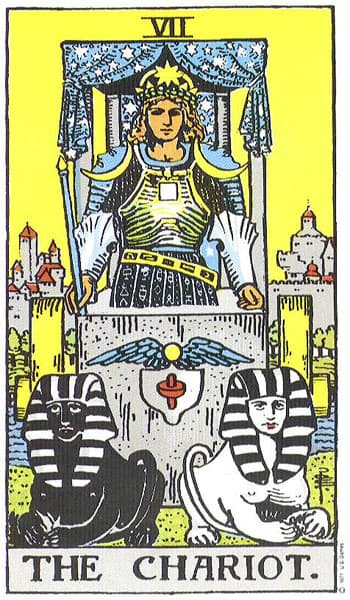
In the Rider-Waite image, a crowned driver stands in a chariot drawn by two sphinxes, one black and one white, with no reins in sight. Upright, The Chariot describes progress that comes from inner command: you hold opposing needs together and steer them toward one goal.
It often appears when a decision has been made and now needs follow-through, such as a move, a launch, a competition or a demanding project. The card rewards focus and steady effort, and it reminds you that control starts with yourself rather than with forcing others.
The light in the card
Clarity, initiative, courage and steady practice can help you act even when fear or resistance is present. The Chariot can suggest leadership that gives people a direction, boundaries that protect something valuable, and coordination that lets different needs work together. Accepting help and sharing responsibility can strengthen that leadership. An achievement may rest on preparation and skill as much as determination.
The shadow in the card
Determination can become pressure, a struggle over authority or a need to win at any cost. Outward progress may leave feelings unheard, while managing every detail can hide fear or keep an unsuitable plan in place. At the other end, energy may scatter or circumstances may seem to take over. A standstill can come from indecision or rigidity; exhaustion can grow when one person holds everything together. These possibilities depend on the question and position, including when the card is upright.
Message
The Chariot brings attention to where things are heading and to the different wishes that come along for the ride. Sometimes the energy to move is already there; sometimes the pieces still need to find a way to work together. You can have a clear intention and make room for a need for time, security or a different approach. Receiving help can be part of leadership too.
The Chariot Reversed Meaning
AGAT readings draw upright cards; the reversed meaning is here for reference.
Reversed, The Chariot shows energy without a clear direction: plans that pull apart, a loss of motivation, or trying to control everything at once. It can also describe pushing so hard that you lose sight of why you started.
The reversed card asks you to stop, choose one direction and set the pace you can actually keep.
Reference for a reversed draw only: lack of direction, poor coordination, overcontrol, feeling carried by circumstances, external resistance, effort on an unsuitable path, or gathering inner strength. Excess and shortage can both look like a standstill. Do not infer an accident or illness, or use a reversed meaning for an upright draw.
The Chariot in Love & Relationships
In relationships, the Chariot can bring initiative, attraction and a wish to move things forward. In a new connection, it may suggest lively courtship, a magnetic presence and quick exchanges. A reading through Hermes adds wit, playfulness and flirtation. This is an interpretive layer rather than a meaning shared by every tarot tradition. In an established relationship, the two sphinxes can represent two people whose needs differ: closeness and freedom, change and security, momentum and time. With no visible harness, the image invites a question about what brings them together willingly: trust, commitment, an ongoing choice or a shared goal. Defining the relationship, navigating distance or moving together may be relevant when the question mentions them. A couple may work well as a team and still need room for affection and emotional conversation. Armor can protect something tender. Taking practical care of a relationship can express love, but it does not tell us everything someone feels. A question about feelings may bring attraction or restraint into focus; intentions may concern initiative; behavior may show who sets the pace. The card does not give direct access to another person’s mind. The difficult side can involve a struggle over pace, trying to win an argument, treating a partner as a goal to acquire, or leading in a way that leaves little room for the other person. Persistence helps when interest is mutual. Independence and closeness can coexist when both people have a voice in decisions. After a crisis or breakup, a wish to reconnect needs to be read alongside a willingness to change the relationship’s direction. The Chariot can describe moving forward together or choosing separate paths; it does not guarantee either. When intimacy is the topic, it may suggest desire and initiative alongside an agreed pace.
If you are single
If you are single, The Chariot suggests taking initiative and being clear about what you are looking for. It can also describe meeting someone while traveling or during a busy, forward-moving season of life.
In a relationship
In a relationship, The Chariot asks two strong wills to choose a shared direction, such as moving forward into commitment, handling distance, or working toward a common goal. Its shadow is trying to win every argument.
As feelings: how someone feels about you
As feelings, The Chariot describes someone who is determined and focused on you, or on making the connection work. They may be decisive and eager to move forward, and sometimes busy with their own goals at the same time.
The Chariot in Career & Money
At work, the Chariot brings ambition, focus, disciplined practice and the ability to carry a plan through. It may relate to competing for a role, preparing for an exam, leading a project, changing direction, becoming independent or traveling when those matters are part of the question. A strong intention still needs skills, resources and a workable strategy. The sphinxes can represent teams, stakeholders or competing priorities. Helpful leadership makes the goal clear, shares responsibility and listens to information from the people doing the work. Delegation and support allow a project to function without one person managing every detail. A Hermes reading adds quick thinking, negotiation, persuasion, mediation, marketing, writing and presentation. These are symbolic applications rather than a prediction of someone’s profession. Learning and creative practice may also help a person develop a voice; debate, performance, acting, singing, journalism and music are examples offered in interpretive sources. In a business, you can remain loyal to the vision while adjusting the product, partnership or strategy. It helps to distinguish resistance that calls for persistence from information that calls for a change. The shadow includes constant racing, office politics, winning at the expense of cooperation, or advancement that no longer fits the life you want. The card does not guarantee a job, promotion or profit.
At work, The Chariot is a card of momentum: leading a complex project, competing for a role, relocating or pushing a plan through. It rewards discipline and clear priorities more than speed.
Money
With money, The Chariot favors a clear plan and the discipline to follow it, such as a savings goal or a budget you stick to. It is a prompt to take charge of your choices, not a forecast or financial advice.
The Chariot can suggest focus on a financial goal, disciplined choices and attention to resources. Consider how the goal fits income, commitments and the capacity to carry risk. Excess confidence or a need to prove success may encourage haste; hesitation or scattered effort may delay action. Material progress can matter without becoming the only measure of personal worth. This symbolic reading needs to sit alongside actual financial information and does not promise a return.
The Chariot as Yes or No
Strong Yes
The Chariot is a strong yes: it supports moving forward, as long as you stay focused and keep your hands on the direction.
For questions about action and progress, the Chariot can support a positive tendency when direction, capability and coordination are supported by the spread. Determination does not guarantee an outcome or automatically confirm feelings, fidelity or a reunion. Answer the question asked and draw any conditions from the spread rather than adding invented requirements.
The Chariot as Advice
As advice, The Chariot says: decide where you are going and commit to it. Gather your scattered energy, set clear priorities and keep moving even when it is hard. Steer with calm control rather than force.
The Chariot in a Reading: Common Combinations
The Chariot + Strength
Willpower with patience. Progress through gentle control rather than force.
The Chariot + Seven of Wands
Holding your course under pressure. Defend your direction without fighting every battle.
The Chariot + Six of Swords
A move or a journey toward calmer waters. Leaving a difficult situation with purpose.
The Chariot + The Lovers
A choice of the heart that sets the direction. Decide together where the relationship is going.
Psychological layer
The Chariot can represent a developed sense of self, the ability to set boundaries and a feeling of influence over life. When worth depends mainly on achievement, a delay may feel threatening. A classical reading distinguishes outward and intellectual victory from inner or spiritual understanding: someone can perform well while finding it hard to feel, rest or acknowledge limits. Armor invites a look at a strong public presence and the vulnerable self it may protect. Emotional regulation gives feelings room while choosing a response; suppression may hide in speed and constant functioning. The card alone does not establish emotional distance. Assertiveness leaves room for other people’s wishes, while coercion narrows that room. Ambivalence may appear as one part pressing ahead and another applying the brakes. What is each protecting? Another possible interpretation opens a question about projecting inner struggles outward, while recognizing that real external obstacles can exist. Overcontrol, difficulty trusting and exhaustion are possibilities to explore. Flexibility, help and shared responsibility can make leadership sustainable. These are symbolic interpretations, not diagnoses.
Personal growth
The Chariot can support agency, choosing a direction and becoming more independent. Different wishes can be heard before a decision, without treating every inner conflict as an enemy. A vision may stay meaningful while the approach changes. Growth can include making room for feelings, accepting help, resting after an achievement and retaining a sense of worth while learning or waiting. Body and habits can symbolize the vehicle carrying the effort; this is not a medical assessment.
Family
In family life, the Chariot may concern protection, responsibility and coordinating different needs. Who sets the direction, whose voice is heard, and how is the effort shared? Protection can create security and support independence, while too much control can leave little room for others. Cancer and the city in the background add themes of home and belonging. Taking a personal path or setting a boundary with family need not mean cutting ties. If the question concerns parenting, a move or living together, explore the balance between keeping people safe and allowing them to grow. Do not assume a family structure or childhood history that has not been shared.
Spirituality
The Chariot can be read as a vehicle for the soul or a deeper intention. What valuable thing does the journey carry, and what is its strength meant to protect? Personality can offer a framework through which a deeper direction becomes visible in the world. This kind of leadership brings receptivity and listening alongside will. A boundary can create a protected space for something to grow, or become a rigid enclosure. Speech gives intention form, and understanding needs the ability to act. A spiritual journey can invite a look at whether effort stays connected to meaning, humility and an awareness of limits. For comparison between traditions only: in the Indian chariot analogy, the senses are horses, the body the chariot, the mind the reins, the intellect the driver and the Self the owner. This can deepen reflection on attention and sensory pull. Rider–Waite–Smith depicts two sphinxes, not horses. Do not import the parable's visual details or present resemblance as proof of historical origin.
Mythic parallel
The traditional name Chariot of Hermes adds a Hermetic layer to the figure. Hermes, messenger of the gods, adds mediation, quick thought, invention and wit. In the Iliad he appears to Priam as a handsome noble youth and guides him; the Homeric Hymn highlights speed and resourcefulness. Through this connection, charm, playfulness and flirtation become possible interpretive layers. The figure is not Hermes in every deck, and this symbolism does not establish a person’s age or appearance. Greek Hermes and Hermes Trismegistus are distinct figures. Helios and Phaethon offer a parallel between power and the ability to guide it. In prominent classical accounts, Phaethon asks to drive the chariot of his father Helios; the later identification of Apollo with the sun does not make all versions identical. The parallel can explore readiness and responsibility without predicting a disaster. Military imagery may evoke Greek Ares or Roman Mars, but it does not replace Cancer in the Golden Dawn attribution. Plato describes a charioteer and two horses as a model of the soul in a discussion of love and desire. In the Katha Upanishad the body is the chariot, intellect the driver and mind the reins. Ezekiel’s living creatures and wheels move with the spirit. These are philosophical and mystical parallels rather than claims about the card’s origin.
Symbols and their relationships
The armor, crown and wand suggest protection, authority and intention. The black and white sphinxes are resting, with no visible harness or reins. Their contrast can represent wishes, people, approach and withdrawal; avoid fixing black as evil, white as good, or the colors as genders. The sphinx’s riddle can represent achievement within the spheres of nature and intellect. Leadership through will is an interpretation of the missing reins. The starry canopy and four pillars can connect practical action with a wider framework; esoteric interpretations read the pillars as the elements. The faced crescents on the shoulders add lunar contrast, and a classical interpretation proposes a link to Urim and Thummim. The crown’s star may suggest aspiration, the square on the chest material grounding, and the belt and wand power given form. Some interpreters read the winged emblem and the shape below it as complementary principles, creation and sexuality. A link to Hermes’ wings is one option. The city and river can suggest home, emotional ties and a transition; the image does not settle whether the figure is leaving or returning. Its stillness may hold preparation, a pause or gathered tension, and does not by itself mean a blockage.
Place in the arcana sequence
In the Rider–Waite–Smith sequence, VII follows the Lovers and precedes Strength. The Lovers can concern values and choice; the Chariot gives a choice direction; Strength brings patience and gentleness toward impulses. In comparison with Temperance, the Chariot holds a goal and coordinates forces even while tension remains, while Temperance considers the proportion and pace that help the parts blend. In a relationship this can mean mutual choice, a shared path and ongoing adjustment. Seven may mark the end of the first group of seven or a union of spirit and matter; it is not a fixed date or an automatic attribution to Netzach.
Intimacy and sexuality
When intimacy is the topic, the Chariot may suggest desire, initiative and attraction between contrasting qualities. A Hermes reading adds playfulness and verbal chemistry. Some esoteric interpreters read the front emblem as a union of principles and creative power. Consider mutual participation and an agreed pace, including whether the encounter is being treated as an achievement or a proof of power. Do not infer preferences, fidelity or sexual compatibility from the card.
Creativity and expression
Focused intention and practice can give a personal voice form. A Hermes reading brings invention, speed and language; connecting disciplines can bring action into conversation with listening. Performance, writing, debate, singing and music are possible examples. A goal can remain meaningful while the approach changes, with room for play and unexpected information.
Historical divinatory lists
The classical list includes assistance and providence alongside war, triumph, presumption, vengeance and trouble; reversed, dispute, conflict, litigation and defeat. The Golden Dawn includes triumph and health with a qualification about instability. Thoth includes triumph, hope, memory and digestion alongside obedience, faithfulness and authority under authority, as well as violent conservatism, ruthlessness and destructive impulses. These traditional terms need context and do not promise events or establish a diagnosis.
Friendship, mobility and habits
Friendship may involve shared activity and goals, with room for each person even when there is no task. Travel and mobility are relevant when the question concerns them; do not infer an accident. Body and habits can invite reflection on movement, persistence and respecting limits without diagnosis. Will needs a vehicle able to carry the journey.
Thoth and the Hermetic path
In Thoth, the figure carries a Grail and the chariot is described as balanced. Four sphinxes combine four living creatures and sixteen sub-elements. The Grail relates to amethyst, the Moon and the sea of Binah; its radiant blood represents spiritual life. A throne in motion can suggest form and containment carrying power and action. Path 18 is also called the Intelligence of the House of Influence. These belong to Thoth rather than the visible details of Rider–Waite–Smith.
Deck history and numerology
A Milanese Chariot from 1450–1480 depicts a crowned woman and two winged horses. It differs from Rider–Waite–Smith and reminds us that the figure need not have a fixed gender. Seven can be read as three joined with four or the close of the first group of seven. A life-path-seven association may invite reflection on inquiry, independence and purpose without defining a person. A personal number is distinct from the card number, letter value and path number.
Reflection through the driver and sphinxes
Three focal points can guide reflection: the driver, the light sphinx and the dark sphinx. They explore direction and two forces without equating light and dark with good and evil. A fourth focus may consider coordination or a shared path. This is an invitation to reflect rather than an assumed problem or a required exercise.
Astrology, Qabalah and number
Golden Dawn: Cancer, cardinal Water, Cheth and path 18 between Binah and Geburah. VII, the letter value 8 and path number 18 are distinct. The Moon rules Cancer; Jupiter’s exaltation there adds a Thoth connection to the Wheel, while the lunar connection relates to the High Priestess. Do not import all those cards’ meanings or turn the Moon into a single direct planetary attribution. The spelled-out Cheth has value 418, linked to ABRAHADABRA in the Thelemic system. Hermetic path colors are amber in Atziluth, dark reddish brown in Briah, rich russet in Yetzirah and dark greenish brown in Assiah. The Golden Dawn title joins the powers of Water to the triumph of light. An alternative Hermetic system uses Zayin and Gemini, while another astrological system uses Libra and emphasizes marriage, contracts and cooperation. These are separate correspondences. Crown chakra and clear quartz in existing fields are possible modern associations rather than binding classical attributions.
More combinations with other cards
Possible readings depend on the question and the cards' actual positions.
| Card | Possible connection |
|---|---|
| King of Cups | Emotional steadiness can support leadership and coordination. Regulation need not mean suppression, and restraint alone does not establish love or its absence. Can direction be held while remaining in touch with feelings? |
| Two of Cups | Progress meets mutual connection. In love, consider shared participation rather than determined pursuit alone; at work, partnership can support coordination. Is the wish to move forward shared? |
| Seven of Cups | Many possibilities and imagination meet a need for a clear goal. Explore a grounded choice without dismissing inspiration or inferring deception. Which possibility is receiving real intention and resources? |
| Wheel of Fortune | Using momentum while keeping direction; consider acceleration that ignores changes in the route or conditions. Changing circumstances meet a wish to keep direction. Distinguish what can be influenced from what calls for adaptation, without treating change as a known fate. Where can you lead, and where might the approach need to shift? |
| Justice | Progress after clarifying direction and responsibility. A wish to win may replace discernment or proportion. Interpret through the question and both fixed positions; co-occurrence is not a chronology or evidence of an event. |
| The Hanged Man | Choosing direction within limits: consider what can move and what willpower alone cannot resolve. The impulse to advance meets a pause or a change in perspective. Consider whether the pause is developing a new approach or leaving a decision unresolved. Does the situation need another viewpoint before action? |
| Death | Movement meets an ending or transformation. Do not assume a breakup; a relationship pattern may be changing. At work, one stage may give way to another. What needs to end for the direction to change? |
| Temperance | The Chariot gathers forces around a goal; Temperance explores proportion and pace. In a relationship, consider mutual adjustment; at work, calibrate effort and resources. What pace would help the different parts work together? |
| The Devil | Strong will can meet attachment, dependence or a binding pattern. Consider whether persistence is still freely chosen and what it costs, without diagnosing addiction or labeling a person. Is another choice available? |
| The Tower | Plans and willpower meet change; finding a new direction instead of holding rigidly to the old one. A disrupted plan can reveal the limits of control. Focus on what has actually changed and what needs a new approach, without predicting an accident or collapse. What becomes visible when the route does not continue as expected? |
| The Star | The Star offers hope and a vision; the Chariot can give them a practical path. A strong aspiration does not guarantee success. Are the steps and resources suited to the hope? |
| The Sun | Visible progress with direction; control can crowd out enjoyment. |
| The Magician | The Magician brings skills and tools alongside will and direction. Communication can support initiative and persuasion, while words still need practical follow-through. Is there a real capacity to carry out the intention? |
| The World | An achievement may become part of a wider whole or the completion of a stage. Consider life after reaching the goal without promising a perfect outcome. Does the achievement fit life as a whole? |
| The High Priestess | The High Priestess adds quiet attention to the urge to act. Inner understanding or something not yet clear may change the approach; do not infer a secret or infidelity. Is something important being given time to be heard? |
| The Emperor | Structure and authority may support direction and protection, or become a contest over who decides. Consider influence and boundaries in a relationship or team. Does authority create security or a struggle? |
| The Lovers | Choice seeks direction and action; are wishes and pace coordinated? A project needs resources and a plan, not an assumed completed decision. The Lovers bring values and choice; the Chariot brings that choice into action. In love, consider mutual choice alongside direction and pace. Do not assume a triangle or two partners. Does the direction honor the choice? |
| Strength | Strength brings patience and gentleness to determination. Leadership can acknowledge impulses instead of fighting them, and make room for a partner’s feelings. Can direction be held without struggling against every emotion? With the Chariot, the sequence moves from leading two sphinxes from outside to touching one lion within. Emphasis: deep mastery lies in the relationship with the impulse, not in victory over it; less pressure, more patience. |
| King of Pentacles | A material goal needs a sustainable structure and resources. Emphasize responsibility and persistence without promising profit or status. Does practical capacity fit the ambition? |
| Four of Pentacles | Protection and holding on may preserve resources while limiting movement or trust. Consider a useful boundary alongside fear of letting go. Does the protective structure support the path or stop it? |
| Seven of Pentacles | The wish to accelerate meets maturation and a review of effort. Look at progress over time and the fit of the strategy without equating waiting with failure. Is the approach bearing fruit or asking for adjustment? |
| Seven of Pentacles + Three of Swords | With the Seven of Pentacles and Chariot: effort and waiting for results, a wish for direction and progress, and disappointment at the gap between investment and what is possible. In a lesson position, allow painful recognition without making all pain an obligation to learn. The Chariot as potential may suggest coordinating wishes, circumstances and capacity, not working harder or declaring a physical limitation mental. Ask what the effort concerns; do not invent treatment or medical failure. |
| Eight of Pentacles | Ambition needs skill and steady practice. At work or in study, emphasize preparation; in a relationship, sustained participation may be relevant. Does the daily work support the goal? |
| Nine of Pentacles | Independence and discipline may create personal space to enjoy. Do not infer wealth or relationship status. Is there room for rest and enjoyment after the achievement? |
| Knight of Swords | With the Chariot, the Knight's momentum is joined by a control that holds direction through focus rather than speed. Emphasis: steer the force rather than be dragged by it, and choose one destination before speeding up. |
| King of Swords | Clear thinking and decisions can give will a path. Consider whether judgment is fair and practical or rigid and detached from feelings. Does the decision hear inconvenient information too? |
| Two of Swords | The Two of Swords adds hesitation, protection and a decision that is not yet clear. The Chariot can explore what direction is possible and what needs to be heard before movement; do not prescribe haste or a decision without information. Does the pause allow understanding, or leave the path without direction? |
| Five of Swords | The wish to win may strain connection or cooperation. Competition is not inherently harmful, but consider what remains after the argument. What happens to the relationship when one person wins? |
| Six of Swords | Two images of transition bring attention to who leads, what is carried and what allows adjustment. The change may be external or a different way of coping, depending on the question. What supports everyone involved in moving? |
| Seven of Swords | Strategy, independence and quick thinking may serve a goal or avoid a direct conversation. A Hermes reading is not proof of dishonesty. Does the approach allow trust and clarity? |
| Nine of Swords | Outward functioning and determination can coexist with worry. Distinguish a real obstacle from what fear adds, without diagnosing anxiety or predicting disaster. Does the effort leave room for what is felt? |
| Ten of Wands | Progress may be sustained under a heavy load. Consider shared responsibility and receiving help rather than prescribing more effort. Is one person carrying too much? |
| Knight of Wands | The Knight's rearing horse meets the Chariot's two resting sphinxes: momentum alongside focus and coordination. In an explicitly sexual context, explore initiative and an agreed pace. There are no horses in this Chariot, and sexual control dynamics require support from the person's account. With the Chariot, the question of the reins sharpens: momentum and impulse meet direction and control. Emphasis: a destination chosen in advance, and movement that is steered rather than only carried along. |
| King of Wands | Vision and leadership meet execution and determination. Consider whether the direction invites participation or concentrates authority. Can leadership and listening happen together? |
| Two of Wands | With the Chariot, the gaze from the wall becomes a departure from between the walls. Emphasis: harness the planning to movement in one direction, and check that the momentum stays true to the decision that was made. |
| Six of Wands | Determination meets recognition and achievement. Distinguish a success already described from potential in the spread, without declaring victory in advance. Does recognition support self-worth or become its condition? |
| Seven of Wands | Determination meets resistance and the need to defend a position. Consider what deserves protection and whether every criticism is being treated as a threat. Does this stand serve the direction? |
Meaning by spread position
| Position | Possible meaning |
|---|---|
| Message | Consider what direction is becoming clearer and what would help different needs move together. Do not assume that racing, conflict or a blockage is already present. |
| Present situation | The situation may involve movement already underway, readiness to act, or an effort to coordinate different wishes. Distinguish what is progressing from what still needs direction. |
| Challenge | Explore whether the difficulty is a lack of direction, competing claims to leadership or too much control. More assertiveness or less pressure may be needed; the position does not make the card reversed. |
| Root | A need for independence, security or a sense of capability may underlie the situation. Offer possibilities without inventing childhood history or dependence. |
| Past | A previous achievement, struggle or move toward independence may shape the present approach. Consider whether a once useful strategy still fits and what remains of its cost. |
| Awareness and thoughts | A focus on plans or outcomes can be helpful while narrowing attention. Notice needs or information outside the plan; this position describes perception rather than forecasting an event. |
| Near future | Initiative or progress may become possible after a decision and coordination. Relate it to conditions and the rest of the spread without guaranteeing that an obstacle will disappear. |
| Self | Explore determination, independence and self-protection; a Hermes reading may add quick thought and persuasion. Does the leadership give others room, and does the armor still fit the situation? |
| Other person | Initiative, ambition or a need for independence may be relevant without establishing feelings, age or appearance. A wish to approach and an ability to sustain closeness need separate consideration. |
| Environment | The environment may encourage progress or present competing demands. Consider who leads, what resources are available and where coordination with others is needed. |
| Hopes and fears | Hopes for achievement, recognition and independence may sit beside fear of failure or losing control. Distinguish wishes and worries from the spread’s outcome. |
| Outcome | Achievement, a decision or a transition may be indicated in the context of the other cards. Consider the quality and cost of the outcome; progress in a relationship does not automatically establish love or commitment. |
| Advice | Choose the emphasis that fits: clarify the goal, gather resources, coordinate pace or adjust the strategy. Avoid a blanket instruction to rush or persist at any cost, and do not prescribe every option at once. |
| Lesson | The lesson may concern leadership with boundaries and listening, and the difference between self-command and controlling others. Strength can include receiving help and acknowledging limits. |
| Potential | Will and skill may be brought together to create progress. Consider what would turn readiness into action; potential is not an outcome already promised. |
| Support | Clarity, practice, an appropriate boundary or help with coordination can support the situation. Anchor the support in what the spread shows or the question actually says. |
Questions for reflection
- What direction is asking to become clearer?
- Could two wishes be difficult to hold together right now?
- Is the uncertainty about the destination or the approach?
- What gives this movement meaning?
- Does the current approach still serve the goal?
- Is there a shared direction, or does each person want something different?
- Could the difficulty concern pace rather than the wish to be together?
- What holds the connection when needs differ?
- Do both people have a voice in the choice and decisions?
- Could there be plenty of practical care but little emotional conversation?
- Can independence and closeness both have a place?
- What happens when one person disagrees?
- Does a wish to reconnect include willingness to change the approach?
- What is this protection keeping safe?
- Does it still fit the present situation?
- What could be shared without needing to impress?
- Is there room for fear, anger or hesitation?
- Could outward functioning be carrying a great deal of emotional effort?
- Can help be received without feeling that strength is lost?
- Does quick communication also leave room to listen?
- What becomes clear in the words, and what remains behind them?
- Does playfulness bring people closer or distract from an important conversation?
- Could mental chemistry be developing before emotional closeness?
- Can the pace slow without losing interest?
- What counts as success here?
- Is everyone working toward the same goal?
- Is resistance a distraction or important information?
- Is the effort shared among the people involved?
- Could the vision be right while the approach needs to change?
- What does this progress cost, and does that cost fit?
- Is there room to enjoy the achievement?
- What wants to move forward, and what wants to be protected?
- Can both wishes have a place?
- What valuable thing does the journey carry?
- Can the deeper intention still be heard within the effort?
- What could allow less struggle and more coordination?
Moment for reflection: If you would like, notice two wishes around the situation. What does each want to protect, and what direction could give both a place?
The image
A crowned, armored figure is in a chariot beneath a starry canopy supported by four pillars. Two resting sphinxes, one black and one white, sit in front with no visible harness. The figure holds a wand; no reins are visible. Faced crescents appear on the shoulders, a winged emblem and another shape on the front, and a city and river in the background.
The visible upper body is upright and alert, with the gaze directed forward. One hand holds a wand at the side, and the other is near the hip. The full body position is not visible, and there are no visible reins.
The Chariot FAQ
Is The Chariot a yes or no card?
The Chariot is a strong yes card. It supports moving ahead with a plan, especially one that needs focus and determination. The condition it carries is direction: the yes holds when you choose one course and stay in control of it.
What does The Chariot mean in love?
In love, The Chariot describes momentum and the need to choose a shared direction. It can point to moving from dating into commitment, handling distance or working through two strong personalities. For singles, it encourages taking initiative and being clear about what you want.
What does The Chariot mean as feelings?
As feelings, The Chariot describes someone focused and determined, who wants to move the connection forward or prove themselves. They may also be busy with their own goals. Pay attention to whether their drive includes you, rather than only the destination.
Is The Chariot a good card?
Yes, The Chariot is a positive card of progress and success through effort. It shows that you have the strength to move forward. It becomes challenging only when determination turns into forcing things or needing to win at any cost.