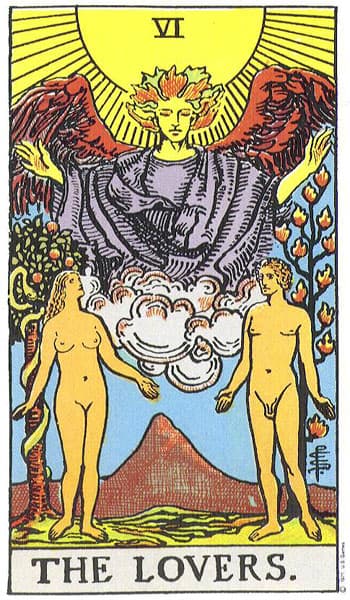
The Lovers Tarot Card Meaning
הנאהבים
In brief
Love, attraction and meaningful choice: bringing wishes, values and actions together while preserving freedom and reciprocity.
- love
- attraction
- choice
- connection
- values
- reciprocity
- covenant
- honesty
- differentiation
- partnership
- fast
weeks to months
By Gemini
Not a timing cardAbout choice and relationship, not time.
Timeweeks to months
By Gemini
Not a timing cardAbout choice and relationship, not time.
Card Facts
ז = Zayin · Simple letter = Gemini — so the path of The Lovers runs from Binah to Tiferet.
On the Tree of Life
Binah to Tiferet
Path 17 of the 32 paths of wisdom
The letter Zayin — simple letter
How the card sits on the treeThe Lovers tarot card stands for love, attraction and choice.
The Lovers describe attraction, love, connection and a meaningful choice. They explore alignment between desire, values and action: whom or what one chooses and what bond one is willing to sustain. They may emphasize reciprocity, partnership, a crossroads or something created through a meeting. Do not reduce the card to a love triangle or a choice between two people. The question and position establish its emphasis; companion cards refine it.
Message
The Lovers speak of deep connection, but also of the choice that allows connection to remain true. Notice whether your heart, values, and actions are moving in the same direction, especially when strong attraction creates uncertainty. As a Major Arcana card, the Lovers point to a meaningful life lesson: choose relationships, identity, and direction in loyalty to inner truth rather than fear or expectation. A healthy bond does not require abandoning yourself. It grows through honesty, reciprocity, and conscious choice. Core qualities of The Lovers: choice, connection, values, honesty and reciprocity.
The light in the card
Mutual attraction, honesty, closeness, consent and partnership that accommodates difference. Freely choosing with self-respect and regard for another. Bringing feeling, thought and action together and creating a new possibility through collaboration.
The shadow in the card
Prolonged indecision, idealization, people-pleasing, dependence on approval or surrendering boundaries to preserve a bond. Gaps between attraction and commitment, promises and behavior, or stated agreements and concealed wishes. Sometimes a painful choice between loyalties. These are contextual possibilities even upright; do not infer infidelity or an undrawn reversal.
Psychological layer
The wish to love and be chosen meets identity, vulnerability and the capacity to bear differences. Projection onto a loved person can illuminate neglected aspects of oneself; maturation allows a meeting with the actual person beyond the ideal. People-pleasing, abandonment fears or reluctance to close possibilities are contextual hypotheses, not diagnoses. A Jungian approach explores the union of opposites; differentiation emphasizes closeness without fusion. Establish whether the difficulty involves missing information, conflicting values, avoidance or real constraints.
Personal growth
Choose in alignment with values, bear the loss of alternatives and retain a sense of self in connection. Differentiation means holding wishes and boundaries without merging into another or cutting off closeness. Growth may involve deciding, clarifying or creating a third way.
Love & relationships
The Lovers can emphasize meaningful affection, attraction, a wish for closeness and choosing a relationship. Do not dilute feeling into indecision alone. Distinguish feelings, intentions, behavior and outcome: attraction does not guarantee exclusivity or sustained commitment. In a feelings position the card may support attraction and significance; in intentions, a choice or conflict; in behavior, alignment between words and actions. In a new connection, consider chemistry alongside compatibility. In an established bond, explore its covenant, agreements and renewed choice; after crisis, either repair or a decision to leave may be relevant. Mature intimacy allows each person wishes and boundaries. An undefined connection, consensual non-monogamy and a concealed additional relationship are different situations. Fidelity concerns the agreements actually made, rather than relationship structure alone. A soulmate description may express significance and connection; it establishes neither destiny nor an obligation to remain in harm.
Career
A professional choice aligned with values, chemistry between partners, negotiation and combining skills to create together. Sometimes two offers are at issue; sometimes a third possibility can be built. Partnership benefits from clear aims, roles, authority and obligations; enthusiasm is neither a contract nor a success guarantee. Attraction between colleagues matters only when stated, including consent, power differences and conflicts of interest. Shadow: pleasing others, accepting work because of a personal bond or refusing the loss of alternatives.
Money & security
Money meets values, wishes and agreements through shared obligations, resources, gifts or a meaningful investment. Consider transparency, shared responsibility and freedom to agree or decline without emotional pressure. Human chemistry cannot replace checking terms and affordability. Shadow may involve buying approval, dependence or a mismatch between desires and obligations; profit is not promised.
Family
Belonging and choice within family: loyalty to a partner alongside family expectations, differences within a household and boundaries that need not make difference into rejection. When parenting or family expansion is the actual topic, explore shared wishes, coordination and responsibility. The card does not announce pregnancy. In friendship and community it can express meaningful connection without romance.
Spirituality
Love meets freedom and responsibility; a covenant gains meaning through conscious choice and practice. Joining opposites need not erase their differences. Explore personal desire alongside belonging, without using fate or external authority instead of choosing. Sacred marriage and covenant are symbolic approaches, not a promise of union with a particular person.
Mythic parallel
The story of Eros and Psyche offers a deep mythic parallel for the Lovers. Their bond does not remain idealized romance; it passes through rupture, loss, trials, and maturation before relationship can be rebuilt consciously. The myth suggests that love is not merely finding 'the right person' but a process through which the self becomes more capable of loving. That is the Lovers' movement from choice driven by attraction toward choice rooted in values and awareness. Further parallels include Heracles at the crossroads for values and direction, the judgment of Paris for the cost of choosing, and Castor and Pollux for brotherhood and difference through mortality and immortality. These are comparisons, not a single historical origin or a justification for suffering in a relationship.
Symbols and their relationships
Two separate figures beneath a winged presence suggest connection without erasing difference. Nudity can express vulnerability and honesty; distance leaves room for independent wishes. Trees, serpent and flames add knowledge, desire and discernment. The angel may be read as blessing, guidance or a wider perspective; Raphael is an interpretive identification rather than a name supplied by Waite. The mountain can represent aspiration or challenge. Symbols establish neither infidelity, sexual compatibility nor health.
Place in the arcana sequence
After the Hierophant, V, associated with tradition and structure, the Lovers, VI, emphasize personally choosing values and connection. The Chariot, VII, adds direction, coordination and execution. This is an optional reflective sequence, not a prescribed chronology. The mirrored Devil raises freedom and attachment; in Thoth, Art continues the alchemical union whose components the Lovers distinguish.
Intimacy and sexuality
Nudity and openness can invite desire, vulnerability and embodied emotional meeting. Consider consent, pace, wishes and boundaries; distinguish chemistry from commitment. Sexuality can express joy and free choice rather than being inherently shadow. Do not infer orientation, preferences, exclusivity or actual sexual activity.
Archetypes
The Lover seeks vitality, beauty and connection; the Chooser bears responsibility and cost; the Partner preserves reciprocity; the Mediator finds possibilities between opposites. Pearson’s Lover concerns intimacy and belonging; Moore and Gillette place a Lover within a historically masculine four-archetype model. These are modern comparisons, not diagnoses or one original card meaning.
When this meaning applies: When archetypes are the actual topic
Union of opposites and differentiation
Coniunctio concerns joining opposites; syzygy concerns a paired relationship of opposites. Anima and animus are historical concepts, not fixed assignments of feeling to women and reason to men. Differentiation in Bowen and Schnarch offers selfhood within connection. Value-action dissonance or fear of missing alternatives may help when relevant; do not attribute this card interpretation directly to Jung.
When this meaning applies: In explicit psychological or archetypal study
Development of the image
Early Italian cards include love and marriage imagery. Marseille presents a person between two figures beneath Cupid, not necessarily two lovers or moral allegories. Rider–Waite–Smith uses Eden imagery. Do not claim ancient Egyptian origin or a single structure for every historical version.
When this meaning applies: When studying history and decks
Knowledge, gaze and angel
Raphael is a common interpretive identification. Case reads the gaze between man, woman and angel through conscious, subconscious and superconscious functions; twelve flames relate to zodiac signs and the fruit to senses. These are particular esoteric attributions. Nudity does not establish sexual orientation, and the mountain need not be called a volcano.
When this meaning applies: When symbolism is requested
Thoth alchemical marriage
Thoth depicts a black king, white queen, a hooded Hermit-related officiant, children, Cupid and an Orphic egg with a serpent. Distinguish the pictured figures from the Cain and Abel narrative in Crowley’s discussion of the Brothers. The Lovers emphasize discrimination and analysis; Art recombination and transformation: Solve et Coagula. Gemini and Sagittarius form a corresponding axis. These belong to Thoth, not the RWS image.
When this meaning applies: For Thoth study
Golden Dawn and alternatives
Golden Dawn imagery shows Perseus freeing Andromeda, inviting release from bonds without assigning a rescuer role. The title is Children of the Voice, Oracle of the Mighty Gods. Papus’s French system uses Vav and Taurus rather than the Golden Dawn’s Zayin and Gemini. Keep systems distinct, including Knight versus Thoth Prince ranks.
When this meaning applies: When comparing systems
Covenant, Sabbath and Shavuot
Waite links the image to covenant and Sabbath. Versions of Sefer Yetzirah connect Zayin, Gemini and Sivan; that text does not originally assign a tarot card. Shavuot as covenant and Jewish bridal imagery are comparative extensions. Union of the Holy One and Shekhinah or Song of Songs may enrich a study of union while retaining their distinct Jewish context.
When this meaning applies: In explicit symbolic or traditional study
Comparative myths and spirituality
Eros and Psyche invite trust and maturation; Heracles at the crossroads, transmitted through Prodicus and Xenophon, offers choice of path; Paris the cost of preference; Castor and Pollux brotherhood across mortality and immortality. Shiva and Shakti, Krishna and Radha, and yin and yang are possible comparisons for meeting and difference, not identical traditions or proof of historical tarot influence.
When this meaning applies: When myths or traditions are requested
Six, hexagram and distinct numbers
Six is a perfect number because its smaller positive divisors sum to six: 1+2+3. A hexagram or interlaced triangles may symbolize harmony between opposites without being present in the image. Card VI, Zayin’s value seven and path seventeen are distinct. A 15/6 birth-card pair can explore freedom and attachment as life themes, not fixed romantic destiny.
When this meaning applies: In a numerology or symbolism question
Historical divinatory lists
Waite’s list includes attraction, love, beauty and trials overcome; its reversed list includes failure, unwise plans and frustrated marriage. These historical terms require context rather than automatic forecasting; reversal does not establish infidelity.
When this meaning applies: When comparing historical lists with interpretation
What grows from the meeting
A meeting can create something neither party held alone. Beyond choosing A or B, explore a third way, shared aims, resources and roles, and whether chemistry becomes work. Birth is a creative metaphor here, not a pregnancy announcement.
When this meaning applies: In a project or shared-creation question
Relationship to the body and support
Explore consent, relationship with the body, support and choices around care. Do not infer pregnancy, illness, fertility or a psychological cause from an image or combination. Astrological anatomy is not diagnosis or a reason to suggest an unreported symptom.
When this meaning applies: Only for a health question
Timing and pace
Gemini can supply a symbolic window in an explicitly stated method, around late May and much of June. Six does not mean six days or weeks. Distinguish emerging desire, deciding and realization; retain the existing timing policy until explicitly changed.
When this meaning applies: Only when timing is asked
Karmic relationships
Familiarity or strong attraction can invite reflection on patterns and a new choice. It proves neither a past life, twin flame nor soul contract and does not make suffering obligatory.
When this meaning applies: Only when the reader introduces a karmic context
Symbolic practice and stones
Three columns can distinguish attraction, values and realistic possibility without treating the first thought as most reliable. Affirmations can bring feeling, thought and action together. Rose quartz, rhodonite, emerald, agate, malachite and green aventurine are optional modern associations alongside existing clear quartz; there is no single classical list or healing guarantee. Heart and crown are reflective associations, not anatomical facts.
When this meaning applies: Optional reference practice
A reflective spread
Seven possible focuses: attraction; the important value; my wish; the other side read symbolically; the gap or boundary; shared creation; and an available choice. A follow-up spread is not a condition for answering.
When this meaning applies: Reference, without requiring another reading
Astrology, Qabalah and number
Golden Dawn: Gemini, mutable Air, Zayin and path 17 between Binah and Tiphareth. Mercury rules Gemini; it is not another card implicitly drawn. Venus can be a thematic association with love rather than this system’s primary attribution. VI, letter value seven and path seventeen are distinct. Hermetic Qabalah is not a single universal Jewish system.
Reversed meaning
Only for an actually reversed draw: misalignment, conflicting values, distance, inward choice or delayed decision. A covenant may be broken or agreements may need repair. Love does not automatically become hatred, infidelity is not established, and an upright card must not be treated as reversed.
Yes or no
For love or connection the card can support the supplied affirmative tendency; do not automatically retreat to indecision alone. For commitment, fidelity, pregnancy or practical results, attraction is not confirmation. Answer the actual question using positions and drawn cards without inventing conditions.
Connections with other cards
Possible readings depend on the question and the cards' actual positions.
| Card | Possible connection |
|---|---|
| Ten of Cups | Connection within a vision of home and belonging; distinguish a shared wish from a reality or promise of a child. |
| Page of Cups | Emerging feeling or an emotional gesture; parenting wishes or children only when relevant, not a pregnancy announcement. |
| Knight of Cups | With the Lovers, the romantic gesture meets the question of choice. Emphasis: a beautiful gesture is a beginning, and choosing the relationship rests on shared values and on deeds over time, not only on a moment of falling in love. Courtship and romantic expression; do words gain continuity? Only an actual reversed Knight may emphasize inconsistent promises or idealization, without declaring a deceiver. |
| Queen of Cups | Emotional depth and receptivity with boundaries, rather than carrying everyone's feelings. |
| King of Cups | Emotional maturity and steadiness; restraint can regulate feeling or create distance depending on context. |
| Ace of Cups | Emotional opening and intimacy or creation. A womb analogy is metaphor, not confirmation of conception. |
| Two of Cups | With the Lovers, the connection deepens into a choice: not only mutual attraction but a shared decision. Emphasis: shared values and a conscious choice of the relationship. Connection and reciprocity deepen choice. Support affection and attraction without treating potential as a completed decision or guaranteed marriage. |
| Three of Cups | Friendship, celebration and social influence. In an explicit fidelity context, consider another person's involvement or boundaries; three figures or a reversal do not establish an affair. |
| Four of Cups | An opening for connection meets withdrawal, saturation or doubt; is the offer suitable or difficult to receive? |
| Five of Cups | Disappointment and grief affect willingness to choose and approach. |
| Six of Cups | Tenderness and familiarity; choose the actual person rather than only a memory. Children can matter when asked about, without predicting reunion or pregnancy. |
| Seven of Cups | With the Lovers, the many options narrow to a question of choice. Emphasis: choose by values and by what nourishes over time, not by what dazzles now. Options, fantasy and temptation meet discernment of what is real; many possibilities do not establish multiple partners. |
| Eight of Cups | Leaving what no longer nourishes or seeking deeper meaning; position distinguishes wish, action and possibility. |
| Nine of Cups | Pleasure and satisfaction; is there room for both people's wishes? Enjoyment does not automatically undermine fidelity. |
| The Fool | An appealing beginning and freedom to explore; wanting to continue need not mean wanting to define commitment. |
| Wheel of Fortune | An encounter or turn inviting mutual choice; a feeling of being meant for each other does not replace compatibility. A meeting or turn changes available choices; distinguish circumstances from agency without treating fate as guaranteed union. |
| Justice | A committed choice, relationship agreement or alignment between values and conduct. A declared choice may lack implementation; no wedding is promised. Interpret through the question and both fixed positions; co-occurrence is not a chronology or evidence of an event. Honesty, agreements and consequences; fairness versus scorekeeping, without a legal prediction. |
| The Hanged Man | An open relational or values choice; infer neither soulmates nor a triangle. Pause and perspective before choosing; meaningful patience versus one-sided sacrifice. |
| Death | A deep change in how the bond exists: a habit, definition or relationship may end, as context clarifies. |
| Temperance | Choice together with living with differences; examining values and relationship. Connection becomes ongoing coordination and proportion; compromise that honors needs versus erasing them. Temptation need not be present. |
| The Devil | With the Lovers, the question is the difference between choice and bondage: attraction and connection chosen out of shared values, as against a grip that goes on out of habit or fear. Emphasis: what in the bond is chosen again and again, and what merely continues by itself. Strong desire meets freedom, attachment and cost. Explore consent and dependence without pathologizing sexuality. A trust question may raise a concealed bond as a hypothesis, not an established affair. |
| The Tower | A truth calls for a choice about relationships and values; this does not establish a romantic triangle. Revelation or a shattered expectation unsettles the bond; exposure of concealment is one possibility in a trust question, alongside changes unrelated to infidelity. |
| The Star | Hope and openness to trust or creation after disappointment; inspiration versus idealization, not a medical or pregnancy prediction. |
| The Moon | Feeling and attraction amid uncertainty: distinguish fear, missing information and possible concealment without dismissing or confirming suspicion. |
| The Sun | Attraction and openness support a choice; warmth does not establish compatibility or commitment. Joy, visibility and shared warmth; creation can gain expression. Parenting may matter in a family question without announcing pregnancy or birth. |
| The Magician | Attraction gains initiative and expression; persuasion versus consistency. In a project, bringing skills together without assuming all resources are available. |
| Judgement | Recognition of what matters and renewed choice; reconsidering a past relationship does not promise reunion. |
| The World | Integrating a bond into a whole life or completing a phase; fulfillment or a mature ending according to context. |
| The High Priestess | Quiet closeness, intuition or something unspoken; distinguish privacy from concealment. Do not identify another woman automatically. |
| The Empress | Sensuality, nurture and shared creation. Family questions may involve parenting wishes; this does not confirm pregnancy or medical fertility. |
| The Emperor | A choice gains structure and responsibility; supportive form versus control. |
| The Hierophant | With the Lovers, the sequence moves from tradition to the heart's choice: what was learned from outside meets a personal decision. Emphasis: a commitment that is both an honest choice and an open agreement, not one at the expense of the other. The heart's choice meets family, community and tradition; consent versus conformity. Ritual or commitment may matter without a wedding guarantee. |
| The Chariot | Choice seeks direction and action; are wishes and pace coordinated? A project needs resources and a plan, not an assumed completed decision. The Lovers bring values and choice; the Chariot brings that choice into action. In love, consider mutual choice alongside direction and pace. Do not assume a triangle or two partners. Does the direction honor the choice? |
| Strength | Desire and vulnerability meet patience and regulation; boundaries matter in an explicit temptation context, but do not invent temptation. |
| The Hermit | Inner reflection supports choice; personal space versus withdrawal according to position. |
| Ace of Pentacles | An opportunity to ground connection in time, resources or a project; a material seed is not a signed contract, profit or pregnancy confirmation. |
| Ten of Pentacles | Connection meets family, legacy and long-term plans; belonging versus pressure to conform. |
| Page of Pentacles | Readiness to learn and build partnership; practical news when relevant, not proof of a child or pregnancy. |
| Knight of Pentacles | Persistence and gradual building; slowness is not absent affection, and routine alone is not mutual commitment. Choice meets consistent actions; consider whether responsibility includes mutual emotional expression. |
| Queen of Pentacles | Everyday nurture and security, including receiving rather than only giving. |
| King of Pentacles | Resources and responsibility support partnership; material security alone is not emotional fit or a right to control. |
| Two of Pentacles | Coordinating connection with other obligations; juggling does not establish two partners. |
| Three of Pentacles | Partnership builds through skills, shared roles and feedback; chemistry becomes practical collaboration. |
| Four of Pentacles | Security meets closeness; protection versus holding on or restricting space. |
| Five of Pentacles | A bond amid practical hardship or exclusion; support and belonging without establishing illness or abandonment. |
| Six of Pentacles | Reciprocity in resources and care; receiving and giving versus emotional debt or power imbalance. |
| Seven of Pentacles | Evaluating effort in a bond or project: what grows, what delays and what is expected? Effort does not guarantee returns. |
| Eight of Pentacles | Choice becomes learning and daily practice; is the work shared and emotionally meaningful? |
| Nine of Pentacles | Closeness preserving independence or choosing partnership; autonomy is not inability to love. |
| Ace of Swords | Conversation and discernment name wishes, truth and boundaries. |
| Ten of Swords | A rupture or ending of an old picture; clarify whether a phase, trust or a relationship is ending. |
| Page of Swords | Questions and checking information; trust questions may involve monitoring, gossip or seeking confirmation without establishing infidelity. |
| Knight of Swords | A drive to speak or decide; does speed leave room for both? Decisiveness meets relationship choice and values; speed establishes neither closeness nor separation. |
| Queen of Swords | Clarity and boundaries with room for feeling. |
| King of Swords | Clear decisions and agreements; reason serving connection versus distancing feeling. |
| Two of Swords | A meaningful choice meets protection, hesitation or missing information; do not assume knowing refusal. |
| Three of Swords | Sharp hurt, disappointment or painful truth in a bond. In a fidelity question, consider a triangle or choosing another alongside breakup or an old wound without a third party; neither this pair nor a reversal proves infidelity. |
| Four of Swords | Space to process within a bond or before choosing; rest need not mean separation or absent affection. |
| Five of Swords | Connection meets a contest someone must win; consider the cost to partnership. |
| Six of Swords | Distance or a move toward calmer conditions; are people moving away from difficulty together or from each other? |
| Seven of Swords | Concealment, evasion, indirect action or caution around choice. In trust questions do not automatically soften lying into caution; consider a concealed bond or a words-actions gap as a hypothesis. Respect position ownership: the querent's card may describe investigation or response to ambiguity, not the partner's act. With the Lovers, the question of honesty enters the choice of the relationship itself: a shared choice needs material information both sides can see. Emphasis: openness about what matters to the shared choice, without demanding that every thought be disclosed and without deciding who hides what. |
| Eight of Swords | Wanting to choose while feeling without options; recognize real constraints too. |
| Nine of Swords | Worry, guilt or recurring thoughts about connection; fear is not proof, but concerning information should not be dismissed. |
| Ace of Wands | A spark and desire animate connection or shared creation. A seed analogy does not confirm conception or compatibility. |
| Ten of Wands | The burden of maintaining a bond or decision; who carries responsibility? |
| Page of Wands | Curiosity and flirtation before settled choice; in a project, an idea seeking exploration. |
| Knight of Wands | Desire and initiative; what sustains choice as excitement changes? Speed does not establish unfaithfulness. Desire meets choice and values; attraction alone is no mutual decision about a bond. |
| Queen of Wands | Charisma and sensual confidence enhance attraction; explicit temptation contexts can involve boundaries. A queen is not automatically another woman and sexuality is not infidelity. |
| King of Wands | Shared vision and initiative; leadership respecting both wishes versus unilateral direction. |
| Two of Wands | A shared horizon or a new path; distinguish plans from commitments already made. |
| Three of Wands | Choice meets expansion and anticipation; what is already done and what remains hoped for? A project can look beyond its beginning. |
| Four of Wands | Celebration and shared space; marking a bond when relevant without guaranteeing a wedding. |
| Five of Wands | Attraction alongside friction, competition or competing wishes. |
| Six of Wands | Recognition of connection; real meeting versus appearing a successful couple. |
| Seven of Wands | Protecting a bond or choice against opposition; commitment to values versus defensiveness. |
| Eight of Wands | Communication or acceleration; speed is not commitment or a realization date. |
| Nine of Wands | Closeness alongside caution shaped by experience; do not invent a history of harm. |
Meaning by spread position
| Position | Possible meaning |
|---|---|
| Message | Make room for connection, attraction and choice in the actual domain asked about, without inventing a crossroads or romance. |
| Present | A significant connection or choice is central; distinguish an existing bond, a wish and an opportunity. |
| Challenge | Conflicting wishes and values, avoiding a decision or attraction without compatibility. A challenge position is not a reversal. |
| Root | A need for closeness, belonging or a past choice may underlie matters; do not invent childhood or attachment history. |
| Past | A past bond or decision may influence the present without establishing a return. |
| Awareness | What the person understands, wants or considers; a thought is not an action or fact about another. |
| Near future | Potential meeting, conversation or decision according to the spread; describe its tendency without guaranteeing fulfillment. |
| Self | Attraction, choosing, conflict or fidelity to values on this position owner’s side. Do not transfer traits to the other person. |
| Other | Potential attraction, significance and choice on the other side as the question requires. Do not redirect everything to the querent or claim private knowledge. |
| Environment | Relationships, expectations and partnerships around the person may support or complicate matters; do not infer a romantic third party. |
| Hopes and fears | Wanting to be chosen or fearing rejection, choice or lost freedom; hopes and fears are not the outcome. |
| Outcome | Potential connection or a meaningful decision in context; do not guarantee marriage, exclusivity or reunion. |
| Advice | Distinguish attraction, values and what can be sustained; choose a relevant emphasis rather than prescribing a checklist. |
| Lesson | Love with differentiation and responsibility: freely agreeing and bearing difference and the cost of choice, without justifying harm as a lesson. |
| Potential | Attraction, partnership or shared creation can develop; distinguish possibility from a choice embodied in action. |
| Support | Reciprocity, honest conversation, shared values or collaboration may support matters; do not invent a partner or available help. |
Questions for clarification
Relevant only when a missing detail changes the reading; these are optional.
- Are you one of the two people in the question?
Only if position ownership is genuinely unknown and changes interpretation; never ask when context already makes it clear.
- Is the question about feelings, an intention to commit or a particular behavior?
Only if the distinction is essential and unresolved; an answer can also distinguish these layers directly.
- What agreements exist about exclusivity?
Only in an explicit fidelity question when unknown agreements materially affect the answer.
- Which options are actually available?
Only when options were not supplied and the choice cannot be interpreted without them.
Questions for reflection
- What attracts you here, and what matters beyond attraction?
- Is the wish for connection shared, and how is it expressed?
- What is known about each person’s wishes, and what remains assumed?
- Is there a gap between agreement and behavior?
- Does suspicion arise from information, a particular behavior or uncertainty?
- What boundary allows closeness without losing yourself?
- Is information missing, or is the cost of choosing hard to bear?
- Could a third way be created together?
- What is each person willing to sustain beyond the moment of attraction?
- What difference between the people can be respected?
- Does this choice reflect a personal value or an external expectation?
- What is the cost of keeping every possibility open?
- Does the project rest on shared aims and clear roles?
- Does giving leave room to receive?
- Is the wish for a family shared, and what does it mean to each person?
- Can both people say no within closeness?
- What remains of connection when the ideal image is set aside?
- What agreement has not yet been spoken aloud?
Moment for reflection: Sit quietly and distinguish what attracts you, what matters to you and what is possible in reality. No immediate answer is required. Where do heart, values and action meet?
The image
In Rider–Waite–Smith, a nude woman stands on the viewer's left and a nude man on the right, separate with arms slightly open. Behind her is a fruit-bearing tree with a serpent; behind him, a tree bearing flames. A reddish-brown mountain rises between them in the distance. Above a cloud is a purple-robed figure with red wings beneath a large yellow sun. No embrace or hand-holding.
Upright figures with arms slightly outward and open palms. The man looks toward the woman, who looks upward. Do not assign fixed psychological functions or traits by gender.