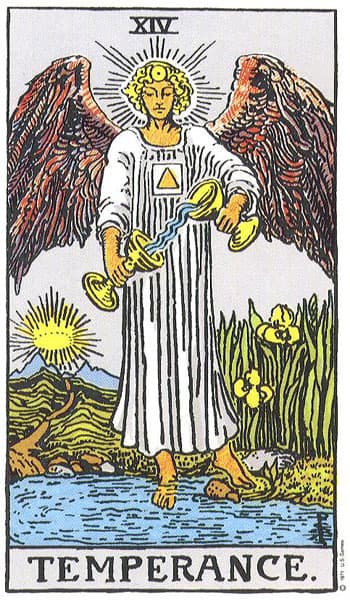
Temperance Tarot Card Meaning
מיזוג
- balance
- blending
- moderation
- active patience
- gradual healing
- adjustment
- listening
- reciprocity
- mediation
- collaboration
- emotional regulation
- integration
- alchemy
- proportion
- assimilation
- maturation
- union of opposites
- boundaries
- humility
- protection and support
- creativity
- renewal
- creative compromise
- slow
months to years
By Sagittarius
Counts for timingPatience and proportion describe a process and its pace; an explicit period in the question takes priority over a general months-to-years span.
Timemonths to years
By Sagittarius
Counts for timingPatience and proportion describe a process and its pace; an explicit period in the question takes priority over a general months-to-years span.
Card Facts
ס = Samekh · Simple letter = Sagittarius — so the path of Temperance runs from Tiferet to Yesod.
On the Tree of Life
Tiferet to Yesod
Path 25 of the 32 paths of wisdom
The letter Samekh — simple letter
How the card sits on the treeThe Temperance tarot card stands for balance, blending and moderation.
Temperance brings different parts together into a workable whole: feelings and thoughts, people and needs, skills and ideas, inner experience and practical life. It speaks of balance, moderation, patience, adjustment, healing and the integration of change. This is balance in motion. Like the liquid passing between two cups, it calls for continued attention to proportion, pace and the relationship between the parts. Sometimes something needs adding, sometimes reducing, and sometimes time to come together. The card invites a way for seemingly opposing sides to work together. Their meeting can create a possibility that neither side could produce alone. Temperance therefore also speaks to creativity, mediation and solutions in which the whole is greater than the sum of its parts.
Message
Temperance invites you to find the right proportion between needs, emotions, and forces that seem different from one another. Healing unfolds gradually when you stop moving between extremes and allow the pieces to blend at an appropriate pace. As a Major Arcana card, Temperance points to a meaningful life lesson: practice patient integration and build a whole path from parts that once competed with one another. Do not rush the outcome or postpone choice indefinitely. Move in measured steps and choose what supports lasting balance. Core qualities of Temperance: patience, proportion, healing, adjustment and blending.
The light in the card
Bringing different sides together can create a new possibility: a shared language, collaboration, reconciliation or an approach whose parts support one another. Active patience makes room to experiment, listen, adjust and proceed at a suitable pace. Healing and stability depend on participation, compatibility and supportive conditions. Receiving help can also be part of balance.
The shadow in the card
Imbalance may show as excess, impatience, differing rhythms or an attempt to force a connection that is not developing. Moderation also has a shadow: postponing decisions, avoiding a needed conversation, pleasing others or maintaining outward peace at the cost of inward tension. Compromise can become a repeated surrender of wishes and boundaries, while an appearance of calm can conceal pain. Read what needs adjustment and what already needs a decision through the question and position. These possibilities apply while upright; do not infer a reversed draw.
Psychological layer
Integrating parts of the personality Temperance can describe holding different feelings and wishes together: closeness with independence, ambition with rest, confidence with vulnerability. Give each part a place and examine how they can work together. A third possibility Where two extremes seem to be the only choices, consider whether another position could develop. In a Jungian reading, tension between conscious and unconscious experience may give rise to a wider, new stance. Emotional regulation Recognize a feeling, bear its presence and choose how to respond. A pause between experience and action permits understanding of what is needed and a suitable response. Inner strength and discernment A psychological reading of Michael can represent a protective capacity to hold experience and choose action. An impulse can be noticed without immediately acting on it; anger can express a need or boundary. Distinguish self-protection from an attempt to control another person. Inner experience and outward conduct Calm functioning may help someone through a difficult period, or may conceal pain and make support harder to receive. Consider whether outward composure permits contact with feeling or repeatedly covers it. Ego, pride and reciprocity The card can raise questions about being right, maintaining an image or seeking recognition. It suggests flexibility, receptiveness to feedback and recognition that the other person has a complete inner world. Self-worth and consideration can coexist without erasing personal needs. Idealization and expectations Move from a perfect image of a person, relationship or future toward the reality of the encounter. Explore actual compatibility, differences and possible adjustments. Assimilation after change After loss, separation or significant change, Temperance can describe learning to live with what happened and building a new routine. Intellectual understanding and feeling may develop at different speeds.
Personal growth
Temperance invites different parts of the self into a workable relationship: closeness and independence, ambition and rest, confidence and vulnerability. Development can come through a small experiment, attention to its effects and another adjustment. Distinguish patience that allows maturation from waiting that postpones a decision. Support and boundaries help insight take root in everyday life. Michael's symbolism suggests consciously held strength; the Narcissus reading invites attention to the space given to self-image and another person's experience without attributing a trait or diagnosis to the reader.
Love & relationships
In an existing relationship, Temperance can describe a partnership developing through listening, mutual adjustment and the meeting of two lives. It emphasizes a rhythm that suits both people, balance between giving and receiving, and closeness that leaves room for individuality. Differences in temperament, culture, habits, life stage or ways of expressing love may become material from which the relationship grows. Explore how the differences can be lived with and contribute to a shared life. During a crisis, the card can suggest dialogue, mediation, reconciliation and rebuilding trust. Repair needs voluntary participation from both people, acknowledgment of what happened and observable changes in behavior. It may proceed through small steps; calm alone does not establish that the underlying issue has been resolved. For a new connection, it can describe gradual closeness, affection deepening or friendship developing into love. A quieter bond after turbulent experiences can offer room to discover compatibility over time. When asking about feelings, Temperance may suggest an inclination to stay connected, approach cautiously or find a comfortable rhythm. Restraint may be part of how feelings are held and expressed; the card alone does not establish another person's feelings or commitment. For reunion, it can suggest an opening for communication or gradual repair, depending on the question, position and other cards. Michael's protective symbolism adds compassion alongside boundaries: seeking closeness while protecting each person's dignity, wishes and security. Notice what supports the process and whether accommodation is genuinely mutual.
Career
Temperance connects skills, teams, disciplines and professional languages. It can suit a career combining several areas or a role that translates between people with different approaches. Within a project, it suggests experiment, measurement and adjustment: choose a workable proportion, observe what happens and improve gradually. Progress may come from combining existing resources and clarifying responsibility rather than replacing everything at once. In professional relationships, it emphasizes listening, negotiation, mediation, sharing knowledge and credit, and finding the common purpose behind a disagreement. Michael's protective symbolism can add measured authority, care for the team and clear limits without turning disagreement into a personal power struggle. During a career transition, it may describe bringing previous experience into a new direction, studying alongside work or moving gradually between roles. Success is supported by clear expectations, practice, adjustment and sustained participation. For workload and burnout, examine the relationship between demands, resources, rest and actual capacity. Patience can allow development; it can also become an excuse to postpone a necessary decision.
Money & security
Temperance can invite balance between income and spending, immediate needs and future planning, saving and enjoyment. Examine proportion, pace and commitments, looking for an approach that can be maintained over time. It may describe gradual stabilization or recovery. Consider what receives too many resources, what lacks support and what can be adjusted to actual conditions. This is a symbolic financial lens, not a promise of returns, profit or the end of financial difficulty.
Family
In family life, Temperance can describe mediation between generations, values and habits, adjustment of a shared routine and room for different needs. Where the account supports it, this may relate to blending families, sharing responsibilities or changing roles. Consider who adapts, who receives support and whether everyone has a voice. Compassion can coexist with clear boundaries. A mediator may help the household, while repeatedly giving up their own needs deserves attention. The card alone does not establish children, a particular family structure or an unreported crisis.
Spirituality
Inner alchemy Temperance offers an image of transformation: different qualities meet and something new develops. An experience may be processed into understanding, sensitivity or a different capacity to act. Holding opposites Spirit and matter, action and receptivity, thought and feeling, faith and testing can be held in relationship. The work involves discovering their appropriate proportions in each situation. Compassion, strength and mercy In Jewish traditions, Michael is associated with water and loving-kindness, and Gabriel with fire and restraint. Their peace is described through a wider principle of mediation; mercy is associated with Tiphareth. This can enrich a symbolic reading of love with responsibility, openness with limits, and generosity with discernment. Michael represents loving-kindness within this account; the mediating principle includes both sides. Hermetic interpretations associate Michael instead with the Sun and fire. Keep each attribution within its own tradition. Guidance and intuition The angel can symbolize inner or spiritual guidance. Listen to inspiration, dreams and impressions while examining how they meet actual life. Protection and support during change Michael's protective role invites attention to what holds a process: a listener, a stable setting, a routine, guidance or a boundary that makes recovery possible. Spiritually it may symbolize a sense of accompaniment; practically it invites recognition of available support. Faith expressed in action Trusting a process can go together with participating in it: learning, acting, experimenting and adjusting. Inspiration takes shape through everyday conduct. Testing inner understanding Examine beliefs and assumptions: does a conviction fit the present situation, or is it a fear, wish or familiar pattern? In some interpretations, Temperance concerns verification through experience. Test a way, notice its effects and adjust: does listening appear in conversation, does the boundary permit connection, and do combined ideas work in practice? Humility and service The card can describe movement toward care, sharing and contribution beyond personal achievement. Michael's name, 'Who is like God?', permits a symbolic reading of humility and recognition of limits. His restraint in religious accounts can suggest acting confidently, accepting help and allowing room for processes outside one's control. This also deepens the Narcissus reading: as attachment to self-image softens, space opens for listening and meeting another person.
Mythic parallel
Iris, messenger of the gods and goddess of the rainbow, offers a mythic parallel of mediation between heaven and earth. Flowers read as irises recall her connecting function. Another reading calls them narcissi and links them with Narcissus, absorbed in his reflection: attention can widen beyond self-image into meeting another person. Narcissi can also represent renewal. Some interpretations identify the angel with Michael. His role as protector and his measured strength can add courage, boundaries and humility. Jewish traditions associate Michael with water and loving-kindness and Gabriel with fire and restraint, while peace arises through a wider mediating principle. Hermetic interpretations instead link Michael with the Sun and fire. These are distinct symbolic traditions and parallels; there is no universally agreed identity. They do not establish a personality diagnosis or supernatural intervention.
Symbols and their relationships
The angel as mediator The winged figure may be read as a guardian angel, inner guidance or a mediating presence between practical life, inner experience and spiritual aspiration. Some interpretations identify Michael. No single identity is universally agreed. The figure also suggests a capacity to hold complexity and help different sides meet, combining qualities read as masculine and feminine, action and receptivity, spirit and matter. Michael: consciously held strength Michael's religious role as a protector and warrior can add courage, protection and discernment. Symbolically, the calm figure may suggest listening during disagreement, bearing frustration and setting a boundary without escalation. A deliberate pause can make appropriate action and timing possible. Hermetic interpretations link Michael to solar and fiery symbols; these are interpretive associations rather than proof of the figure's identity. Two cups and the liquid passing between them The cups can symbolize giving and receiving, feeling and thinking, self and other, conscious and unconscious. Pouring suggests ongoing adjustment and processing. Alchemically, the encounter changes the qualities of what is being combined. The diagonal flow can suggest a movement between inner and spiritual levels; practically, it offers an image of communication that maintains connection. One foot in water and one on land Water can represent emotion, intuition and unconscious experience; land practical action and grounding. Standing in both suggests feeling deeply while acting thoughtfully and giving inner experience a place in daily life. The pool Water symbolizes memories, feelings, images and patterns not always accessible to awareness. Their presence invites listening and processing at a bearable pace. The path and mountains The winding path can symbolize inner experience becoming intelligible and finding meaning and direction. In a Jungian reading, it can connect consciousness with the personal unconscious, and with the collective unconscious understood in that tradition as archetypal patterns expressed through myths, dreams and shared human symbols. The mountains offer a wider perspective on a private story within experiences such as love, loss, change and renewal. The crown-like light can suggest understanding or an inner direction gradually becoming clearer. The depicted connection to the mountains is a path; do not invent a river flowing down from them. Flowers: communication and renewal Many interpreters call the yellow flowers irises and associate them with Iris, messenger of the gods and rainbow mediator between worlds. This can symbolize communication and growth through emotional connection. Iris is a mythic association; no rainbow is depicted in the site's card. Narcissus: self-image and meeting the other Another reading identifies narcissi and associates them with Narcissus, absorbed in his reflection. It invites exploration of pride, self-image and a need to be right, admired or central. Temperance suggests room for oneself alongside room for another, extending attention into reciprocity. Narcissi may also suggest renewal. Here narcissism means symbolic self-absorption; it is not a personality diagnosis. White robe and red wings White may suggest clarity and clean intention; red wings vitality, desire and energy held consciously. Triangle within a square In an esoteric reading, the triangle can represent spirit and the square matter: inspiration given a livable structure. The mark on the forehead The circular mark is often read as solar, suggesting awareness, clarity and inner direction.
Place in the arcana sequence
Temperance follows Death and precedes The Devil. Read as a developmental sequence, Death describes an ending or transformation and Temperance the time needed to process it and reorganize life. Explore what is carried forward, what needs to change and what new relationship between the parts can develop. The Devil then permits reflection on habits, dependence, control or attractions that disturb balance. This is a symbolic relationship between cards, not a prediction that a later crisis must follow.
Intimacy and sexuality
Temperance can describe intimacy joining desire, feeling, presence and security. It emphasizes attention to each person's pace, wishes and boundaries, and the mutual adjustment of giving and receiving. It can invite a conversation about needs and wishes, shared discovery of what feels comfortable, or gentle closeness after tension or distance. Intimacy develops through trust and encounter. Where desire or rhythm differs, explore the difference and seek a shared approach without pressure or assuming that the other person should feel the same. In an imbalanced situation, one person may repeatedly adapt, conceal a wish or give beyond what suits them.
Friendship and community
Temperance can describe connecting different people, developing a shared language or mediating between groups. Listening and reciprocity allow differences to contribute. Notice whether the mediator's own needs have a place and whether peace permits disagreement to be discussed.
Creativity and learning
The card joins ideas with skill and inspiration with practice. Experiment, combine, edit and improve until a clearer form develops. Learning needs assimilation: knowledge taking root in experience and action. Connections between disciplines may create new possibilities, while practical testing helps refine them.
Personal wellbeing
Symbolically, examine the relationship between activity and rest, effort and support, and attention to the body. A changed routine may need adaptation and patience. This meaning is not a medical diagnosis or a basis for recommending treatment.
Astrology, Qabalah and number
Astrology In the Golden Dawn correspondence system, Temperance relates to Sagittarius, mutable Fire, whose ruler is Jupiter. This emphasizes meaning, wider horizons, faith, learning and connections between worlds. The centaur can symbolize consciousness meeting instinct. Fire expresses aspiration and movement; Temperance brings direction and proportion. Hermetic Qabalah In the same system, the card corresponds to Samekh and Path 25 between Yesod and Tiphareth. Symbolically this may be read as movement from images and habitual inner patterns toward a center of awareness, harmony and meaning. Number 14 can be read as two sevens; its reduction, 1+4=5, offers a symbolic lens of movement, change and adaptation. The Hebrew gematria of 'gold' is also 14, permitting an alchemical parallel with understanding and transformation. Do not derive a duration from the number. Jupiter rules Sagittarius; it is not a separate direct planetary assignment for this card. The Fire association follows Sagittarius. Water and Fire associations of Michael remain within their respective traditions.
Reversed meaning
A reversed Temperance may be read as imbalance, excess, impatience, differing rhythms, difficulty cooperating or forcing a connection that is not developing. The extremes may move between overactivity and withdrawal, control and outburst, or excessive giving and retreat. One area may consume attention at the expense of the rest. Moderation can also become postponement, avoidance of a needed disagreement, appeasement or outward peace concealing inward tension. In relationships only one person may adapt; at work constant mediation may cover a structural problem; spiritually talk of harmony may avoid pain or anger. At times reversal can symbolize the imbalance becoming visible: a crack in appearances makes it possible to say that something is not working and begin change. This reference meaning does not establish that any card in an upright-only reading was reversed.
Yes or no
Temperance tends to support a positive possibility where cooperation, adjustment and patience are available. A question assuming an immediate solution or unilateral action may call for a change of approach and expectations. The card's symbolic tendency does not override the spread's numeric yes/no scheme.
Connections with other cards
Possible readings depend on the question and the cards' actual positions.
| Card | Possible connection |
|---|---|
| Knight of Cups | Feeling meets regulation and proportion; closeness may develop at a pace respectful of both people. |
| Two of Cups | Mutual encounter, emotional coordination and a relationship allowing giving and receiving. |
| Wheel of Fortune | Gradual adaptation to new conditions; pacing may need adjustment when expansion exceeds present capacity. |
| Justice | A flexible, proportionate arrangement and integration after differences become clear. Compromise may blur a boundary, or agreement may remain awaited. Interpret through the question and both fixed positions; co-occurrence is not a chronology or evidence of an event. Emotional adjustment together with clear agreements, responsibility and boundaries. |
| The Hanged Man + Death | Suspension and reframing meet transformation and adjustment among what remains. An old arrangement may need to change before a different integration becomes possible. |
| The Hanged Man | Pace, proportion and adjustment within suspension; maturation does not require indefinite waiting. |
| Death | Assimilating change and rebuilding after an ending. |
| The Devil | Examining habits, dependence and power struggles, seeking a more balanced relationship. |
| The Tower | Reorganizing after disruption and finding a pace and resources for rebuilding. The capacity to process, mediate or reconnect after an intense release; reconnection is not guaranteed. |
| The Star | Hope, recovery and a gradual return to trust. |
| The Moon | Processing fear, uncertainty and deep feeling, connecting impressions with checking reality. |
| The Sun | Warmth finds a sustainable balance; vitality need not accelerate the process. |
| The High Priestess | Listening to dreams, intuition and inner experience, giving conscious expression to what emerges. |
| The Lovers | Choice together with living with differences; examining values and relationship. Connection becomes ongoing coordination and proportion; compromise that honors needs versus erasing them. Temptation need not be present. |
| The Chariot | The Chariot gathers forces around a goal; Temperance explores proportion and pace. In a relationship, consider mutual adjustment; at work, calibrate effort and resources. What pace would help the different parts work together? |
| Two of Pentacles | With the Two of Pentacles, the balance may be a juggling act among several things at once more than a joining of them. Emphasis: moving from constant manoeuvring between demands to a measure in which the different parts strengthen one another, and checking which of them truly need attention now. With Temperance, juggling between demands meets the measured proportion of the angel pouring from cup to cup. Emphasis: moving from constant manoeuvring to a sustainable pace, in which the different parts strengthen one another rather than only competing for attention. |
| Three of Pentacles | Combining expertise, teamwork and professional coordination. |
| Seven of Pentacles | With Temperance, the farmer's waiting becomes active patience: measured fine-tuning, not postponement. Emphasis: what still needs time and adjustment, and what already calls for a decision. |
| Eight of Pentacles | Practice, improvement and the maturation of a skill. |
| Knight of Swords | Speed meets patience and proportion; slowing may improve how a message is heard. |
| Two of Swords | With the Two of Swords, Temperance's shadow sharpens: balance that turns into avoiding a decision. Emphasis: check whether the moderation lets the sides meet or only postpones a necessary choice. |
| Six of Swords | Gradual transition, distance from tension and processing what remains from an earlier period. |
| Ten of Wands | Adjusting workload to resources and reconsidering how responsibilities are shared. |
| Knight of Wands | Vitality meets proportion and a shared pace; fire can be kept without rushing everyone. |
| Eight of Wands | With the Eight of Wands, acceleration meets Temperance's measured pace. Emphasis: let the movement go forward without losing proportion, and check what needs to happen quickly and what needs time to settle in. With Temperance, the Eight of Wands' acceleration meets a measured pace and a sense of proportion. Emphasis: tell apart what has an open path and can move quickly from what needs time to settle in. |
Meaning by spread position
| Position | Possible meaning |
|---|---|
| The message | Temperance invites attention to what needs adjustment or connection now. Listen to different needs and consider a small change in proportion, pace or the way an encounter happens. |
| Present situation | A period of adaptation, integration, recovery or an attempt to connect different needs. Examine what already works and what still needs coordination. |
| Challenge or obstacle | Different rhythms, incompatibility, difficulty adapting or a compromise that conceals an issue. The challenge may be patience or avoiding a decision in its name. This is the position's role, not evidence of a reversed card. |
| Root of the situation | A pattern of mediation and adjustment, or an attempt to connect worlds that do not yet work together. Explore how the pattern contributes and what it asks of those involved. |
| Past | An earlier period of adaptation, reconciliation or finding balance may still influence the situation. Consider what has already been tried and learned without inventing an unreported event. |
| Awareness | Awareness of a need to coordinate needs, rhythms or values. Consider how a wish for wholeness or peace shapes the view of the situation and what still needs checking in practice. |
| Potential | An opportunity to develop a shared language, collaboration, a relationship or a new approach. This is potential to cultivate, not proof that reciprocity already exists or another person has chosen to participate. |
| Near future | A possible direction of gradual closeness, adaptation or stabilization. Read it within the requested period and in relation to participation and conditions, without inventing an unsupported date. |
| Your position | A listening, adaptable or mediating stance the reader may bring. Consider whether flexibility also leaves room for their own needs and boundaries. |
| Environment | A setting or people that may support coordination and maturation, or an environment requiring adjustment between different needs. Do not assume support already exists without the account supporting it. |
| Hopes and fears | A wish for peace and recovery alongside fear of prolonged waiting, excessive compromise or losing individuality. This position describes a hope or fear, not proof of an outcome. |
| Outcome or direction | A possible stabilization and gradual progress through coordination, processing and adjustment. Outcomes also depend on actions and conditions; do not promise reconciliation, commitment or success. |
| Advice | Examine proportion and pace, clarify needs, listen and proceed through practical adjustments. Depending on the question, this may mean a conversation, a small experiment, accepting support or a clear boundary. |
| Lesson | Learn to hold differences and recognize another person while maintaining boundaries and an individual place. Examine where moderation permits connection and where it becomes appeasement or delay. |
| The other person | Possibly a person seeking calm and cooperation, approaching cautiously or balancing commitments. Restraint may permit connection or make wishes harder to express. This is an interpretive possibility, not knowledge of their thoughts or feelings. |
| What supports | Listening, a shared rhythm, coordination and support may help. Identify what is available and how to use it without assuming harmony is guaranteed. |
Questions for reflection
- Which two sides are looking for a way to meet?
- Is there a difference in pace, needs or expectations?
- Is adjustment mutual, or does one person carry most of it?
- What needs more time, and what already needs a decision?
- Does the quiet make room for listening, or conceal unspoken tension?
- Is there a need around the question to be right, recognized or maintain an image?
- Is there room for the other person's experience?
- Does a familiar pattern, dream, story or symbol arise?
- What from inner experience seeks a place in awareness and action?
- Could another way develop beyond the two options that seem available?
- What could be added, reduced or adjusted to allow progress?
- What small step could give this connection a place in life?
- Does the situation need more gentleness, a clearer boundary or both?
- What could support the process and allow it to develop?
- Is it possible to act confidently without controlling the whole outcome?
Moment for reflection: Sit comfortably and notice two needs or voices around the situation. Give each a place, and consider one small adjustment that could help them meet.
The image
A winged figure in a white robe with red wings stands with one foot in a pool and one on land, passing liquid between two cups. A circular mark is on the forehead and a triangle within a square on the chest. Yellow flowers grow by the water. A winding path leads toward distant mountains, with crown-like light between them.
An upright, calm stance with one foot in water and one on land; the hands hold two cups at different heights and pass liquid between them.