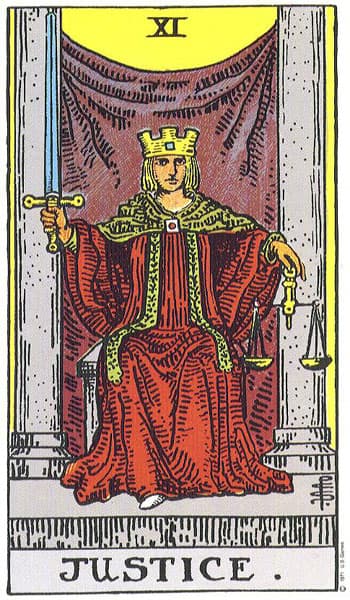
Justice Tarot Card Meaning
צדק
- truth
- fairness
- integrity
- responsibility
- discernment
- decision
- proportion
- clarity
- evidence
- judgment
- criteria
- context
- checking assumptions
- reciprocity
- transparency
- consent
- commitment
- boundaries
- shared responsibility
- repair
- implementation
- keeping promises
- settling an open matter
- law
- contract
- ruling
- review
- evaluation
- rules
- rights and duties
- Libra
- Lamed
- precision
- adjustment
- severity and harmony
- opposites in relationship
- self-righteousness
- judgmentalness
- scorekeeping
- harshness
- bias
- denial
- evasion
- missing information
- a deferred decision
- an ongoing process
- an unclear stance
- medium
weeks to months
By Libra
Only when asked whenTiming questions only; pace may depend on information, agreement or a decision. Do not infer a legal date or outcome.
Timeweeks to months
By Libra
Only when asked whenTiming questions only; pace may depend on information, agreement or a decision. Do not infer a legal date or outcome.
Card Facts
ל = Lamed · Simple letter = Libra — so the path of Justice runs from Gevurah to Tiferet.
On the Tree of Life
Gevurah to Tiferet
Path 22 of the 32 paths of wisdom
The letter Lamed — simple letter
How the card sits on the treeThe Justice tarot card stands for truth, fairness and integrity.
Justice asks for a clear view of the situation, a weighing of what is known, acknowledgement of responsibility and a decision that can be upheld. It connects action with consequences, rights with duties and truth with a decision. An arrangement, agreement or division of responsibility may need repair; a boundary may need recognition and a choice. The scales examine and compare; the sword distinguishes, decides and implements. Weighing without a decision can become postponement. Deciding without weighing can become rash judgment. Fairness is not always an equal split, and hearing two sides does not require giving them equal weight. Circumstances, needs, power, agreements and responsibility can differ. Justice neither requires compromise at any cost nor guarantees that institutions or life will be fair.
Message
Sometimes a little clarity begins with separating what happened from the story we tell about it. Justice invites a look at an agreement, a decision or a boundary that may need attention today. You do not have to resolve everything at once. Let the facts have a place alongside feelings, and consider what would be fair in the circumstances.
The light in the card
Willingness to consider inconvenient facts; discernment, a decision that is not arbitrary, fair treatment, reliability and accountability. An agreement, review or competent authority can be relevant when the question already concerns it. Upright Justice is not proof of a person's honesty.
The shadow in the card
Bias, scorekeeping, harsh judgment and avoiding responsibility can narrow the view. A wish to decide may be blocked by missing information, agreement or conditions for implementation, or by fear of being unfair or appearing mistaken. In excess, relationships become a courtroom: every gesture is tallied, every mistake proves character, and flexibility becomes weakness. Self-righteousness replaces curiosity and compassion and context disappear in the name of truth. Avoidance can also prevent accepting consequences.
Psychological layer
Responsibility without total blame Consider what was within a person's control, what was chosen and what can change. Responsibility for a particular action differs from declaring oneself a bad person; responsibility for one's response is not responsibility for harm done by someone else. Conscience and the inner judge Conscience can reveal a gap between values and conduct. A harsh inner judge turns every mistake into a verdict on identity. Does this voice suggest a possible repair or demand endless punishment? Guilt and shame Discomfort about an action can be distinguished from global shame about oneself. What happened, what harm followed, and what would count as repair? This is reflection, not a diagnosis. Fact, interpretation and hypothesis Reported information, inference and the story built around it are different. Evidence may not support a conclusion, or may support only a limited decision. Known and unknown can be distinguished even without certainty. Bias and double standards People may seek confirmation for an existing view, excuse themselves while judging others, or do the opposite. Would the same criterion apply if the people exchanged places? Intuition and explanations after the fact Moral judgments can begin as quick reactions and acquire reasons later. A feeling need not be suppressed; examine its evidence and what it reveals about values, fears or memories. Intention and effect A good intention does not erase harm, and a difficult outcome does not prove a bad intention. A fair assessment can hold both and consider what is needed now. Decisions and fear of error Waiting for information can be careful or a way of avoiding a choice. Possible error does not eliminate the need to decide. Distinguish uncertainty that can be reduced from a demand for impossible certainty. Boundaries and separation The sword can distinguish wishes, roles and responsibility. A boundary need not be punishment. A valued bond may need a different form or agreement. Repair instead of an endless trial Acknowledging error can lead to practical repair appropriate to the harm and available capacity, without self-punishment. Forgiveness, reconciliation and rebuilding trust are separate processes and need not happen together. Social justice and belief in a just world Wanting the world to be fair can encourage blaming someone who was harmed. The card does not justify that conclusion: discrimination, unequal power, chance and institutional failure may matter. Injustice does not prove lack of worth, and karma is not permission to blame victims. Inner reflection may examine values and correct self-judgment. In an upright-only deck, position and companions can reveal the challenging expression; reversal is not automatically bad and an upright card is no certificate of integrity.
Personal growth
Examine values against conduct, decide on a sufficient basis without total certainty, and acknowledge a mistake in ways that make repair possible. Learning from consequences need not turn a particular act into a verdict on a person. Boundaries and compassion can coexist, and new information can change a stance.
Love & relationships
What is being examined Consider what was agreed, given, received, said and left unclear. Feeling does not resolve the division of responsibility, while fairness need not become an exact account of every gesture. A new connection Someone may cautiously assess compatibility, intentions and differences before declaring commitment. Deliberate restraint is possible, but the card alone proves neither interest, attraction nor emotional coldness. Look at conduct as well as words. Expectations and defining the relationship Exclusivity, availability, pace, commitment and boundaries are not automatically shared. A private expectation can differ from a mutual agreement. Do both people understand what was promised? Reciprocity and shared load Money, time, tasks, initiative, emotional support and the quiet work of planning and remembering may be uneven. Fairness need not mean half each: illness, children, work hours and resources can justify changing arrangements that are understood, agreed and revisable. Formal commitment Marriage, a relationship agreement, shared housing or financial planning fit when already part of the question. Justice promises no wedding, and official status does not prove stability. Feelings Respect, appreciation, fairness or thinking feelings through before acting are possibilities. So are distance, continual assessment or preoccupation with being right. Feeling, stance and decision differ; the card gives no direct access to another person's inner life. Intentions and conduct Declarations need follow-through. Wanting a relationship differs from being able to sustain it; clear agreements and keeping them matter beyond persuasive wording. Conflict and keeping score Separate the present event from accumulated grievances. A conversation aimed only at proving guilt can lose room for feelings and solutions. Blame need not be split equally when responsibility for a particular harm is asymmetric. Trust, harm and repair Truth, acknowledgement and repair can be constructive; denial or using details to evade the whole picture can be challenging. The card alone does not establish infidelity. After harm, consider apology, restitution, changed behaviour and what could rebuild trust. Reconciliation is not required to be fair. Separation and divorce An unsuitable relationship may need recognition, obligations may need settlement, or the bond may need a new definition. The sword is not an instruction to leave; children, property and legal questions depend on reality. Reconnecting Ask what has changed and what would be different. A promise to return is not evidence of repair; terms for returning or an unresolved decision may matter. Power, distance and circumstances Unequal power, financial dependence, distance or administrative constraints can affect fairness. The card does not reveal them, but known differences in capacity deserve weight.
Career
Role, contract and expectations Clarify responsibilities, conditions and limits. The official role and actual work may differ, as may a spoken promise, written policy and daily conduct. Hiring and promotion Evaluation, selection and criteria may matter. A structured process or understanding how decisions are made can be relevant; there is no promise of a job, promotion or unbiased process. Compensation and recognition Pay, benefits, credit and advancement can be assessed against contribution and agreements. Contribution is not only hours or numbers; work enabling others can remain invisible. Workload and boundaries Distinguish professional commitment from routinely carrying others' work. Clarifying authority, availability and priorities can be responsible rather than disloyal. Feedback and performance reviews Useful feedback separates changeable conduct from a verdict on a person. Are criteria known, facts heard and opportunities to respond or improve available? A consistent metric is not necessarily a suitable one. Managers and colleagues Transparency, reliability and credit may matter. Favouritism, gossip, blame and rules that change by person are possible challenges. Facts can help without automatically resolving unequal power. Leadership Fair authority explains decisions and accepts responsibility. Distinguish a mistake, a process failure and deliberate misconduct. Searching for a culprit, disproportionate severity and hiding behind policy avoid judgment. Owning a mistake and making repair can be constructive. Professional ethics Conflicts of interest, confidentiality, copyright, transparency to clients and honest reporting fit relevant questions. Legality is one consideration alongside impact and fairness. The card alone proves no offence. Negotiation and partnership Seek an agreement that can be kept, clear authority and a workable sharing of risk and reward. The midpoint between demands need not be fair; the structure may need to change rather than both parties conceding equally. Changing work or leaving A gap between values and the workplace, or an orderly transition, may matter. The card does not command resignation; meaning, income, obligations and real options deserve consideration without unlimited loyalty. Independent work Price, scope, client expectations, responsibility and cancellation terms embody the relationship between two parties. Ambiguity rather than bad intention may create difficulty. Distinguish generosity from unlimited availability. Symbolic occupations Law, mediation, audit, compliance, regulation, HR, policy, data evaluation and editing can express these qualities. They do not identify a person's profession or suitability.
Money & security
Consider income and spending, risk and return, debt and entitlement. Shared payments, property division, inheritance, insurance, taxes or long-term obligations fit when actually asked about. What was agreed, documented, remains unknown, and who bears the cost? A feeling of entitlement does not replace facts or actual eligibility. Distinguish emotional value, price and contractual standing. Promised versus paid, an unsettled debt, outdated expense sharing and under-pricing one's work are possible examples, not predictions of gain or loss. In legal questions, decisions, evidence, formal processes and authority can be relevant, as can the gap between legality and felt justice. A pending decision may be an unfinished process. Do not infer a date, compensation or victory; practical choices depend on documents and relevant professional information.
Family
Family Roles and habits may seem natural without being agreed. Consider who cares, decides and has freedom to choose. Sibling arrangements, caring for a relative and property need context rather than being inferred from the card. Parenting Consistency can provide security while different children need different responses. Fairness includes explanation, listening and proportion. Distinguish boundaries from scorekeeping and age-appropriate responsibility from adult responsibility. Friendship Reliability, reciprocity, promises and room to name discomfort can matter. Availability need not be identical in every period. Measuring loyalty, unspoken tests and a bond based on debt can be challenging.
Spirituality
Justice can symbolize freedom in relation to consequences: choice does not happen in a vacuum. Intention, action and influence deserve attention, as do alignment between values and life, willingness to see truth and holding tension between opposites. Karma is not a synonym for every kind of cause and effect; its meanings differ between traditions. Even within karmic traditions, experience need not arise exclusively from past actions. Do not infer that someone chose a disaster, deserved suffering, or will receive cosmic revenge. Moral justice and cosmic balance differ. Thoth emphasizes precision of relationships; the Rider–Waite–Smith tradition also distinguishes moral recompense from the mystery of providence. Reflection on responsibility does not require deciding theology. Learning, self-examination and repair can deepen the message. Spirituality should not bypass pain, responsibility or material conditions. Everything being balanced is not a sufficient response to injustice needing recognition or change.
Mythic parallel
These are symbolic parallels, not proof of tarot's ancient origin. Ma'at represents Egyptian truth, cosmic order and right relationship: the heart is weighed against her feather or figure; Anubis weighs and Thoth records, with Osiris and other judges also playing roles. Themis represents divine order, custom and law; Dike concerns justice between people and the gap between a proper order and conduct. Something legal can still be unfair. Astraea evokes justice, purity and departure from a corrupted world. Some genealogies make her a daughter of Zeus and Themis, others of Astraeus and Eos. Sometimes identified with Dike, she is the last to leave Earth and associated with Virgo. Virgo's proximity to Libra does not replace the Hermetic Libra attribution. Roman Justitia expresses justice as virtue and authority through sword and scales. Michael's Christian soul-weighing imagery is a possible iconographic parallel, not an established identification of the tarot figure. Nemesis adds measure and response to excess and hubris, not simply revenge. Jewish demands for honest scales, impartial judgment and justice joined with kindness enrich moral reflection without constituting an explicit tarot system. Distributive justice concerns the allocation of goods and standing; corrective justice concerns repairing harm or an unbalanced transaction. A particular case can need consideration that a general rule cannot supply. These philosophical tools do not imply that ancient philosophy discussed tarot.
Symbols and their relationships
Rider–Waite–Smith: the seated figure's direct gaze and stable posture can express presence, accountability and facing the question. Open eyes emphasize attention rather than knowing every fact. The left-hand scales weigh evidence, needs, rights, duties and consequences. The upright sword in the figure's right hand, on the viewer's left, brings clarity, decision, a boundary, separation or authority. Its two edges suggest that a decision also binds its maker and affects others. The square in the crown can suggest ordered thought and a guiding principle. The red robe can express willingness to implement a decision; the green garment can suggest life, growth and Venus's relational dimension. Two pillars frame structure, two sides and a threshold between knowledge and decision. The purple curtain can suggest what remains unrevealed: judgment does not eliminate mystery. The white shoe may suggest moving from sitting to action, an optional reading rather than a fixed meaning. The figure need not be a particular woman or imply compulsory gender traits. This image contains no sphinxes, reins or blindfold; other decks' symbols are not hidden Rider–Waite–Smith details.
Place in the arcana sequence
In Rider–Waite–Smith, Justice XI stands between the Wheel of Fortune X and the Hanged Man XII. Changing circumstances outside control are followed by the question of what remains within choice and responsibility. After weighing and deciding, the Hanged Man can offer another perspective; a decision is not necessarily the final word. In a three-by-seven arrangement, Justice can be a balancing point between acquired knowledge and responsibility to apply it, inner and outer life, past and future. This is an interpretive model, not a required sequence of events. The Lovers share choice, values and commitment but emphasize desire and fit; Justice also weighs agreements and consequences. Temperance combines and regulates; Justice distinguishes and may separate. The Chariot gathers forces toward movement; Justice examines the direction and means. Strength works patiently with impulses; Justice works through discernment and boundaries. The High Priestess shares pillars and a threshold but stays with mystery; Justice asks what can be established and applied. The Emperor stabilizes order; Justice assesses fairness. The Hierophant supplies tradition and shared values; Justice can examine them. The Wheel emphasizes circumstances and change; Justice examines responsibility within them. Judgement invites awakening and reassessment; Justice emphasizes weighing and proportion. The King of Swords can indicate a style or relevant role; Justice a broader principle or process. The Lovers–Justice–Temperance axis asks what is chosen and by which values, what follows and is fair, then how differences can be lived with. Justice can clarify a boundary that Temperance needs for healthy integration; Temperance can soften a distinction made too rigid. Connection need not erase differences, and decision need not end a bond.
Intimacy and sexuality
When intimacy or sexuality is actually the topic, consider freely given consent, mutual desire and room to say yes or no. Body judgment, performance measurement or a sense of obligation may be challenging expressions. The esoteric Lamed/intercourse association is an optional layer, not a default sexual reading. Do not infer attraction, compatibility, fidelity, preferences or conduct from the card.
Early imagery and historical context
Justice appeared as a European moral virtue before tarot's later esoteric systems. The four cardinal virtues are justice, temperance, fortitude and prudence; the first three have named cards, while identifying prudence with Justice, the World or another card is interpretive rather than a single agreed tradition. Social order, authority, law and a ruler's duty to judge appropriately can matter historically. The image proves no Egyptian origin or continuous secret teaching from antiquity; astrological and Kabbalistic correspondences developed later. The mid-fifteenth-century Visconti–Sforza Justice shows a seated woman with scales and sword in a Gothic architectural frame, with a young armored rider on a white horse above. The rider may represent the force implementing a judgment. A Milanese political reading links the image to Sforza legitimacy; religious parallels with a righteous rider or heavenly authority have also been proposed. These are possibilities, not certain artistic intention. The original cards were unnumbered; the modern label 08 Justice proves no printed VIII, and orders varied by place and deck. Outlines behind Justice in early French decks such as Rolichon and Dodal, Marseille type I, have been read as wings. The eighteenth-century de Hautot makes an angelic appearance more prominent; conventional type II Marseille has no wings, and other nonstandard decks also have winged variants. Wings permit a reading beyond human authority without making every Justice an angel. The Budapest deck has been associated with Michael and soul-weighing as a possible iconographic interpretation; this does not rename the figure Michael or Gabriel in every deck. Many historical and Rider–Waite–Smith figures have open eyes. A blindfold was not a constant part of European Justice from the beginning. Open eyes invite attention to circumstances, not an assumption that all facts are known.
Numbering and optional numerology
Marseille places Justice VIII and Strength XI; Rider–Waite–Smith exchanges them, aligning Golden Dawn astrological ordering so Leo/Strength precedes Libra/Justice. The deck appeared in 1909 and its companion book in 1910. Thoth returns Justice/Adjustment to VIII without adopting all Marseille correspondences, retaining Lamed and Libra. Eight may be read as two structures of four, stability meeting stability or a cycle of action and consequence. A rotated eight resembling infinity is a later analogy, not a proven historical explanation. Eleven may suggest two units in relation, is sometimes called a master number in modern numerology, and 1+1=2 can invite a High Priestess connection as an optional layer. XI is the middle of the 21 numbered trumps when the Fool is excluded, not the middle of all 78 cards or a 22-card sequence including the Fool. Some traditions pair 8 and 11 as Justice and Strength and use their sum 19 for further reflection; this is not a binding reading rule. These are symbolic models, not dates.
Moral justice and spiritual mystery
In the Rider–Waite–Smith tradition the figure preserves conventional symbolism. The pillars recall the High Priestess without equating what lies behind them. Moral recompense by deeds differs from spiritual election or providence: gifts and talents do not necessarily follow a simple ledger of merit. This theological distinction does not justify every inequality. Historical upright lists name equity, integrity, justice, applied authority and the deserving side prevailing in law; reversed lists include law and legal complications, bias, fanaticism and excessive severity. Preserve these as historical vocabulary, never a guarantee of a real ruling.
Thoth Adjustment
Thoth distinguishes moral justice from precision in nature. Adjustment emphasizes right relationship and continuing correction rather than a tribunal of rewards and punishments. Apparent stability can need tiny movements. The narrow balanced figure is associated with Ma'at, standing on tiptoe with feathers, a serpent crown and mask; both hands hold a downward sword. Alpha and Omega on the scales suggest poles; geometrical forms, chair, spheres and pyramids emphasize law, limit and parts within a whole. These are Thoth details, not Rider–Waite–Smith imagery. Lamed as an ox-goad directs Aleph, the ox of Fool symbolism; AL, value 31, is significant in the Thelemic system. The Fool connection and sexual sword symbolism are particular esoteric layers and say nothing about a person's sexuality. Precision, equilibrium, compensation between forces and a pending decision contrast fairness with self-righteousness. Homeostasis can explain continuing regulation as a metaphor, not a medical message. The proposed ad/iuxta explanation of the name, relation, joining and yoking is an interpretive suggestion, not a required linguistic basis.
Contemporary interpretive perspectives
A balancing point in a three-by-seven journey can emphasize responsibility for acquired knowledge, relationships between inner and outer life and past and future; it does not exhaust the social dimension. Partnership and marriage can express the relation between forces beyond legal procedure. Truth asks for dropping comforting illusions: preference does not change the weight. Personal involvement, decisions and consequences can be examined without assigning every event to the person. Modern guidance can combine truth, fairness and clear agreements with examination of harshness, bias and evasion. Social readings ask who defines the rules, who is heard and who bears the cost; legality, neutrality and justice differ. Authenticity, removing masks and separating from what does not fit can be relevant to work or relationships without an automatic instruction to resign or divorce. One optional distinction views Marseille as institutional justice, Rider–Waite–Smith as spiritual justice and Thoth as embodied balance. It is not an exclusive definition: Rider–Waite–Smith also distinguishes moral justice and providence. These practical interpretations are a synthesis, not an agreed psychological or therapeutic theory.
Community and social conditions
Rights, accessibility, resource distribution and the ability to be heard can be relevant when the question concerns society. A uniform rule can affect people differently. Personal responsibility can coexist with institutional and structural responsibility; a conflict need not involve parties of equal power.
Body, wellbeing and habits
When wellbeing or habits are actually the topic, consider effort and rest, needs and obligations or judgment of the body. Traditional astrology links Libra with bodily regions including kidneys and the lower back; these do not diagnose, predict illness or establish physical conditions. Small actions have cumulative effects. A rule may serve life or become a test of personal worth. Useful consistency does not require rigidity, and balance can change across life periods.
Learning and creative work
When study or creation is relevant, consider assessment criteria, academic integrity, information checking and feedback. A mistake can point to learning without deciding whether someone is capable; no grade or exam success is promised. Editing, precision, the relationship between parts and deciding what to keep or cut can serve creation. Criticism may also stop work when applied too early. Consider personal taste, external requirements and the creative voice. Precision and flexibility can have different proportions at different stages.
How to use the additional material
Choose the meaning relevant to the original question, spread role, known situation and cards actually drawn. Companion guidance applies to co-occurrence anywhere in the spread, not necessarily adjacency or chronology. Treat it as conditional emphasis, not evidence of an event, trait or intention. Distinguish depicted detail, a tradition's correspondence and a contemporary interpretation. Historical and alternative-deck details are reference material; do not import them into Rider–Waite–Smith imagery. Sexual material is relevant only when intimacy is raised; legal material only when the question concerns law, without predicting a verdict. Health parallels never establish a condition. Do not turn upright into proof of honesty, reversal into proof of lying, or suffering into deserved punishment. Choose at most one relevant reflection question across a reading after answering, without assuming infidelity, guilt, trauma or a legal case. Invite reflection rather than prescribe an exercise. Keep a humane tone when a boundary or decision is needed.
Astrology, Qabalah and number
Golden Dawn/Hermetic: Libra, cardinal Air; Lamed, the twelfth letter with value 30; path 22 from Geburah (severity and boundary) to Tiphareth (beauty and harmony). Card number XI, letter value 30 and path number 22 are distinct. Venus rules Libra, and Saturn is exalted there; neither is a direct planetary assignment for Justice. The esoteric title is Daughter of the Lords of Truth, Ruler of the Balance. Use Rider–Waite–Smith as the base tradition; its Strength is VIII. Marseille Justice is VIII, but not every historical deck originally printed that number. Thoth Adjustment is VIII while retaining Lamed/Libra. A number alone does not determine the letter or sign system. Lamed relates to learning and teaching and to an ox-goad; its shape rises above the line and can symbolize aspiration, guidance and correction. Its alphabetical position does not make this card XII. The Hermetic Geburah–Tiphareth path can be read as bringing context and proportion to a boundary. Compassion without distinction can blur responsibility; severity without relation can become cruelty. Justice is not identical to Geburah. Tarot/path assignments are a later Hermetic tradition, not a claim that Sefer Yetzirah describes Justice. Lamed is among the twelve simple letters, linked in the editions considered to Libra and Tishrei. Human functions and bodily correspondences vary: action/work in some tables, intercourse in others. A modern illustrative appendix to chapter five of an English Hermetic edition also assigns sexual desire; the edition itself marks this detailed table as modern rather than present in that form in its ancient copies. Examine the edition and textual layer rather than imposing one table on every manuscript or dividing all Jewish and Hermetic versions into two fixed camps. Tishrei, Rosh Hashanah and Yom Kippur can enrich self-examination, judgment and repair. This is a symbolic relation: lunar Tishrei does not match the solar Libra dates exactly every year. Intercourse can enrich reflection on consent and relationship only in an appropriate question, not establish preferences or behaviour. The separate companion text Thirty-Two Paths of Wisdom calls path 22 the Faithful Intelligence, associated in a Hermetic translation with increasing spiritual powers and broad influence on Earth's inhabitants. It is not a sentence from the body of Sefer Yetzirah; the tarot link comes through the Hermetic path system. Alternative Hermetic schemes assign Justice VIII to Cheth and Cancer; another astrological scheme assigns Scorpio. Marseille does not universally mean Cheth: a deck alone does not define a single Kabbalistic system. Keep alternatives distinct. Crown chakra and clear quartz are possible modern associations rather than compulsory classical correspondences. Use this material for symbolic or spiritual relevance, not facts about a person or a date.
Reversed meaning
For a reversed draw only: bias, unfairness, partial information, denial, hiding behind technicalities, rash judgment or excessive severity. Someone may avoid responsibility or carry responsibility that is not theirs. Context distinguishes their conduct, an unfair environment and painful self-judgment. Reversal is not proof of lying; do not apply a reversed meaning to an upright draw.
Yes or no
Some methods lean toward yes if the matter is fair and handled honestly, but this is not universal. The decision may be pending or conditions unclear, and the question may need discernment rather than confirmation. The stored lean remains 3 out of 5, a lesson or condition; derive any condition from the actual question and spread. Upright Justice never promises a legal win.
Connections with other cards
Possible readings depend on the question and the cards' actual positions.
| Card | Possible connection |
|---|---|
| King of Cups | Feeling and discernment can share a decision. Restraint may hide a stance, or pleasing others may undermine a boundary. Interpret through the question and both fixed positions; co-occurrence is not a chronology or evidence of an event. |
| Two of Cups | Reciprocity and agreement between two people. Emotional closeness and the terms of the relationship may differ. Interpret through the question and both fixed positions; co-occurrence is not a chronology or evidence of an event. |
| Three of Cups | Fairness in a group, support and transparent relationships. Group expectations, sides in a dispute or unclear boundaries may matter; do not infer a third party or infidelity. Interpret through the question and both fixed positions; co-occurrence is not a chronology or evidence of an event. |
| Five of Cups | Acknowledge loss without global blame. Focus may be narrowed to cost or deciding who is at fault. Interpret through the question and both fixed positions; co-occurrence is not a chronology or evidence of an event. |
| Six of Cups | Examine old agreements and habits. Loyalty to an old story or a debt not currently agreed may matter. Interpret through the question and both fixed positions; co-occurrence is not a chronology or evidence of an event. |
| Eight of Cups | Leaving while recognizing needs and commitments. Consider withdrawal before clarification or difficulty accepting a right to change direction. Interpret through the question and both fixed positions; co-occurrence is not a chronology or evidence of an event. |
| The Fool | Freedom with responsibility; a new start with clear agreements. Consider a step made before checking consequences, or fear limiting every beginning. Interpret through the question and both fixed positions; co-occurrence is not a chronology or evidence of an event. |
| Wheel of Fortune | Examining consequences and making fair arrangements within change; do not frame every rise or fall as what a person deserves. With Justice: changed needs or an internal shift may call for a practical decision and a revised agreement; an unsuitable arrangement can end without proving anyone is a bad person. Recognize consequences and opportunities for repair within change. Do not assign every event to what someone deserves or ignore circumstances; separate chance from choice. Interpret through the question and both fixed positions; co-occurrence is not a chronology or evidence of an event. Do not blame someone for what was outside their control or abandon what remains within choice. With Wheel of Fortune: changed internal needs or boundaries may call for external change and a revised arrangement; what suited an earlier stage need not continue without review. |
| Wheel of Fortune + Four of Swords | With Wheel of Fortune, Four of Swords and Justice, where an arrangement is reported as burdensome, explore a shared theme: changed internal needs; a suspended decision and outward quiet despite inner difficulty; and giving the change practical expression through a decision. Healthy rest and reflection remain alternatives. Do not invent mental states or another person's intentions. Respect spread roles; this is not necessarily a timeline and does not require adjacency. |
| The Hanged Man | Consider a new viewpoint before deciding. There may be suspension, a one-sided concession or a decision that cannot yet be implemented. Interpret through the question and both fixed positions; co-occurrence is not a chronology or evidence of an event. What would allow a decision to be implemented and which obligations constrain it; predict no legal result. |
| Death | A clear ending, changed commitment or orderly transition. Consider rash cutting or recognition of an ending already described; never infer physical death. Interpret through the question and both fixed positions; co-occurrence is not a chronology or evidence of an event. |
| Temperance | A flexible, proportionate arrangement and integration after differences become clear. Compromise may blur a boundary, or agreement may remain awaited. Interpret through the question and both fixed positions; co-occurrence is not a chronology or evidence of an event. Emotional adjustment together with clear agreements, responsibility and boundaries. |
| The Devil | Recognize dependence, unequal power or a burdensome commitment when the context supports it. Coercion, scorekeeping or an agreement restricting freedom are possibilities to examine, not diagnoses or accusations. Interpret through the question and both fixed positions; co-occurrence is not a chronology or evidence of an event. |
| The Tower | Reassess a framework that failed; truth may have consequences. Consider a decision made in shock, without treating the pair as proof of a particular revealed secret. Interpret through the question and both fixed positions; co-occurrence is not a chronology or evidence of an event. A crisis meets agreements, rights, responsibility or legal arrangements; examining what holds after change, without predicting a court ruling. |
| The Star | Repair can make room for trust and hope. Hope alone does not settle what remains unclear. Interpret through the question and both fixed positions; co-occurrence is not a chronology or evidence of an event. |
| The Moon | Acknowledge what is unknown and check assumptions. Fear, uncertainty or judgment based on unsupported information may matter; no deception is proved. Interpret through the question and both fixed positions; co-occurrence is not a chronology or evidence of an event. |
| The Sun | Transparency and clarity can support a decision. Certainty may still leave out inconvenient facts. Interpret through the question and both fixed positions; co-occurrence is not a chronology or evidence of an event. Facts and accountability gain clarity; no legal outcome or cosmic settlement is guaranteed. |
| The High Priestess | Inner knowing with checking information. Missing information may call for distinguishing a feeling from evidence. Interpret through the question and both fixed positions; co-occurrence is not a chronology or evidence of an event. |
| Judgement | Reassessment and a decision that takes the past into account. A harsh inner trial may be present; a formal judgment is relevant only to a legal question and its outcome is not predicted. Interpret through the question and both fixed positions; co-occurrence is not a chronology or evidence of an event. |
| The World | Completing a process and settling commitments. Consider a wish to finish before all parts have been addressed. Interpret through the question and both fixed positions; co-occurrence is not a chronology or evidence of an event. |
| The Empress | Fair treatment of needs, care and contributions that resist measurement. Giving may have become an obligation, or harsh judgment may need softening. Interpret through the question and both fixed positions; co-occurrence is not a chronology or evidence of an event. |
| The Emperor | Accountable authority and explainable rules. Consider rigid law, control or assuming that authority guarantees fairness. Interpret through the question and both fixed positions; co-occurrence is not a chronology or evidence of an event. |
| The Hierophant | Examine values and commitments within a framework. Consider obedience to a norm without checking whom it benefits. Interpret through the question and both fixed positions; co-occurrence is not a chronology or evidence of an event. |
| The Lovers | A committed choice, relationship agreement or alignment between values and conduct. A declared choice may lack implementation; no wedding is promised. Interpret through the question and both fixed positions; co-occurrence is not a chronology or evidence of an event. Honesty, agreements and consequences; fairness versus scorekeeping, without a legal prediction. |
| The Chariot | Progress after clarifying direction and responsibility. A wish to win may replace discernment or proportion. Interpret through the question and both fixed positions; co-occurrence is not a chronology or evidence of an event. |
| Strength | A firm boundary without forcefulness. Self-righteousness and the urge to dominate may feed each other in an argument. Interpret through the question and both fixed positions; co-occurrence is not a chronology or evidence of an event. |
| The Hermit | Time for inner inquiry and an independent decision. Perfection-seeking or withdrawal may prevent a choice. Interpret through the question and both fixed positions; co-occurrence is not a chronology or evidence of an event. |
| Ten of Pentacles | Arrange long-term responsibility and property. Family or institutional rules may narrow choice; inheritance is relevant only in an appropriate question. Interpret through the question and both fixed positions; co-occurrence is not a chronology or evidence of an event. |
| Knight of Pentacles | Effort meets agreements and fairness; promise neither financial nor legal reward. |
| Two of Pentacles | Practical sharing of time, money and responsibility. Continual balancing may conceal an unfair load. Interpret through the question and both fixed positions; co-occurrence is not a chronology or evidence of an event. |
| Three of Pentacles | Cooperation, credit and professional criteria. Responsibility may be unclear or a contribution unrecognized. Interpret through the question and both fixed positions; co-occurrence is not a chronology or evidence of an event. |
| Four of Pentacles | A financial boundary and clearer ownership. Holding on, dependence or scorekeeping may arise from fear of loss. Interpret through the question and both fixed positions; co-occurrence is not a chronology or evidence of an event. |
| Five of Pentacles | Examine access to support and the fairness of a framework. Exclusion or blaming someone for hardship may need recognition. Interpret through the question and both fixed positions; co-occurrence is not a chronology or evidence of an event. |
| Six of Pentacles | Giving and receiving with awareness of power and conditions. Help may become debt, control or dependence; distribution should be fair and transparent. Interpret through the question and both fixed positions; co-occurrence is not a chronology or evidence of an event. With Justice, the scales in the merchant's hand take on the weight of fairness. Emphasis: whether the distribution serves a fair and transparent order, not only how much is given. |
| Seven of Pentacles | Assess results against effort and time. A return may be awaited without agreed criteria; no financial outcome is promised. Interpret through the question and both fixed positions; co-occurrence is not a chronology or evidence of an event. |
| Eight of Pentacles | Fair evaluation of work, skill and consistency. Narrow measurement or effort turned into a test of worth may matter. Interpret through the question and both fixed positions; co-occurrence is not a chronology or evidence of an event. |
| Ace of Swords | State a truth or principle that supports deciding. Clarity can become cutting without context or sensitivity. Interpret through the question and both fixed positions; co-occurrence is not a chronology or evidence of an event. |
| Knight of Swords | Sharpness meets fairness and responsibility to evidence; predict neither legal outcome nor procedural speed. |
| Queen of Swords | A reasoned boundary and direct conversation. Consider judgmentalness, coldness or cutting too soon. Interpret through the question and both fixed positions; co-occurrence is not a chronology or evidence of an event. |
| King of Swords | A professional decision, clear criterion or relevant authority. Rationalization or detached wording can be mistaken for objectivity; no legal outcome is predicted. Interpret through the question and both fixed positions; co-occurrence is not a chronology or evidence of an event. With Justice, two cards of judgement reinforce each other, and they are easily read as a verdict. Emphasis: facts, fairness and transparency in the process, not a prediction of a ruling or a formal outcome. |
| Two of Swords | Recognize the choice and information needed. Consider impasse, avoidance or treating unequal options as equal; honest examination should enable deciding rather than endless postponement. Interpret through the question and both fixed positions; co-occurrence is not a chronology or evidence of an event. With Justice, the Two of Swords' weighing meets scales that are meant to move. Emphasis: an honest look at the facts can make a decision possible, and a pan left hanging in the air forever is not justice but only suspension. |
| Three of Swords | Acknowledge pain and what needs repair. Consider judgment made from hurt or truth delivered painfully. Interpret through the question and both fixed positions; co-occurrence is not a chronology or evidence of an event. |
| Four of Swords | With Four of Swords: outward quiet may coexist with reported inner difficulty and avoidance of a decision. Explore whether the pause brings clarity or prolongs a burdensome arrangement; the sword may signify a considered decision to change or end it rather than punishment. With Justice: tension between suspending a decision and the need to weigh and decide. Ending an arrangement may feel difficult despite its internal cost; clarity can honour needs without making the cards an automatic instruction to end it. |
| Five of Swords | Examine the cost of a struggle and reduce escalation. Winning may leave harm; consider whether being right is worth the cost to the relationship. Interpret through the question and both fixed positions; co-occurrence is not a chronology or evidence of an event. With Justice, fairness meets a struggle over who is right. Emphasis: technical rightness is not enough when it hides cruelty, and a fair decision holds the relationship too, not only the win in the argument. |
| Six of Swords | An orderly transition after clarification. An unresolved matter may be carried into the next stage. Interpret through the question and both fixed positions; co-occurrence is not a chronology or evidence of an event. |
| Seven of Swords | Distinguish privacy, strategy and concealment. Partial information or evasion may merit examination, but the pair does not establish fraud. Interpret through the question and both fixed positions; co-occurrence is not a chronology or evidence of an event. With Justice, the card's ethical question sharpens: not everything clever is honest. Emphasis: check whether what was done could be fully revealed and explained simply, without becoming defensive. |
| Eight of Swords | Separate an actual restriction from an assumption. A belief that there is no choice, or fear of consequences, may immobilize. Interpret through the question and both fixed positions; co-occurrence is not a chronology or evidence of an event. |
| Nine of Swords | Clarify responsibility and reduce self-judgment. Guilt, regret or a frightening scenario are not established facts. Interpret through the question and both fixed positions; co-occurrence is not a chronology or evidence of an event. |
| Ten of Wands | Redistribute load and authority. Someone may be carrying more than their share or an obligation that cannot be revised. Interpret through the question and both fixed positions; co-occurrence is not a chronology or evidence of an event. |
| The Magician | Conscious use of skill and influence. Consider a gap between persuasive wording and facts or conduct. Interpret through the question and both fixed positions; co-occurrence is not a chronology or evidence of an event. |
Meaning by spread position
| Position | Possible meaning |
|---|---|
| Central message | Clarity, fairness and a decision that can be upheld responsibly. |
| Present situation | Assessment, review, arrangement or a need to define a stance. |
| Challenge | Bias, excessive severity, missing information or fear of deciding. A challenge is not an automatic reversal. |
| Root | An earlier agreement, rule, decision or unequal division of responsibility may underlie the situation; do not invent personal history. |
| Past | An earlier decision and its consequences; an unfinished matter may affect the present. |
| Awareness and intention | A wish to do what is right or to justify an existing stance; this describes perception rather than proving facts. |
| Near future | A possibility of clarification or decision, not a legal date or guaranteed event. |
| Self | Discernment, conscience, boundaries or a harsh inner judge. |
| Other person | A cautious stance, need for fairness or evaluative role; no mind-reading or proof of feelings. |
| Environment | An institution, policy, agreement or social expectations may shape the situation. |
| Hopes and fears | A wish for acknowledgement and a fair outcome, or fear of judgment and consequences; neither is an established result. |
| Possible outcome | Arrangement or decision depending on information, actions and conditions; no legal victory is established. |
| Advice | Examine facts, clarify criteria and acknowledge one’s part. Offer the emphasis relevant to the question rather than a list of tasks. |
| Lesson | Distinguish justice from self-righteousness and responsibility from total blame. |
| Potential | More transparent relations or a decision that can be kept, not an outcome already guaranteed. |
| Support | A clear principle, documented agreement, boundary or impartial assessment. |
Questions for reflection
- What is known here, and what still rests on a hypothesis?
- What fact could change the way the situation looks?
- What deserves attention even if it does not fit the conclusion already formed?
- Would the same information receive a different weight from someone else?
- What differs between what was said and what happened?
- What part of the story has not yet been heard?
- Which values can guide the weighing of options?
- Is more information needed, or is deciding the difficulty?
- What makes a decision sufficiently grounded without complete certainty?
- What boundary could clarify the situation?
- Would compromise serve the matter or blur an important difference?
- What would the choice mean in practice?
- What is within personal responsibility, and what belongs to other factors?
- Does this assessment concern a particular act or the whole person's worth?
- What could be repaired without continuing to punish?
- Is the standard applied to oneself similar to that applied to others?
- What differs between intention and actual effect?
- What does responsibility without self-punishment look like?
- What was agreed in the relationship, and what was merely taken for granted?
- What does reciprocity look like when needs and capacities differ?
- What contribution is currently going unrecognized?
- Does clarification bring understanding or return to who is right?
- What would need to change for a promise to be credible?
- Is there clear room in the relationship for desire, consent and boundaries?
- Does actual responsibility match what was defined?
- How is contribution evaluated, and what does that criterion miss?
- How are workload, risk and credit shared?
- What commitment needs clarification?
- Are compensation and expectations understood in the same way by everyone involved?
- What differs between a legal arrangement and one experienced as fair?
- Who can have a voice in the decision, and who has difficulty doing so?
- Does a uniform rule affect different people differently?
- What circumstances matter for understanding responsibility?
- Does the proposal account for unequal power and freedom to choose?
- What calls for a change in relationships, and what for a change in the framework?
- Does the preferred outcome also look fair from another perspective?
- What remains open before moving on is possible?
- What repair fits what happened and what is possible now?
- What differs between closing a matter and erasing pain?
- Is the apology accompanied by visible change?
- What agreement needs updating as circumstances change?
- What could allow a process to end without giving up something essential?
- Does the division of effort leave room for existing needs?
- What rule helps, and what rule has become too rigid?
- Does feedback help learning or mainly provoke self-judgment?
- What can be understood from a mistake without making a global conclusion?
- Does criticism serve the creative work at its current stage?
- What relation between precision and flexibility fits this period?
- Where do values and the way life is lived align?
- Does a spiritual explanation help see the situation or bypass it?
- What differs between recognizing a consequence and saying someone deserves it?
- How can a boundary and compassion be held together?
- What truth could guide without becoming an absolute verdict?
- What asks for adjustment rather than a one-time decision?
Moment for reflection: You may stay with the question: what asks for a clear and fair view here?
The image
In Rider–Waite–Smith, a crowned figure sits on a stone bench between two gray pillars, facing forward with open eyes and no blindfold. An upright sword is in the figure’s right hand and scales in the left. A red robe, green garment with a square clasp, gold crown with a square blue jewel, purple curtain behind and yellow sky above. A white shoe shows below the robe. The image is frontal, symmetrical and still.
Upright seated posture facing the viewer, direct gaze and open eyes; sword in the right hand, scales in the left. Do not infer a particular person’s gender or traits from the pose.