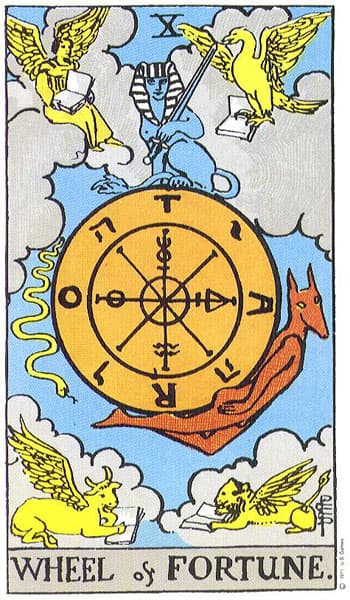
Wheel of Fortune Tarot Card Meaning
גלגל המזל
- change
- turning point
- cycles
- opportunity
- timing
- movement
- chance
- encounter
- changing conditions
- external factors
- new stage
- adaptability
- responsiveness
- initiative
- flexibility
- recognizing an opening
- connections
- patterns
- systems
- consequences
- meaning
- renewal
- relief
- momentum
- trust
- openness
- gratitude
- fatalism
- gambling
- excess
- pride
- instability
- reliance on luck
- loop
- habit
- distance and return
- returning opportunity
- cyclic stage
- unready conditions
- resistance
- missing information
- externally directed process
- readiness
- influence
- inner centre
- reciprocity
- fast
now to weeks
By Jupiter
Only when asked whenOnly in a timing question: distinguish the speed of a turn from the event date and retain the question’s period.
Timenow to weeks
By Jupiter
Only when asked whenOnly in a timing question: distinguish the speed of a turn from the event date and retain the question’s period.
Card Facts
כ = Kaph · Double letter = Jupiter — so the path of Wheel of Fortune runs from Chesed to Netzach.
On the Tree of Life
Chesed to Netzach
Path 21 of the 32 paths of wisdom
The letter Kaph — double letter
How the card sits on the treeThe Wheel of Fortune tarot card stands for change, turning point and cycles.
The Wheel of Fortune points to a turning point, changing conditions, or a pattern returning for review. An opportunity may arise unexpectedly, while its outcome depends on readiness, choices, and circumstances. Notice what is changing, what remains within your influence, and what calls for adaptation. A return to something familiar may repeat a cycle or allow development; consider what is different this time.
Message
Sometimes a small change opens a possibility you hadn’t planned for. The Wheel of Fortune invites you to notice what is shifting today: a conversation, an idea, changed circumstances or something familiar returning. You don’t need to know where it all leads right away. Your experience may help you meet the moment, even when some things are beyond your influence.
The light in the card
Openness, opportunity, renewal, momentum, flexibility, trust and gratitude
The shadow in the card
Fatalism, unexamined repetition, holding on to changed conditions, gambling, excess and overconfidence after success
Psychological layer
Locus of control concerns how people understand the relationship between their actions and results, compared with luck, fate or other people. The Wheel offers a reflective comparison; it does not measure a psychological trait. Feeling influential and having influence in this particular situation are different. Distinguish what can be decided, what can be influenced, and what must be met or responded to. Another person’s choice cannot be controlled by stating a personal position. Acknowledging a limit can coexist with initiative. Responses themselves are affected by stress, emotional capacity and resources; responsibility does not require perfect self-control. Desired outcomes can create an illusion that a nearby action caused them. Repetition and coincidence are not enough to establish causation. Uncertainty can feel exciting and unsettling together: the previous phase can be over before the next becomes clear. Neither anxiety nor excitement establishes what will happen. Natural cycles, workload and stages of a relationship differ from an automatic response repeating an unwanted result. Ask what recurs, under which conditions and what is different this time. Recurrence does not prove a failure to learn. Returning with new understanding can be imagined as a spiral; the spiral is a contemporary metaphor, not the shape depicted on the card. Success and setbacks describe outcomes, not a verdict on personal worth. Timing and help can contribute without cancelling skill. A sound action can meet unsuitable conditions. Financial hardship, discrimination, family circumstances and organizational change need not reflect an inner blockage. Adaptability can change the method while preserving values; it does not require accepting harm or every condition. Momentum may feel alive, while drama can be mistaken for meaning and instability for passion. These are possibilities to explore, not diagnoses. Independent losses do not make a win due, and a winning streak does not guarantee the next result. In less random systems, examine the actual conditions rather than the story of a streak. Synchronicity describes the experience of meaningful coincidence in a framework of connection without ordinary causation. A meaningful encounter does not establish compatibility, intentional signs or a fixed future. Hope can coexist with pain without requiring an immediate lesson or gift from suffering. The centre offers a point of reference in values, needs or relationships as circumstances move. Inner change can affect attention, choices and participation; it does not require external events to obey the mind.
Personal growth
A familiar pattern can return with another response available. Distinguish the influence of habits from an assumption that every event reflects an inner blockage. Greater inner room can change participation even when circumstances do not immediately shift. Flexibility can create choice; waiting for luck to do the work may leave preparation unused. Learn from outcomes by examining several contributors. A success does not prove a method, and a setback does not prove it worthless. Looking over time can be more accurate than a story built from one event. Notice what recurs, what has changed, and which values can guide an updated approach.
Love & relationships
The Wheel of Fortune in relationships may describe an unexpected encounter, a change in status, a new season of an existing bond or a familiar pattern returning. Distinguish changing circumstances, changing feelings and a changing form of relationship: none automatically proves another. Timing is not fully controllable, and the ability to respond depends on real capacity and conditions. For someone seeking a relationship, changed routines or a chance connection may open an encounter. A sense of significance can be meaningful while compatibility still needs to be explored through getting to know each other and observing behaviour. “Destined” does not mean suitable. Two people may want connection while availability, commitments or readiness differ. Excitement and a sense of possibility may be relevant; in another context feelings remain consistent while circumstances change. This card alone cannot reveal another person’s inner life or prove infidelity. Openness to seeing where things lead can be genuine, or a way of postponing a position; the question, observed behaviour and other drawn cards determine which possibility deserves attention. An established relationship can adapt to new work, a move, parenting or changed resources when these are already part of the question. Previous agreements may need updating without implying a crisis. Closeness and distance can vary in healthy relationships; consider whether the partners can reconnect and understand the context. Cycles do not excuse harmful inconsistency. If an on-and-off pattern is already known, examine what changed between rounds, whether choice is mutual and whether behaviour is different. Renewed contact is not the same as rebuilding a stable bond. A theme from the past may return for review, but the Wheel neither promises nor rules out an ex returning. A return that actually occurs needs new conditions, not just familiar feelings. A crisis may involve factors beyond one person, or a phase that cannot continue in the same form. The card does not require a breakup. After a separation, it can describe adaptation and uncertainty without dating the end of pain. A turn can create room for commitment, while marriage, cohabitation and stability still need mutual choice and practical expression. The Lovers, Hierophant or building cards can emphasize that distinction when drawn. When relationship status becomes the sole measure of worth, every change can feel like a complete rise or fall. The centre suggests needs and values that remain available through change. Being single does not establish an inner imbalance, and changing perspective does not guarantee attraction from others.
Career
A professional opening can arise when organizational need, availability and contacts meet. Preparation can make an unexpected opening usable. Luck and favourable timing may play a part, while the deeper task is adaptability. An opening does not guarantee an offer or promotion; skills, time and resources determine readiness. Restructuring, a new manager, a project ending or market changes can alter responsibilities, authority and opportunities. Such changes may be wider than an individual and do not necessarily reflect performance or professional worth. Consider which abilities remain useful and which professional pattern recurs across workplaces. A career change may have direction or may repeat an attempt to solve the same issue by changing surroundings alone; explore this without labelling someone as escaping. Difficulty does not automatically require leaving. Recognition may bring influence, resources and new expectations, alongside pressure, pride or overconfidence. Success still leaves room for learning and listening. When loss of work or downsizing is already known, examine several contributing factors rather than punishment or lack of worth. Experience and connections can remain useful when a role ends. Recurring deadlines, demand and busy seasons can support planning or expose too little recovery time. Cyclic overload does not necessarily resolve itself. In business, changing demand, a new client or a useful introduction may open a path. Reliance on one customer, pursuing every new idea or treating temporary success as a permanent trend can be challenging possibilities. Partnerships need capacity, commitment and clear responsibilities to develop beyond initial enthusiasm; the card does not replace business information. Technological and professional shifts can change which skills matter. Adaptation need not discard all previous experience or start again. In management, distinguish a plan from an assumption and a change of direction from having no direction. Transparency about what is known and uncertain can provide relative stability without absolute confidence. Travel, trade, logistics, recurring planning, change management and entrepreneurship can echo the symbolism. Jupiter adds teaching, learning, broad perspective and meaning. These are associations with qualities, not a prescribed occupation.
Money & security
The Wheel can reflect fluctuations in income, unexpected spending, changing demand or financial opportunities when these are the question’s topic. Recurring periods can help identify patterns, including fixed commitments as resources change. Luck is not information about risk. The card promises no profit, windfall or recovery and does not justify gambling. Expansion may create useful room and commitments beyond capacity. Temporary success should not automatically be treated as a proven trend. In debts, buying and selling, timing, terms and other people’s decisions may be central. A recurring expense can be examined without assuming it arises from emotion. The Wheel describes a relationship to a changing process; practical decisions depend on actual information, not a market date inferred from the card.
Family
Family roles can change with age, availability and needs. Someone receiving support may later offer it, or the reverse. Consider what needs updating without assuming a problem or illness. If parenting is already relevant, different stages may need different ways of relating; a once-useful rule may need revision. Similarities across generations do not establish identical fate or prove repeated harm. Friendships can change with distance, availability and social circles. Reconnection may renew a bond or reveal that shared ground has shifted. Change need not mean disloyalty. Reciprocity can change with capacity: someone giving today may need help tomorrow. Giving is not a transaction guaranteeing repayment, and needing assistance is not a fault. These family examples do not establish a household or children in a dating question.
Spirituality
The Wheel invites reflection on time, becoming and the relationship between personal life and a wider whole. Birth, growth, decline and renewal may be metaphors, while freedom meets conditions not chosen. Fate, providence, karma and chance belong to different frameworks and should not be collapsed into one explanation. Karma can invite reflection on consequences and unfinished processes in traditions using it, but no event is established as the exclusive result of past acts. The card proves neither previous lives, karmic debt nor punishment. In Waite’s framework, providence gives the movement a divine dimension. Trust need not require interpreting every pain as part of a good plan; faith can accompany inquiry and action. The centre can be a value, relationship or inner position that remains accessible during change. It need not be perfect calm, withdrawal from life or freedom from feeling. A meaningful coincidence can open reflection without establishing that the universe intentionally sent a sign. Personal meaning and factual evidence remain different. Development may involve returning with a changed relationship to a pattern, imagined as a spiral rather than a closed loop. Inner change can alter how reality is met, what is noticed and how one acts with others. It does not establish mental control over all circumstances or turn suffering into personal blame.
Mythic parallel
Tyche and Fortuna personify changing fortune, abundance and uncertain footing. A rudder, cornucopia, sail or unstable sphere appear in related art without being required elements of every tarot card. These images allow humility: neither every gain is personal merit nor every loss personal fault. The Moirai — Clotho, Lachesis and Atropos — evoke spinning, allotment and cutting of life. They offer comparisons about time and limits; the Wheel’s figures are not automatically the three Fates and do not disclose lifespan. Anubis evokes passage and the realm of the dead; Hermanubis combines Hermes and Anubis in a syncretic figure. Messenger and communication associations do not make the Wheel a flirtation card by default. Typhon evokes upheaval and descent, while the sphinx adds a riddle and equilibrium. Historical language about good rising and evil descending must not turn loss of status into moral condemnation. The Buddhist wheel of existence concerns samsara, causes, realms and suffering, in a different symbolic system. Comparison can illuminate attachment and recurrence; visual similarity does not prove tarot descended from it. The Dharma wheel and wheel of existence are also distinct. Philosophical or literary eternal recurrence can sharpen attention to how life is lived now without promising the past will return unchanged.
Symbols and their relationships
The wheel offers an image of movement at the rim and a centre from which it can be observed. The sphinx and sword suggest balance and discernment within change; the rising and descending figures suggest transitions between states. In Hermetic interpretation, the four creatures correspond to Taurus, Leo, Scorpio, and Aquarius. The letters and alchemical signs add themes of order and becoming. Kaph, the palm, offers an image of receiving and holding; Jupiter adds expansion and possibility, alongside excess. These are symbolic associations rather than promises of an outcome.
Place in the arcana sequence
In Rider–Waite–Smith order, the Wheel X stands between the Hermit IX and Justice XI. This can suggest a movement from inner reflection into changing circumstances, followed by discernment and responsibility. What was understood in the lantern’s light may shape choices and participation in the process; it does not mean that inner work alone determines external events.
Intimacy and sexuality
Desire, availability and intimate pace may change at different stages. When intimacy is already the topic, consider curiosity and renewal alongside differing needs and rhythms. Changed circumstances do not prove changed feelings. Neither Kaph nor the wheel’s shape establishes sexuality, preferences, behaviour or infidelity.
Luck, fate, karma and cycles
Luck concerns opportunity or outcomes not explained by planning alone; chance describes unplanned circumstances. Fate is spiritual language about a path or necessity, not proof that the future is fixed. Karma concerns action and consequences in particular traditions, not blame for every suffering. Cycles describe recurring stages, not a requirement that an event or person return. Synchronicity is meaningful coincidence, not evidence of causation or shared destiny. Timing relates readiness to opportunity and conditions, not an unsupported exact date. These frameworks may overlap but are not interchangeable.
Identity and correspondences
The Major Arcana Wheel is X in Marseille, Rider–Waite–Smith and Thoth, called La Roue de Fortune in Marseille and Fortune in Thoth. Early historical cards were not always numbered. Golden Dawn associations are Jupiter, Kaph, path 21 between Chesed and Netzach, and Lord of the Forces of Life. Kaph is the eleventh letter, value 20; the card number is 10. Elemental correspondences vary. A planetary association is not a single solar sign, nor evidence that historical Marseille decks were designed around this later Hermetic system.
History and the wheel of status
Before tarot, Fortuna’s wheel represented changes in status, property and power in European art. A person rises, reigns, descends and loses authority; status does not confer immunity from change. Fortuna and Greek Tyche also appear with a rudder, cornucopia, sail or unstable sphere in related art. Boethius wrote The Consolation of Philosophy in prison in the early sixth century, considering lost power and reliance on transient goods. Fortune’s nature is change. His discussion also includes providence, freedom and goods beyond wealth and status; it does not require denying real loss. In another image, concentric circles revolve around an axis, with proximity to the divine mind associated with less subjection to fate. The modern psychological centre is an analogy, not a proof that a human mind turns external events. The fifteenth-century Visconti–Sforza image shows winged, blindfolded Fortuna in a wheel with four stages of rule: Regnabo, I shall reign; Regno, I reign; Regnavi, I reigned; Sum sine regno, I have no kingdom. The top figure has donkey ears and a sceptre; another rises, an inverted figure has a tail, and a bearded figure is on hands and knees below. Animal features can criticize pride and folly. Neither loss nor poverty proves moral failure. A modern printed X must not be mistaken for an original number on an unnumbered card. Marseille versions emphasize axle, mechanism and sometimes a handle or watery-looking base, with creatures whose details and direction vary. Egyptian identifications are not universal historical facts. Nineteenth-century occult interpreters added Egyptian, Qabalistic and alchemical associations: Lévi described the sphinx, Typhon and Hermanubis alongside an Ezekiel comparison; Wirth developed poles, movement and balance. Later symbolism does not establish an ancient Egyptian origin for tarot.
Three decks
Marseille emphasizes a wheel, axis and figures rising and falling, offering reflection on changing circumstances and status. Rider–Waite–Smith adds clouds, letters, a sphinx and four winged creatures, emphasizing stability within movement and a wider providential framework. Thoth’s ten-spoked wheel, creatures and lightning stress changing states and an incalculable factor. These are distinctions of emphasis, not exclusive rules: inner development and ordinary relationship or career questions can be read in each tradition.
The four creatures, elements and the World
In Rider–Waite–Smith: upper-left winged human corresponds to Aquarius/Air, upper-right eagle to Scorpio/Water, lower-left bull to Taurus/Earth, and lower-right lion to Leo/Fire. The eagle is an esoteric form of Scorpio, not a fifth sign. Fixed signs suggest endurance within change, and the four elements invite attention to thinking, feeling, action and material conditions together. The biblical comparison is with Ezekiel’s creatures; Christian evangelist associations commonly pair human/Matthew, lion/Mark, bull/Luke and eagle/John. Ezekiel does not name these signs or evangelists. Open books evoke learning. The same four beings frame the World, where completion rather than the Wheel’s turn becomes central; the connection does not guarantee a successful ending.
Letters and alchemy
Latin T A R O permits symbolic readings TARO, ROTA and TORA, and returning to the first letter can form TAROT. Rota means wheel in Latin; Tora permits an association with Torah. The Divine Name’s Hebrew letters are interspersed. Formulas linking wheel, utterance, law and deity, sometimes associating ATOR with Hathor, are Hermetic wordplay rather than a proven etymology of tarot or evidence of Egyptian origins. The inner signs are described as mercury, sulphur, salt and water. Mercury, sulphur and salt are alchemical principles; this is not simply the classical four-element list. Their changing relationships can suggest becoming without assigning substances to someone’s body or recommending practical use.
Waite, providence and equilibrium
Waite describes using Lévi’s models, permits Egyptian symbolism as interpretation without claiming Egyptian origins, and sees perpetual movement in a changing universe. The Divine Name and four creatures express providence in his framework. He explicitly denies chance within that framework; this differs from saying personal mental change causes every external event. The sphinx represents equilibrium in flux at the top, not at the wheel’s central axis.
Thoth, alchemy and the three gunas
Thoth’s Fortune has ten spokes against stars and lightning. Crowley associates Jupiter and Kaph with an incalculable factor beyond simple good luck. The sphinx with sword is above; Hermanubis rises on the left and Typhon descends on the right, unlike Rider–Waite–Smith’s directions. Alchemical links are sphinx/sulphur, Hermanubis/mercury and Typhon/salt. Ten spokes relate to the ten Sephiroth and manifestation, without changing path 21. The force at the top is temporary. Crowley’s synthesis links the movement to the Indian gunas: sattva, clarity and equilibrium; rajas, activity and agitation; tamas, heaviness and inertia. Changing dominance can illuminate current qualities, not diagnose personality or declare rest a spiritual failure. This synthesis does not make Thoth a traditional Hindu text. Some Thelemic interpretation compares Kaph with Greek kteis and phallos as creative forces; this is an esoteric analogy, not Hebrew etymology or evidence about a person’s sexuality. Keep all these details separate from the RWS illustration.
Kaph, path 21 and Sefer Yetzirah
Kaph evokes the palm: receiving, holding and meeting the world. An open or grasping hand can be a modern metaphor, not actual palm reading. Kaph has value 20 and alphabetic position 11; the word kaph totals 100 in ordinary letter values. Card X and Hermetic path 21 remain different numbers. Path 21 connects Chesed, associated with expansion, generosity and order, to Netzach, associated with desire, feeling and life forces. This can suggest a wider framework meeting living participation. It does not make the Wheel a Sephirah such as Chesed or Malkuth. In Westcott’s Thirty-Two Paths text, path 21 is Intelligence of Conciliation and Reward, receiving divine influence through blessing; other renderings differ. That text accompanies rather than belongs to the main Sefer Yetzirah text. Kaph is one of the seven double letters, associated with human opposites and the seven traditional planets, with assignments varying across versions. Westcott’s illustrative modern supplement links Kaph to life, Venus, Wednesday and the left eye, and distinguishes the supplement from older copies. Golden Dawn instead assigns Jupiter. Wealth/poverty associations are not one uniform table across all texts. Keep Jewish text, particular edition and later tarot correspondence distinct.
Astrology, numerology and alternative systems
Jupiter traditionally evokes expansion, confidence, generosity, meaning and opportunities, and is called the Greater Benefic. Excess can take the form of overpromising, overconfidence and feeling immune after success. Jupiter rules Sagittarius and traditionally Pisces, allowing additional vision, learning, faith and imagination associations; neither becomes this card’s sole sign or identifies a person’s birth sign. Golden Dawn minor links include Two of Pentacles/Jupiter in Capricorn, Six of Wands/Jupiter in Leo, Nine of Cups/Jupiter in Pisces, Four of Swords/Jupiter in Libra and Eight of Swords/Jupiter in Gemini. They emphasize adaptation, recognition, pleasure, a pause or mental complexity, not fixed pair results or dates. Ten can suggest a concluding stage and another beginning. Reduction 1+0=1 links the Magician; 19 also reduces to 1, linking the Sun in some numerological families. Birth-card use can reflect agency and conditions without determining character or future. Ten does not equal Kaph or turn the Wheel’s path into Malkuth. Other systems differ: Papus discusses Yod and Virgo in his scheme, with different tables for different purposes; Thierens uses Capricorn and the tenth house. Dates and meanings cannot be silently transferred between systems. Some modern associations include tin as Jupiter’s metal, blue and purple, Sachiel and Zadkiel, the throat chakra and sapphire, lapis lazuli or amethyst. These vary by tradition or author, are not all pictured on the card, and are not medical treatments. The site’s Crown and Clear Quartz values are modern conventions, not universal research findings.
Contemporary perspectives
Modern perspectives emphasize a wider picture and connections between events, an opening created by changed understanding, an inner centre and moving beyond fatalism. Pride, rigidity and intoxication with success can be shadows as much as delay or bad luck. Social interpretation distinguishes wider forces from personal and collective influence. A favourable turn, karma and changed awareness are different interpretive languages, not a formula establishing that a person caused every event. Psychological concepts do not prove predictive validity.
Ezekiel, reciprocity and inner change
Ezekiel’s vision places the living creature’s spirit in the wheels and coordinates their movement. It is a divine vision, not an account of a human mind controlling reality. Each biblical creature has four faces, while the tarot corners contain four separate figures. A symbolic bridge between spirit and movement can preserve this difference. In the Talmudic poverty discussion, the saying about a wheel returning in the world is attributed to the school of Rabbi Ishmael. Rabbi Hiyya uses it when urging prompt giving to a poor person, recognizing that descendants may also need help. The emphasis is shared vulnerability and reciprocity across time, not an exact ledger of rewards or blame for poverty. An inner-change reading is a Hermetic and psychological possibility: understanding can change perception, decisions and action. It does not establish that human spirit turns every circumstance. A centre can alter how movement is experienced, while acceptance can coexist with changing boundaries, relationships and actual conditions.
Legal process and changing conditions
When the question is legal, the Wheel may describe a changed process, new information or shifting circumstances. Justice or the Emperor may emphasize a formal framework when drawn. The combination does not establish victory, compensation, recovery of money or an event date.
When this meaning applies: Only when a legal matter or process is already the topic
Community, systems and relocation
Policies, crises, working conditions and resources affect people differently. Look at systems as well as individual responses; influence can be shared rather than placed on one person. Travel, migration or relocation may express movement if stated or supported in context. The Wheel alone does not announce a trip, child, house move or a particular family event.
Body, habits and wellbeing
The Wheel may be a metaphor for energy, routines and the relationship between effort and recovery when wellbeing is the topic. Distinguish a known cycle from a new assumption about the body. The wheel’s shape cannot establish hormonal cycles, pregnancy, diagnosis or a recovery path. Habits can be explored through triggers, environment and workload; recurrence is not automatically failure. Traditional bodily associations with Jupiter, Sagittarius or Pisces are not medical information here. Hope and perspective can matter without promising that positive thinking heals.
When this meaning applies: Only when habits or wellbeing are already the stated topic
Study and creative work
A new need may open a field of study, and older knowledge may find another use. Revisiting a subject can deepen understanding; progress need not be linear and no exam outcome is promised. A chance encounter or an unexpected connection between materials can spark an idea. Exploration, making, editing and rest can form a creative cycle. A change of pace does not necessarily mean lost ability.
When this meaning applies: Only when learning or creation is relevant to the question
Success, expansion and capacity
When success or expansion is already known, enjoy it while considering timing, help and readiness. Increased scale differs from capacity to sustain it. Possible shadows include feeling immune, excess and commitments larger than resources. Recognizing change does not require predicting a fall.
Timing and relative pace
The Wheel may illuminate a turn, conditions coming together or a date that remains hard to estimate because factors are shifting. Do not automatically abandon a timing question: examine the method, actual cards and the requested period. If three months were asked about, retain those three months rather than replacing the question with vague fate or an invented date. The fixed signs can suggest four seasonal associations: Taurus with northern spring, Leo with summer, Scorpio with autumn and Aquarius with winter. All four appear together, so the image does not choose one season automatically. Southern-hemisphere seasons differ; a sign-based date requires a previously chosen method and contextual support. Jupiter takes about twelve Earth years to orbit the Sun. This can be a symbolic long cycle without prescribing a twelve-year wait. The traditional planetary association with Thursday does not promise an event next Thursday. Ten does not decide between days, weeks and months or imply October. Eight of Wands or Knight of Wands can emphasize movement; Knight of Pentacles or Seven of Pentacles emphasize consistency and maturation; the Hanged Man or Four of Swords emphasize pause; the World or Judgement can emphasize a concluding stage or a decision enabling transition. These are relative tendencies through the actual positions and requested window. A sudden turn can follow long waiting, and fast movement does not prove deep emotional change.
When this meaning applies: Only in a timing question, within its method and stated period
Using the layers
Select through the original question, actual spread role, stated situation and cards drawn. Companion co-occurrence anywhere in the spread establishes neither adjacency nor chronology. History and alternative decks are reference material, not hidden details in the RWS image. Light and shadow are upright possibilities. Choose at most one relevant reflection after answering, without declaring unreported history, diagnosis or events and without assigning a writing exercise.
Astrology, Qabalah and number
Golden Dawn correspondences: X, Jupiter, Kaph with value 20 and alphabetic position 11, path 21 connecting Chesed and Netzach, and Lord of the Forces of Life. Card number, letter and path are distinct. Sefer Yetzirah is not a tarot text, and its letter-planet correspondences vary between versions.
Reversed meaning
Reference only: contemporary reversal interpretations may emphasize delay, resistance, instability or recurrence. Waite’s historical reversed list instead includes increase, abundance and excess, while upright includes destiny, fortune, success, elevation and happiness. Identify the method; do not apply reversal in an upright-only system. An upright shadow can also involve excess or fatalism.
Yes or no
The tendency is favourable toward an opening or possible turn. Answer the actual target through the whole spread: change differs from lasting stability, a recurring theme does not promise someone’s return, and opportunity does not guarantee profit. Do not replace the reader’s question with a different target. Readiness matters in a chosen action; another person or system’s outcome involves additional factors.
Connections with other cards
Possible readings depend on the question and the cards' actual positions.
| Card | Possible connection |
|---|---|
| Ten of Cups | Development affecting a relationship or family when relevant; do not expect everyone’s circumstances or satisfaction to change together. |
| Ace of Cups | An emotional opening or new experience; strong feeling should not immediately establish destiny. |
| Two of Cups | A mutual encounter or renewal; distinguish a moment of closeness from the ability to sustain a bond. |
| Four of Cups | An opening to reconsider something familiar; a new possibility may not fit current wishes, or change may not yet be noticed. |
| Five of Cups | Room for loss alongside remaining possibilities; do not require optimism before pain has been acknowledged. |
| Six of Cups | A past theme in a new context; examine nostalgia or an unchanged agreement without promising an ex will return. |
| Eight of Cups | A change of direction recognizing a need; another move may leave the original question unresolved. |
| Nine of Cups | Enjoyment, abundance and receptivity; consider excess or relying on momentary satisfaction. Jupiter in Pisces is a symbolic link, not a fixed result. |
| The Fool | An opening for a new path and willingness to meet opportunity; examine a leap made without checking conditions or expecting luck to solve everything. |
| Justice | Examining consequences and making fair arrangements within change; do not frame every rise or fall as what a person deserves. With Justice: changed needs or an internal shift may call for a practical decision and a revised agreement; an unsuitable arrangement can end without proving anyone is a bad person. Recognize consequences and opportunities for repair within change. Do not assign every event to what someone deserves or ignore circumstances; separate chance from choice. Interpret through the question and both fixed positions; co-occurrence is not a chronology or evidence of an event. Do not blame someone for what was outside their control or abandon what remains within choice. With Wheel of Fortune: changed internal needs or boundaries may call for external change and a revised arrangement; what suited an earlier stage need not continue without review. |
| Justice + Four of Swords | With Wheel of Fortune, Four of Swords and Justice, where an arrangement is reported as burdensome, explore a shared theme: changed internal needs; a suspended decision and outward quiet despite inner difficulty; and giving the change practical expression through a decision. Healthy rest and reflection remain alternatives. Do not invent mental states or another person's intentions. Respect spread roles; this is not necessarily a timeline and does not require adjacency. |
| The Hanged Man | Time to see differently before movement; a delay or unready condition does not necessarily mean unwillingness. Changing conditions alongside suspension may open an option or extend uncertainty; no turn is guaranteed. |
| Death | A substantial transition and the end of an old form; examine attempts to restore a finished stage, without a literal reading of death. |
| Temperance | Gradual adaptation to new conditions; pacing may need adjustment when expansion exceeds present capacity. |
| The Devil | Possible dependence or a pattern worth examining; excitement, gambling or a binding cycle are hypotheses, not an addiction diagnosis. Distinguish a felt lack of choice from actual limits. |
| The Tower | Change can reveal a structural weakness; a disruptive turn is possible without assuming its source is external, predicting collapse or claiming it could all have been prevented. A wider change in circumstances affects the existing structure. |
| The Star | Opening toward hope after change; distinguish hope from expecting improvement regardless of conditions or action. |
| The Moon | Acknowledging uncertainty and missing information; avoid making fear of fluctuations or unsupported intentions into facts. |
| The Sun | Clarity, momentum and enjoyment of a new opening; examine overconfidence or treating one success as a guarantee of the next. A change becomes visible; neither fate nor a completed karmic cycle is established. |
| The High Priestess | Attention to a process not yet clear; avoid turning a feeling or coincidence into certainty. |
| Judgement | A returning subject can invite reassessment; distinguish renewed understanding from returning without a changed position, and do not promise someone will come back. |
| The World | Completion of a stage and a broader picture; consider whether closure is being sought while the process still changes. |
| The Empress | Conditions allowing growth and renewal; distinguish expansion from suitability or excess, without promising pregnancy. |
| The Emperor | A structure capable of holding change; examine trying to freeze reality or control conditions that have shifted. |
| The Hierophant | A transition given meaning or a framework of commitment; distinguish chosen values from treating a norm or habitual membership as destiny. |
| The Lovers | An encounter or turn inviting mutual choice; a feeling of being meant for each other does not replace compatibility. A meeting or turn changes available choices; distinguish circumstances from agency without treating fate as guaranteed union. |
| The Chariot | Using momentum while keeping direction; consider acceleration that ignores changes in the route or conditions. Changing circumstances meet a wish to keep direction. Distinguish what can be influenced from what calls for adaptation, without treating change as a known fate. Where can you lead, and where might the approach need to shift? |
| Strength | Patience and regulation in meeting fluctuations; distinguish steadiness from forcing something to remain unchanged. |
| The Hermit | A wider view and inquiry into a recurring cycle; distinguish useful reflection from isolation or waiting for complete understanding before participating. With the Wheel of Fortune, after the quiet of the mountain the world starts moving again. Emphasis: reflection is a season, not a permanent state, and what is found by the lantern's light is what helps to stand steady as things change. |
| Ace of Pentacles | A practical opening, proposal or tangible beginning; promising appearances still need terms to be checked and do not guarantee income or a job offer. |
| Ten of Pentacles | Change within a long-term structure or shared resources; consider instability without assuming a family event. Inheritance is relevant only if raised in the question. |
| Knight of Pentacles | Consistent action can meet an opening or changed conditions; a slower pace may differ from the window available, while change does not require haste or identify a particular person. With the Wheel of Fortune, a fixed method meets changing circumstances. Emphasis: persistence in direction together with willingness to update the way, not clinging to the familiar furrow once the season has turned. |
| Two of Pentacles | Adapting time, money and resources; fluctuations may become continuing overload. Jupiter in Capricorn links the symbolism without establishing a financial forecast. |
| Five of Pentacles | Consider support during material change; hardship, exclusion or dependence on circumstances do not justify blaming the affected person. |
| Seven of Pentacles | Review results before changing direction; waiting for a turn differs from examining what is actually developing. |
| Ace of Swords | An understanding changes the relationship to the process; avoid deciding from one detail or premature certainty. |
| Ten of Swords | Acknowledging an ending and the need for another way; fear of recurrence does not make every turn a disaster or imply physical harm. |
| Two of Swords | Recognition of a need to choose within uncertainty; circumstances may continue changing while a decision remains paused. |
| Four of Swords | Room to meet change thoughtfully; consider whether a pause fits the actual opening. Jupiter in Libra adds a symbolic correspondence, not a scheduled event. With Four of Swords: an internal change may already have occurred while the external decision is suspended. Explore whether the pause supports reflection or maintains a burdensome situation. With Wheel of Fortune: an internal need may have changed while waiting preserves the external arrangement; alternatively, a healthy pause can support processing change. |
| Six of Swords | Passage and adaptation to different conditions; outward movement may leave an inner tension or pattern unchanged. |
| Eight of Swords | Distinguish real constraints from a felt absence of options; examine external limits and assumptions without blaming the person. Jupiter in Gemini adds an optional correspondence. |
| Ace of Wands | A spark meeting a new opening; enthusiasm may still lack conditions or continuity. |
| Ten of Wands | A change inviting review of workload; expansion may create more commitments than capacity. |
| Knight of Wands | Initiative and courage to meet movement; consider enthusiasm followed by retreat, or excitement replacing consistency, without identifying a particular person. |
| King of Wands | A vision able to use new conditions; avoid overconfidence about controlling the wider system or identifying a person by the court card. |
| Two of Wands | Choosing a direction within an opening; examine waiting for every option or a vision disconnected from circumstances. |
| Three of Wands | Expansion and new connections may be possible; outside results still matter, and travel is relevant only when supported by the question. |
| Four of Wands | A change finding shared ground; agreement is needed for stability, and the pair does not promise marriage. |
| Six of Wands | Recognition, momentum and visible success; consider intoxication with success or constant comparison. Jupiter in Leo adds an optional correspondence, not a guarantee. |
| Eight of Wands | Rapid development, response or converging events; the pace can challenge processing or choice and does not supply an exact date. |
| The Magician | Skill meets opportunity and action participates in change; do not assume every result depends on personal will or tools. |
Meaning by spread position
| Position | Possible meaning |
|---|---|
| Main message | A turn, cycle or relationship between opportunity and participation; consider what is changing and which response is available. |
| Present | Conditions are moving or a transition is beginning; distinguish observed change from an expected event. |
| Challenge | Instability, attachment, gambling or a sense of little influence may be the difficulty, not the prediction of an inevitable bad turn. |
| Root | A recurring pattern, earlier choices or wider system conditions may contribute; do not assign every cause to the person’s mind. |
| Past | A previous turn helped shape the present; it does not by itself determine a return or the next outcome. |
| Awareness | A desire for change, expectation of opportunity or hope for an external turn; examine readiness as well as wishing. |
| Near future | A possible shift in direction or conditions within the question’s period; the card alone supplies no event date. |
| Self | Adaptability, openness, seeking excitement or relating to fate can be possible approaches; do not declare a fixed personality. |
| Other person | Changing availability, circumstances or a personal stage may be relevant; these do not establish fluctuating feelings, intentions or infidelity. |
| Environment | Organizational, social or family conditions may be changing when relevant; this does not establish another person’s intention toward the reader. |
| Hopes and fears | Hope for a favourable turn or fear of losing stability describes an expectation in this position; it does not confirm the event. |
| Possible outcome | A developing path also depends on factors not yet settled. Opportunity or a favourable tendency does not guarantee permanence or completion. |
| Advice | Notice patterns and actual conditions, then consider an available response. Adaptability is different from relying on luck or taking a gamble. |
| Lesson | Participate in life without making each rise or setback a measure of personal worth; respect both agency and limits. |
| Potential | A window of possibility, a changed response or new use of an existing resource; potential still needs conditions and participation. |
| Support | Flexibility, a wider view, contacts and preparation may help meet an opening; they do not make the whole process controllable. |
Questions for reflection
- What is actually changing here, and what only looks different for now?
- Which new condition may affect how the situation develops?
- What remains available as circumstances change?
- Is this a single turn or a process already underway?
- Which part of the situation depends on wider factors?
- What would matter to notice if the outcome differed from expectations?
- What can be influenced, and what calls for adapting to existing conditions?
- Is waiting responsive to reality, or based on hope that everything will happen by itself?
- What is the difference here between flexibility and giving up something important?
- Does trying to control the outcome leave room for a new possibility?
- Which resource could help with participating in change?
- What can remain a guiding principle as the approach changes?
- What recurs, and under which conditions does it tend to return?
- What is different from the previous round?
- Does the return allow development, or reproduce the same point?
- Which part of the cycle is natural, and which part invites examination?
- Does a familiar response appear before the same result?
- What would continuity look like if it were more than repetition?
- Does the change concern feelings, circumstances or the form of the relationship?
- Which pace suits each person now?
- What needs to be present for a meaningful encounter to continue?
- If a theme from the past returned, what changed in its conditions?
- Does the feeling of destiny come with getting to know each other and choosing together?
- Which agreement may need updating for the new stage?
- Which opportunity arose from changed conditions?
- What previous preparation could become useful now?
- Does increased activity fit the capacity to sustain it?
- What in the result relates to skill, and what to timing and help?
- Is temporary success being treated as an already proven trend?
- Which change in the wider setting affects personal possibilities?
- Is the current situation being seen as a period of life or a verdict on the person?
- What can be learned from the outcome without assuming all its causes?
- Is there room to enjoy success without feeling immune to change?
- Is difficulty being considered in the context of circumstances too?
- What remains from the experience even when something did not work?
- Which hope creates room without promising an outcome?
- Which condition needs to mature before the next stage becomes possible?
- Is a different pace needed, or a different relationship to the existing pace?
- What could sudden movement change after a long wait?
- Does the opportunity depend on a limited window, and how is that known?
- What can already be examined within the period of the question?
- Does an estimated date help explain the process, or create unsupported certainty?
- What does this coincidence bring up without assuming it was intentionally sent?
- Does the spiritual explanation widen the view or narrow it?
- How can meaning have a place without replacing facts?
- What is the difference between accepting circumstances and accepting harm?
- What could be a centre within this movement?
- Could a changed perspective reveal an option that was not visible before?
- Is momentum, room to pause or a different direction needed?
- Which workload recurs, and does the cycle allow recovery?
- Does the excitement expand life or return to familiar tension?
- What remains useful, and what no longer fits this stage?
- Which new possibility became available without being planned?
- What does participation look like in a process that cannot be fully controlled?
- Could returning to the same subject be a different encounter this time?
- What allows openness without relying on luck alone?
- Which connection becomes clearer when the wider picture is considered?
- What calls for change now, and what calls for stability?
Moment for reflection: Consider the centre and the rim: what is changing, and what remains a point of reference?
The image
In Rider–Waite–Smith, an orange-gold wheel with eight spokes floats among clouds, bearing T A R O, letters of the Divine Name and alchemical signs. A blue sphinx holds a sword at the top; a yellow serpent descends on the left, and a red jackal-headed figure rises on the right, interpreted as Anubis. A winged human figure, eagle, bull and lion hold open books in the corners. The Roman numeral X appears above.
A steady sphinx at the top, descending serpent and rising jackal-headed figure; four winged corner creatures with open books. The axis is at the centre of the disc, distinct from the sphinx.