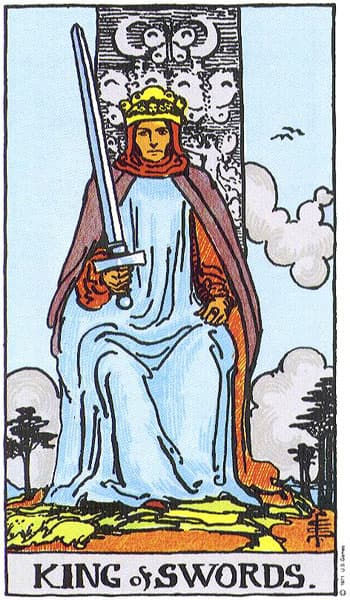
King of Swords Tarot Card Meaning
מלך החרבות
- intellectual authority
- fair judgment
- clarity
- medium
weeks to months
By its element: Air
Counts for timingA court card: usually stands for a person.
Timeweeks to months
By its element: Air
Counts for timingA court card: usually stands for a person.
Card Facts
King = י (Yod) = fire · Swords = air — so King of Swords is fire of air.
Thirty degrees on the wheel, from 20° Taurus to 20° Gemini. The three numbered cards in that span:
On the Tree of Life
2 · Chokmah
The first force out of the root: momentum, impulse, a direction not yet defined.
י — the first letter of the Tetragrammaton
Air · Yetzirah, the world of thought
How the card sits on the treeThe King of Swords tarot card stands for intellectual authority, fair judgment and clarity.
Fair and clear judgment based on disciplined thought. This card invites you to examine how this message is operating within thoughts, communication and decisions.
Message
The King of Swords represents clear thinking, intellectual authority, and decisions grounded in principles and facts. Rise above temporary emotional noise, see the larger picture, and define a consistent standard for action. Yet logic that does not listen to people can become rigid or distant. Use knowledge to create order and fairness rather than control. A mature decision combines precision, transparency, and responsibility for how its consequences affect everyone involved. Core qualities of King of Swords: fair judgment, authority, consistency, transparency and responsibility.
The light in the card
Fair judgment grounded in facts
The shadow in the card
Excessive detachment or judgmentalness
Psychological layer
Psychologically, this card reflects fair and clear judgment based on disciplined thought.
Personal growth
Decide from fairness, not only cold logic
Love & relationships
In Swords, relationship is examined through thought, words, truth, boundaries, and the way fear or interpretation shapes connection. The King of Swords in love brings a need for definition, truth, and the ability to discuss difficult subjects. He can represent a steady, thoughtful partner, while his shadow is intellectualizing emotion or using logic to invalidate the other's experience. As a King, the card tests how maturity becomes responsibility in relationship. Power is measured not only by what a person feels, but by what they can hold, promise, and sustain over time. Swords ask for truth spoken in a form that can be heard, and for a distinction between fact, inner story, and an old wound seeking protection again.
Career
At work, Swords concern decisions, communication, information, conflict, strategy, and the cost of mental overload. At work, he is a card of professional authority, strategy, policy, and principle-based decision-making. His power grows when authority is accompanied by transparency and fairness, and weakens when 'objectivity' becomes an excuse for distance. As a King, the suit's quality becomes external leadership. Experience, responsibility, and influence must be joined without turning authority into control. The direction is to sharpen facts and goals without turning the workplace into a battlefield or the mind into a place that no longer knows how to rest. In a professional conversation with a manager or authority, the King of Swords suggests clarity with courtesy, tact, listening, fairness and consideration of several perspectives. Give feelings precise words rather than suppressing them to sound professional. Distinguish observations, feelings and interpretations of another person's intentions; connect a need to a concrete request and feedback. Depending on context, the King may represent an authority or a useful approach, without identifying a person with certainty. Possible clarifying questions: What is this person's role relative to you, and who decides? Are you seeking to share a difficulty, change responsibilities or transfer teams? What would a useful outcome look like? What explicit feedback have you received about trust and performance, and what is your impression? Select one or two relevant missing details rather than asking every question automatically.
Money & security
In financial matters, this card reflects fair and clear judgment based on disciplined thought, and recommends choosing with awareness, stability and a long-term view.
Family
Within family life, this card brings forward the theme of fair and clear judgment based on disciplined thought, and invites awareness of roles, needs and patterns within the household.
Spirituality
On a spiritual level, this card teaches: Decide from fairness, not only cold logic.
Mythic parallel
Tyr, Norse god associated with law and courage, who sacrificed his hand so the gods could bind Fenrir, offers a deep parallel. Real authority sometimes requires paying a personal price for a rule that protects the whole. The King of Swords asks whether the principle you defend also applies to you. This is an interpretive parallel intended to deepen the reading, not a claim that the myth is a fixed historical source of the card.
Connections with other cards
Possible readings depend on the question and the cards' actual positions.
| Card | Possible connection |
|---|---|
| Justice | A professional decision, clear criterion or relevant authority. Rationalization or detached wording can be mistaken for objectivity; no legal outcome is predicted. Interpret through the question and both fixed positions; co-occurrence is not a chronology or evidence of an event. With Justice, two cards of judgement reinforce each other, and they are easily read as a verdict. Emphasis: facts, fairness and transparency in the process, not a prediction of a ruling or a formal outcome. |
| The Sun | Transparency, decision and rational structure; authority does not hold all the truth. |
| The Lovers | Clear decisions and agreements; reason serving connection versus distancing feeling. |
| The Chariot | Clear thinking and decisions can give will a path. Consider whether judgment is fair and practical or rigid and detached from feelings. Does the decision hear inconvenient information too? |
| Queen of Swords | With the Queen of Swords, two figures of clarity appear together: the Queen discerns, the King decides. Emphasis: a decision that rests on fine discernment and leaves the conversation open, not authority that speaks only the language of logic. |
| Two of Swords | With the Two of Swords, the weighing stalls and the decision is put off again and again. Emphasis: the King's ability to decide by principles and facts can make a choice possible, as long as it does not become a hasty ruling meant only to end the discomfort. |
Moment for reflection: Sit quietly and ask: What step today expresses the message “Fair and clear judgment based on disciplined thought”?
The image
A king sits frontally on a stone throne holding an upright sword, surrounded by clear air and distant clouds.
Straight upright seated posture, sword held vertically before the body