The Horse in Tarot: Life Force, Desire, and the Soul’s Journey
What does the horse symbolize in tarot? A journey through the seven cards featuring horses, psychology, desire, the body, mythology, and esotericism, with card combinations and questions for reflection.
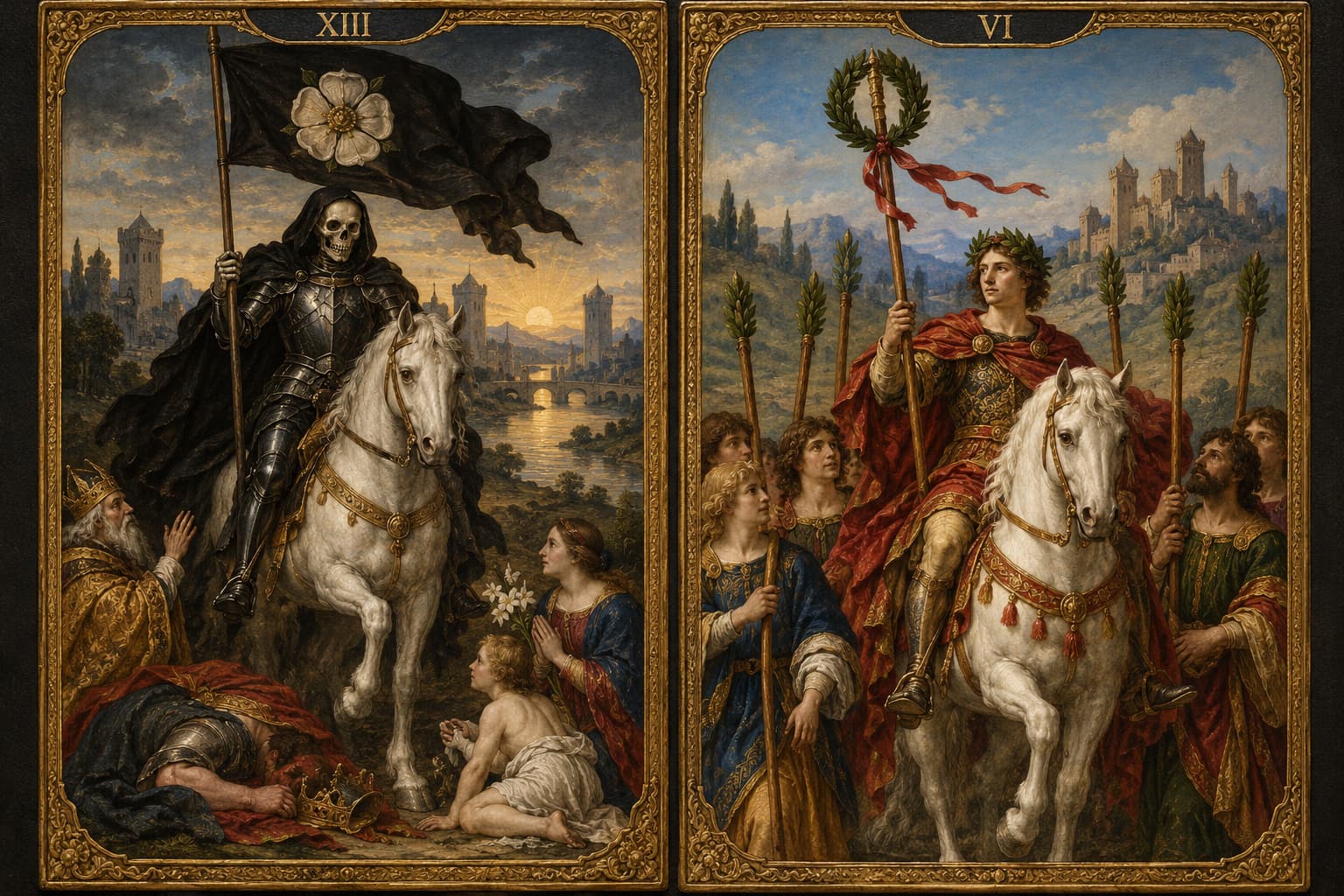
The horse in tarot carries a person, but it is no passive vehicle. It has a body, strength, and a will of its own. Its presence invites us to consider both the force that moves us and our relationship with that force: do we listen to it, guide it, struggle against it, or let it carry us away?
The horse may symbolize vitality, desire, freedom, initiative, courage, and the ability to move from one state to another. It can also illuminate urgency, a need for recognition, resistance, or difficulty adjusting our pace to others. Its meaning does not arise from its presence alone: posture, movement, riding equipment, the rider, and the surrounding cards all help shape the story.
This article focuses on the Rider–Waite–Smith deck, with comparisons to other traditions. Historical explanations, psychological frameworks, and interpretations in a reading are distinct layers. The parallels between myths and cards offered here are intended to enrich reflection; resemblance does not prove a shared historical origin.
Where Do Horses Appear in the Deck?
In Rider–Waite–Smith, horses appear in seven cards: the four Knights, the Six of Wands, Death, and The Sun. The Chariot in the Rider–Waite–Smith deck features two sphinxes, one black and one white—some decks depict horses in their place. Guiding seated sphinxes is a mental and spiritual endeavor, in contrast to controlling horses.
| Card | Visual Emphasis | An Invitation to Reflect |
|---|---|---|
| Knight of Wands | A rearing horse, its front legs raised | Momentum, arousal, initiative, and aligning impulse with direction |
| Knight of Swords | A galloping horse and a rider leaning forward | The body mobilized by a decision, an idea, or a sense of urgency |
| Knight of Cups | Measured movement and an extended cup | Drawing closer, courtship, and emotion taking form |
| Knight of Pentacles | A dark horse standing still | Strength held in reserve, stability, preparation, or difficulty getting started |
| Six of Wands | A rider crowned with a wreath, elevated above those on foot | Visibility, recognition, and status |
| Death | A white horse carrying an armored skeleton | Transition and change that are not entirely within our control |
| The Sun | A child on a white horse, with no visible saddle | Ease with vitality, trust, and play |
In Marseille decks, horses appear in The Chariot, while Death and The Sun are generally depicted without a horse. Details also vary in other historical and modern decks. The image of the child on horseback in The Sun predates Waite and Smith’s deck: Waite himself mentions a description of it by Eliphas Lévi.
Horse and Rider: Power and Intention
The horse can be read as living energy, and the rider as the intention seeking to give it direction. This is a useful metaphor, but not a fixed division: horse and rider also form a single unit, and sometimes both express the same temperament.
In one reading, conscious will and desire support each other. In another, the mind says to move forward while the body tightens; or the body is already drawn toward something while the person still struggles to acknowledge wanting it. Sometimes control is so strong that vitality diminishes, and sometimes arousal runs ahead of the capacity to choose.
> The question is not only how much power we have, but how we relate to it and what path it makes possible.
This also brings in the tension between freedom and domestication. Structure can offer safety, skill, and continuity. It can also become too rigid. Freedom can expand our lives, yet constant movement may also serve to distance us from feelings that are difficult to face. Without context, the card does not determine which possibility applies.
For more on the four mounted figures, see The Knights in Tarot: Desire, Emotion, Thought, and Action on the Path to Fulfillment.
The Body and Experience That Does Not Yet Need Words
The horse invites us to explore the bodily dimension of experience: excitement, tightening, a need for space, fatigue, attraction, or readiness to act. Sometimes we understand something intellectually before it feels possible in the body. Sometimes physical sensation comes before an explanation.
A standing horse may suggest strength held in reserve; a charging horse, forces being mobilized; a rearing horse, arousal, tension, or resistance. These are images for reflection, not a way to diagnose the nervous system, trauma, illness, or sexual function.
The Horse Through a Psychological Lens
Freud: When the Explanation Follows the Impulse
In The Ego and the Id, Freud compares the ego to a rider contending with the horse’s greater strength. At times, the rider must guide the horse where the horse wants to go; similarly, the ego turns the id’s will into action as though it were its own.
This adds a subtle distinction to a reading: someone may experience themselves as making a considered decision even when a need for excitement, recognition, or relief has already given the action its direction. There is no need to judge the impulse; we can explore how fully it is recognized and put into words. With the Knight of Wands, for example: is the choice still desirable once the excitement settles? With the Knight of Swords: is the decision meant to advance something important, or to bring uncertainty to a quick end?
Jung: Libido as Life Force
In his early writing, Jung connects the horse with libido and the unconscious animal nature. Within this framework, libido is not limited to sexuality: it offers a way of thinking about psychic energy that also finds expression in creativity, aspiration, desire, and development.
The horse can therefore carry a question about where life is seeking expression. The same intensity may appear as sexual desire, anger, vigorous work, or a wish to set out on a journey. We should not assume that all these expressions are equivalent, or that anger necessarily comes from blocked desire.
Jung also discusses connections between horse imagery and maternal imagery in certain contexts, but this does not yield a formula in which a horse always represents a mother. In a reading, themes of carrying, nurturing, and leaning on someone can be explored when they are already relevant to the querent.
The Shadow and the Right to Want
The horse can serve as an image of parts of themselves that a person struggles to acknowledge: aggression, sexuality, ambition, independence, or a need for recognition. Sometimes what has been repressed is vitality itself—the right to enjoy life, take up space, or say, “I want.”
We can therefore ask whether this force needs boundaries, or whether it is finally asking for room. Maturity does not require acting on every impulse; it can mean being able to feel it, acknowledge it, and choose.
For a deeper exploration of the shadow, persona, and Self, see Carl Jung: From the Persona to the Self.
Personal Symbolism, Fear, and Dreams
In the case of “Little Hans,” Freud interpreted a phobia of horses through family relationships and unconscious conflicts. This is a historical interpretation of a particular case, not a universal key to the symbol.
For one person, a horse evokes freedom; for another, a fall, authority, hard work, or a pleasant memory. In dreams, too, it is important to explore personal associations. An injured horse may invite a conversation about vulnerability or vitality, but it does not prove a loss of strength; a wild horse does not diagnose a repressed instinct.
Sexual Meaning: Desire, Rhythm, and Connection
The horse may evoke associations with physical power, rhythmic movement, riding, and desire. A useful reading about sexuality explores how desire operates: does it lead toward closeness, excitement, competition, security, or a need for approval?
Attraction Alone Does Not Tell the Story of a Relationship
The horse can highlight the body and the desire to draw closer. On its own, it does not reveal whether attraction is mutual, how much commitment there is, or what someone is hiding. One way to phrase this is: “Physical attraction may be a significant force in the relationship; it is worth exploring how it connects with emotion, communication, and continuity.”
Four Qualities of Desire
The Knight of Wands invites exploration of passion, initiative, novelty, and spontaneity. The Knight of Cups highlights the possibility of arousal through atmosphere, courtship, and imagination. The Knight of Swords can illuminate stimulating conversation, urgency, or tension. The Knight of Pentacles invites reflection on sensuality built through time, trust, and familiarity. These are possible qualities of an encounter, not fixed sexual types.
Leading and Surrendering
Riding can serve as a metaphor for choosing to lead or surrender. Useful questions include who sets the pace, how desire is expressed, and whether it is possible to slow down, stop, or change direction. Even great intensity can coexist with attentiveness and gentleness.
Specific sexual preferences should not be inferred from the bridle, the armor, or the horse’s posture. Surrender does not require giving up boundaries, and initiative does not replace consent.
Desire and Anger in the Same Story
When a querent describes both attraction and conflict, we can explore whether a heightened state of tension finds expression in both. The body may be expressing things that are difficult to say, or physical intimacy may restore a sense of closeness without resolving the disagreement. This is a possibility to explore. Anger is not proof of desire, and desire does not justify harm.
Beyond a Masculine Symbol
The horse can be read as phallic or associated with masculinity, but it should not be reduced to that. The mare in the Song of Songs, female figures associated with horses, and images of horse goddesses broaden the perspective to include attraction, fertility, independence, and feminine power. Song of Songs 1:9 compares the beloved to a mare among Pharaoh’s chariots; interpretations of the verse differ, and there is no need to present a military hypothesis about releasing mares as fact in order to recognize its erotic force.
In a contemporary reading, initiative, receptivity, strength, and tenderness can be qualities of any person. Fertility, too, can be an image of creativity and maturation; a horse is not evidence of pregnancy or physical fertility.
Seven Cards—Seven Expressions of Power
Knight of Wands: Wanting and Choosing a Direction
The rearing horse suggests a force seeking expression: excitement, courage, arousal, and sometimes impatience. It may illuminate a beginning that restores vitality, or difficulty staying once the novelty has worn off. In sexuality, we can speak of direct attraction and a desire for experience; in action, of initiative and setting out. The horse and the upright wand also allow an erotic reading when the question supports it, without attributing that meaning with certainty to the illustrator’s intent.
Question: Do I want the thing itself, or mostly the excitement of its possibility?
Knight of Swords: The Body Mobilized by an Idea
The galloping horse and forward-leaning body suggest a decision that marshals every available resource. This may be the courage to say something necessary, offer protection, or break through hesitation. The potential difficulty is an urgency that leaves less room for listening. In a question about intimacy, we can explore whether there is room for a response that is not immediate. The light-colored horse does not prove that the rider is right.
Question: Does speed serve the connection, or does it mainly put an end to tension that is hard to bear?
Knight of Cups: Emotion Taking Form
The horse’s measured pace and the extended cup suggest the possibility of drawing closer through a gesture, imagination, and feeling. Romance can open the way to connection while also running ahead of getting to know the actual person. The light color is not evidence of pure intentions. In a reading about sexuality, we can explore emotional safety, seduction, and a pace that allows both people to express what they want.
Question: Am I meeting the person, or the story I am creating around them?
Knight of Pentacles: Strength That Does Not Need to Hurry
The standing horse invites readings of stability, preparation, and conserving resources. We can also explore waiting for certainty, rigidity, or a habit that no longer nourishes. In sexuality, it may illuminate sensuality that develops through familiarity and comfort, and the place of curiosity within routine. Sexual fidelity, stamina, or level of desire cannot be inferred from it.

Question: What does the pause make possible, and what does it postpone?
Six of Wands: Being Seen and Feeling Valued
The horse carries the rider above those on foot, emphasizing public visibility. It may represent recognition of effort while also inviting an exploration of dependence on applause. The people alongside the rider call to mind support and shared credit. In a relationship, we can explore the pleasure of being desired, and the difference between connecting with another person and receiving validation from them.
Question: Does recognition deepen confidence and connection, or does it require me to keep performing?
Death: Carrying Us Through Transition
The horse carries an armored skeleton through a scene in which different figures respond to transition. We can reflect on the life force that continues even as a familiar form changes. This is a symbolic reading, with no promise that the change is beneficial. Although the horse is depicted moving at a measured walk, this does not establish that events will unfold slowly.
In a relationship, the card may illuminate an ending or a change in a pattern, an expectation, or a shared identity. Pain does not prove clinging. In an explicitly sexual question, we can explore changes in needs and ways of approaching one another. “The little death,” as a term for orgasm, may appear only as a literary parallel; it is not an automatic meaning of the card.
Question: What has changed, and what still needs space and time?
The Sun: Feeling at Home in Life
The child and the horse invite a reading of trust, play, and ease with vitality. There is no need to present this as psychological perfection or an absence of difficulty. We can experience warmth even when not everything is resolved. Here, the child symbolizes openness and curiosity and is not a sexual image. In a question about intimacy between adults, we can consider the overall atmosphere of warmth, acceptance, and safety.
Question: Where can I feel alive without needing to impress anyone or control every detail?
The Language of the Image: Color, Movement, and Riding Equipment
| Feature | Possible Directions for a Reading |
|---|---|
| White or light-colored | Clarity, an ideal, renewal, or visibility; does not guarantee pure intentions |
| Black or dark-colored | Depth, materiality, strength held in reserve, and the unknown; does not necessarily symbolize evil |
| Reddish-brown | Warmth, the body, desire, passion, and urgency |
| Standing | Strength held in reserve, preparation, waiting, or difficulty moving |
| Walking | A gradual approach or movement at a manageable pace |
| Galloping | Determination, urgency, excitement, or escape—depending on the context |
| Rearing | Arousal, resistance, and tension seeking direction |
| Bridle | The relationship between power and guidance; its appearance alone does not establish coercion |
| Saddle and covering | Mediation, skill, protection, culture, or status |
| The rider’s armor | Protection needed for action, and sometimes the cost of difficulty being vulnerable |
Colors vary between editions. Nor is the direction of movement a universal code for past and future. In a spread, we can consider the card the horse faces, or two riders facing one another, but interpret this alongside the positions and the story.
Spiritual Traditions, Mythology, and Esotericism
Plato: The Chariot of the Soul
In Phaedrus, a charioteer drives two winged horses with different tendencies. The allegory concerns the soul, love, and the relationship between aspirations and desire. It offers a way to think about guiding forces that are not alike. We can compare it to The Chariot in tarot while making clear that Rider–Waite–Smith depicts sphinxes and that this is not proof of direct historical influence.
The Upanishads: The Senses as Horses
In the Katha Upanishad, the body is the chariot, the senses are the horses, the mind is the reins, the intellect is the charioteer, and the Self is the owner of the chariot. Here, the horse adds a dimension of attention and attraction to stimuli: what draws us, and what allows us to choose where to focus? The allegory does not require suppressing experience; we can reflect on the relationship between sensation, discernment, and direction.
The Hebrew Bible: Earthly Power, Eros, and Fire
In the Hebrew Bible, the horse appears within the tension between power and its limits. Psalms 20 and 33 contrast trust in horses with another source of security; Song of Songs 1 uses a mare as an image for the beloved, while Jeremiah 5 uses horses as an image of unrestrained lust. These appearances should not all be folded into a single meaning.
In the story of Elijah, a chariot of fire and horses of fire separate him from Elisha, and Elijah ascends in a whirlwind. Precision matters: the verse does not explicitly say that he ascends riding in the chariot. As a cultural image, the fire and horses invite reflection on transition and power beyond the ordinary.
Revelation and Death on Horseback
Revelation 6 features horses of different colors, including the pale horse whose rider is called Death. Waite points to the apocalyptic connection of the Death card. This is an important context for the image, but it does not warrant transferring every meaning of these horses to the seven tarot cards or treating them as an identical system.
Greece: Inspiration, Power, and the Danger of Overreaching
Pegasus invites reflection on inspiration and flight; the story of Phaethon in the chariot of the sun offers a parallel to power whose pursuit outstrips the ability to guide it. The centaur joins a horse’s body with a human upper body, offering an image of the meeting between the human and the animal. These are parallels for a reading, not the sole interpretation of these figures or proof of the cards’ origins.
Epona and Sleipnir: Protection and Passage
Epona, a goddess associated with horses in the Gallic and Roman world, brings the feminine, protection, and the bond with the animal into view. Sleipnir, Odin’s horse, also appears in Norse tradition in Hermod’s journey to the realm of the dead. In mythological comparison, then, the horse can serve as a means of passage between worlds, beyond its role in conquest or speed.
The Wind Horse and the Human as a Vessel
Tibetan prayer flags are also known as lung-ta, “wind horse.” This image extends the horse’s associations to wishes, spirit, and vitality. In Haitian Vodou, the image of a spirit “riding” a person appears in ritual: the person becomes a vessel for the spirit’s presence. This is a belief and ritual within a particular tradition, not a diagnosis of someone drawing a card. The comparison invites us to reverse the question: am I the rider, or am I carrying a force I experience as greater than myself?
Alchemy: Change That Does Not Ask to Be Rushed
The term venter equinus, “horse’s belly,” was also used in alchemical literature to describe heating with horse manure. The moderate warmth allowed processes of digestion and maturation within matter. This offers a possible symbolic parallel to development that needs the right conditions and time. Connecting it with the Knight of Pentacles or Death is a proposed interpretation, not a documented meaning of the horse in the illustrations.
The Four Elements and the Distinction Between Systems
We can read the four Knights through the elements of their suits: Wands as fire—passion and initiative; Cups as water—longing and drawing closer; Swords as air—ideas and decisions; Pentacles as earth—the body and continuity. This clarifies the quality of the force in each card without assigning the horse itself a single element in every appearance.
In the Thoth deck and the Hermetic framework from which it arises, the mounted figures called Knights belong to a different court structure and are associated with the letter Yod and the power of fire. We should therefore not automatically transfer all of Crowley’s Knight correspondences to a Knight in Rider–Waite–Smith. Correspondences involving rank, letter, element, and zodiac sign require us to specify which system we are using.
Sagittarius, whose symbol is a centaur, can also invite an astrological conversation about expansion and direction, but the presence of a horse does not make every card a Sagittarius card or establish a person’s zodiac sign.
For more on the Hermetic framework and the differences between the decks, see Aleister Crowley: His Life, Family, Worldview, and Thoth Tarot.
Multiple Horses in a Spread: A Shared Theme, Different Rhythms
When several horses appear in a spread, we can explore whether power, desire, and movement form a recurring theme. They may represent several people, different ways one person acts, or areas of life in which that person moves at different speeds. Multiple horses do not necessarily mean rapid movement, as the Knight of Pentacles illustrates.
In a relationship question where attraction has already been described, multiple horses may support an exploration of the physical and instinctual dimension. The Queen of Cups beside a Knight or Death can add a question about the relationship between intensity, emotion, and the capacity to hold space. When conflict has also been reported, we can explore whether needs are expressed in words or felt mainly through tension and the body. This is a possible story to explore, without declaring who is more sexual, what the other person is hiding, or where the anger comes from.
Combinations That Enrich the Reading
| Combination | Possible direction to explore |
|---|---|
| Knight of Wands and The Lovers | Attraction alongside choices about relationships and values |
| Knight of Wands and Queen of Cups | Momentum and desire alongside sensitivity; bringing the body and emotional conversation into alignment |
| Knight of Swords and Queen of Cups | Directness and urgency alongside listening and holding space |
| Knight of Swords and Five of Swords | The difference between resolving a disagreement and overpowering another person |
| Knight of Cups and The Moon | Longing and imagination alongside ambiguity and missing information |
| Knight of Pentacles and The Sun | Stability and routine making room for play and pleasure |
| Knight of Wands and Six of Wands | The excitement of an encounter alongside a wish to feel wanted and appreciated |
| Six of Wands and The Sun | Public recognition contrasted with an ease that does not depend on an audience |
| Death and The Sun | Transition and vitality in two images of a light-colored horse; no promise of a happy ending or a chronological sequence |
| A Knight and The Devil | Desire, attachment, and freedom to choose; without diagnosing addiction |
| Knight of Wands and The Chariot | A rearing horse alongside resting sphinxes: momentum, focus, and coordination |
These combinations are not formulas. As discussed in The Celtic Cross Tarot Spread: Ten Cards, One Broader Picture, it is important to honor each card’s role: a card in the hopes and fears position does not necessarily describe reality, and another card in the potential position does not guarantee an outcome.
Spread Position, Pace, and Reversed Cards
In the present position, we can ask what is driving the situation and how quickly it is moving now. In the obstacle position—is there urgency, restraint, or a mismatch in pace? In the resource position—what strength can be drawn on? In the advice position—what way of moving would suit the situation? Sometimes this includes slowing down. In the potential position—how might this force develop under the existing conditions?
When using reversed cards, we can explore excess, blockage, energy turned inward, or difficulty with coordination. The Knight of Wands may illuminate enthusiasm that is hard to sustain or energy with no outlet; the Knight of Pentacles may point to a rigid routine or difficulty persevering. We should not automatically apply every contradictory possibility. An upright card can also express a shadow aspect through its context.
When a timing question arises, the horse’s pace can support a relative comparison between cards. It is not a calendar, and it does not guarantee that someone will get in touch, a project will be completed, or relief will arrive within a certain number of days.
For more on the distinction between symbolic pace and an actual date, see Time, Timing, and Movement in Tarot.
Questions for Reflection and Clarification
- What makes me feel alive, and what is asking for more room?
- Is this movement bringing me closer to something I want, or taking me away from something difficult to face?
- Are my body, emotions, and thoughts aligned with the same choice?
- Where do I need structure, and where has it become too rigid?
- Is there room for desire without an obligation to act immediately?
- In a relationship, how do we discover a pace that works for both of us?
- Am I seeking closeness, excitement, recognition, or several of these at once?
- What does pausing protect, and what does it postpone?
- What in me feels alive even when no one is watching?
- What would help me move through change without demanding that I renew myself immediately?
When context is missing, we can ask whether the subject is attraction, commitment, or communication; whether it concerns something that has already happened or a fear; and whether the querent wants to explore a psychological, spiritual, or sexual dimension. A brief clarifying question can open the way to a more precise reading than a long list of possibilities.
The horse gives form to desire and life force, but also to the relationships we have with them. Sometimes it carries us forward with momentum, sometimes it conserves energy, and sometimes it allows us to feel secure without holding everything in a tight grip. Reflecting on it becomes richer when there is room both for what wants to move and for the person who must live the journey.