Blue Lace Agate
Blue lace agate combines pale blue and white bands in delicate patterns. Explore its origins, natural versus dyed color, and associations with calm, clear communication.
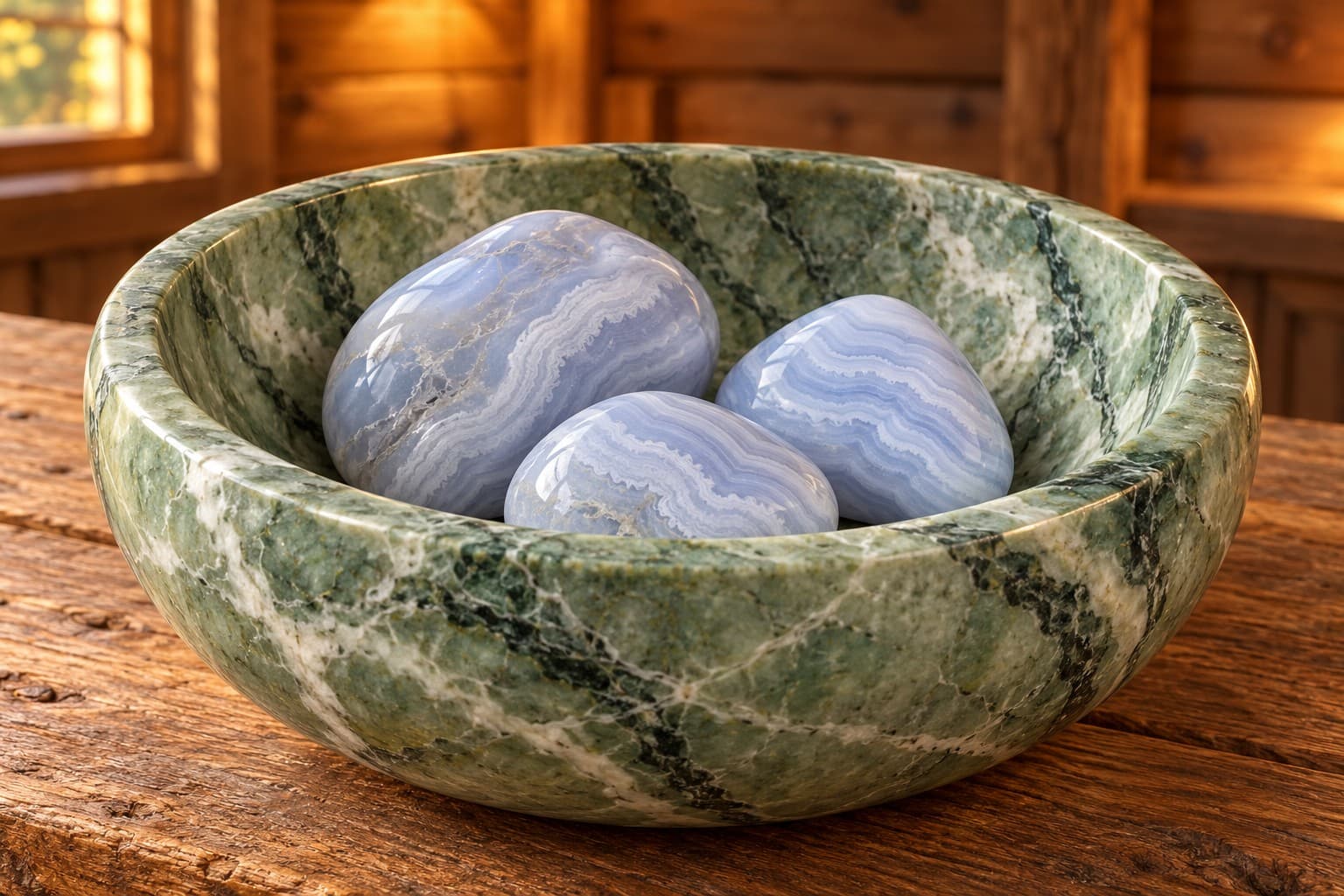
Blue lace agate is a banded chalcedony in shades of pale blue, white, gray, and sometimes a slightly deeper blue. Its bands wind like lace, waves, clouds, or delicate lines of ink. Unlike blue stones with a strong, uniform color, its charm lies in soft transitions and the rhythm of its lines.
Symbolically, it is easy to see why it has become associated with calm and communication: it looks like a voice moving through layers rather than a sharp declaration.
This page focuses on one variety. For the broader family, its formation, and general uses, see our page on Agate: An Overview.
What Is Blue Lace Agate?
This variety of agate is made of chalcedony, a finely crystalline silica composed primarily of quartz and sometimes moganite as well. Its hardness is approximately 6.5 to 7 on the Mohs scale, its specific gravity is close to 2.6, and its luster ranges from waxy to glassy when polished. It is translucent to opaque and usually displays white and pale blue bands that cross one another in soft, rounded patterns.
The source most closely associated with classic blue lace agate is the Ysterputs Mine near Karasburg in southern Namibia. The Namibian material is a hydrothermal vein agate that formed in fractures within Jurassic dolerite. The mine operated for decades and closed in 2017, making documented Namibian material increasingly rare and expensive. Other sources have yielded banded blue chalcedony or material resembling blue lace agate, but the name is sometimes also used commercially for imitations, dyed agate, and blue chalcedony without the characteristic lace pattern.
What the Stone Evokes
Blue lace agate quiets the mind. This description comes up among almost everyone who works with it, and it is also the most precise. The inner monologue does not stop; it slows, as though someone has turned down the volume in the room. People describe a softening in the jaw and throat, breaths that naturally grow longer, and a space opening between thought and word.
It does not make you drowsy or dull your awareness. It resonates with calm: the kind of serenity found in watching a still sea or the sky after rain. This makes it a stone for the evening, for unwinding after a day full of conversations, and for the moments before sleep. Highly verbal people, whose minds never stop composing sentences, say that with it they can “hear themselves thinking more slowly.”
Which Chakra Is It Associated With?
Its primary association is with the throat chakra, Vishuddha (vih-SHOOD-hah), which modern yogic traditions connect with voice, truth, listening, and expression. Yet blue lace agate has a distinctive quality: it works on the throat from below, from the direction of the heart, rather than from above, from the head. The speech it encourages has passed through the heart before leaving the mouth.
Some extend this work to the third eye because of its blue tones and contemplative quality. In practice, it is often worn on a short pendant at throat level, or a flat stone is placed in the hollow between the collarbones while lying down for a few minutes of slow breathing. Chakra maps and their color correspondences developed within different traditions and are not identical from one book to another.
Energy Work
In crystal traditions, blue lace agate is considered a stone of calm, a slower pace, and clear communication. People often carry it before a sensitive conversation, a presentation, a meeting, or writing that requires precise wording. The energy attributed to it is not a driving force but a regulating quality: less need to react immediately, and more capacity to listen, choose words, and leave room for silence.
You can place it beside your computer while composing a difficult message, hold it before a conversation about boundaries, or use it as an anchor for breathing. The stone does not make someone communicate well, but it can become a cue we establish for ourselves: when we touch it, we slow down, check our tone, and only then respond.
If you would like to keep this quality on your table, not just in your hand, our page on Three Agate-Based Grids includes the “Blue Breath Grid,” a gentle circle of six stones around a blue lace agate, with an illustration.
Judy Hall also describes it as a supportive stone for practitioners and those who support others. Anyone who reads tarot or works with people may find in it a reminder of the gentle boundary between another person’s story and their own: listen all the way through, and speak only after listening.
How It Compares With Other Blue Stones
Aquamarine is also a throat stone, but it is a cold, clear sea. It offers the courage to speak a difficult truth and has a sharper quality. Blue lace agate softens words; aquamarine sharpens them.
Sodalite is the deep blue of the intellect. Orderly thoughts, logic, analytical clarity, less emotion. Someone who needs to think clearly may choose sodalite; someone who needs to settle down before they can think at all may choose blue lace agate.
Celestite and angelite are lofty and airy. They open upward and are less grounded. Blue lace agate, because it is an agate, keeps its feet on the ground even as it soothes.
Lepidolite calms anxiety through the body and is suited to acute distress. Blue lace agate is gentler, better suited to the mind’s everyday noise than to a storm.
Of all these stones, blue lace agate is the softest: soothing without inducing sleep, quieting without disconnecting.
Spiritual Perspective
On a spiritual level, blue lace agate symbolizes truth that does not need violence to be heard. Its bands are not straight, yet they remain continuous. This suggests a way of speaking honestly even while a thought is still developing, and of holding complexity without losing your own voice.
In his book on stones, Robert Simmons proposes approaching each stone as having an archetypal character, with keywords, chakra associations, and emotional and spiritual descriptions. In the spirit of that approach, blue lace agate can represent a meeting of stillness and expression: a voice that emerges from a steady inner place rather than from pressure to prove something. This is a symbolic, experiential perspective, not a scientific measurement of energy.
Emotional Perspective
Symbolically, blue lace agate is suited to situations in which words get stuck or come out too quickly. Some people give up their voice to avoid conflict; others speak forcefully because they fear they will not be heard. The stone can serve as a reminder of a third possibility: slow, clear, respectful speech that does not erase the underlying need.
It can also accompany work with self-criticism. Its delicate pattern reminds us that not every sentence has to be perfect before it is spoken. We can begin with our experience, refine what we mean as we go, and make corrections without treating every mistake as a failure. Emotionally, this is a shift from communication governed by anxiety to communication that allows curiosity and the capacity to sit with a response.
How to Work With the Stone
Before an important conversation. Hold the stone and write three lines: what happened, what I feel, and what I am asking for. Then read them aloud and consider whether they describe a need or blame another person. Here, the stone serves as an anchor for a communication practice, not a substitute for the conversation.
In meditation. Follow a single band in the stone with your eyes and breathe slowly. Whenever the band branches or disappears, return to it without struggling. The practice mirrors listening: there is no need to force continuity, only to return gently to what matters.
Throughout the day. Wear a pendant near your throat, place a small stone beside a notebook, or carry it on a day filled with conversations. Your intention might be a short sentence such as “I speak clearly and leave room to listen.”
A Geological and Gemological Perspective
So far, we have explored tradition and experience. What follows is what mineralogy and gemology can tell us about the stone, for anyone who also wants to understand the material itself.
How the Bands and Color Form
Agate forms when silica-rich fluids enter cavities or fractures and deposit layers of chalcedony. In vein agate, silica fills a fracture or network of fractures, rather than necessarily filling the rounded cavity left by a gas bubble. Changes in fluid composition, temperature, silica concentration, and trace elements create layers that differ in thickness, transparency, and color. The lace-like pattern results from curved growth and folds or distortions in the layered structure.
Agate’s natural blue color comes primarily from light scattering within extremely small structures, rather than from a blue pigment. A soft, uneven pale blue interspersed with white layers can therefore be entirely natural. However, agate readily absorbs dye, and blue dyeing is a long-established commercial treatment. An intensely saturated, highly uniform electric blue, color concentrated in fractures, or unusually dark edges are signs that call for further inquiry.
Identification and Buying
In natural blue lace agate, look for subtle transitions between white, pale blue, and gray, bands with depth, and a pattern that does not look printed. Magnification can help reveal whether strong color is concentrated in fractures or pores. There is nothing wrong with choosing a dyed stone if you like its appearance, but the treatment should be disclosed and the price should reflect it.
Blue lace agate differs from uniformly blue chalcedony, dyed blue agate, sodalite, and larimar. Blue chalcedony can be almost unbanded; sodalite is a different mineral, usually deep blue with white veins; and larimar displays a white volcanic pattern against Caribbean blue. Professional gemological testing is needed when identity or value is particularly important.
Choosing, Caring for, and Cleaning Your Stone
Choose a stone with distinct but natural-looking bands, in a color you also enjoy in daylight. Check for strong dye concentrations in fractures, and ask the seller about its origin and any treatments. Lukewarm water, a little soap, and a soft cloth are enough for cleaning. Avoid acids, steam, ultrasonic cleaners for fractured stones, and prolonged exposure to strong sunlight, especially if the stone is dyed.
What Science Says
Agate’s composition and structure can be examined through gemological testing, but there is no evidence that blue lace agate treats anxiety, throat conditions, or thyroid conditions. Using it can support personal ritual, breathing, and intention, but a physical symptom or persistent emotional difficulty calls for appropriate professional guidance. A controlled 2025 study on crystals and anxiety found that reported effects did not exceed those of a placebo and were associated with prior expectations.
This page distinguishes research-based geological and gemological knowledge from spiritual interpretations rooted in crystal traditions and literature. Spiritual use of the stone can be part of a personal practice, but it is not a substitute for medical diagnosis or treatment.