When the Sun Begins to Rise in the Ten of Swords
The Ten of Swords accompanied a day that began with anger and painful emotions. A chance encounter revealed a surprising web of connections and reflected my own mistaken patterns of thought back to me. Like the light breaking over the horizon in the card, even in the midst of a dark day, an understanding began to dawn within me: there is another way to read reality.
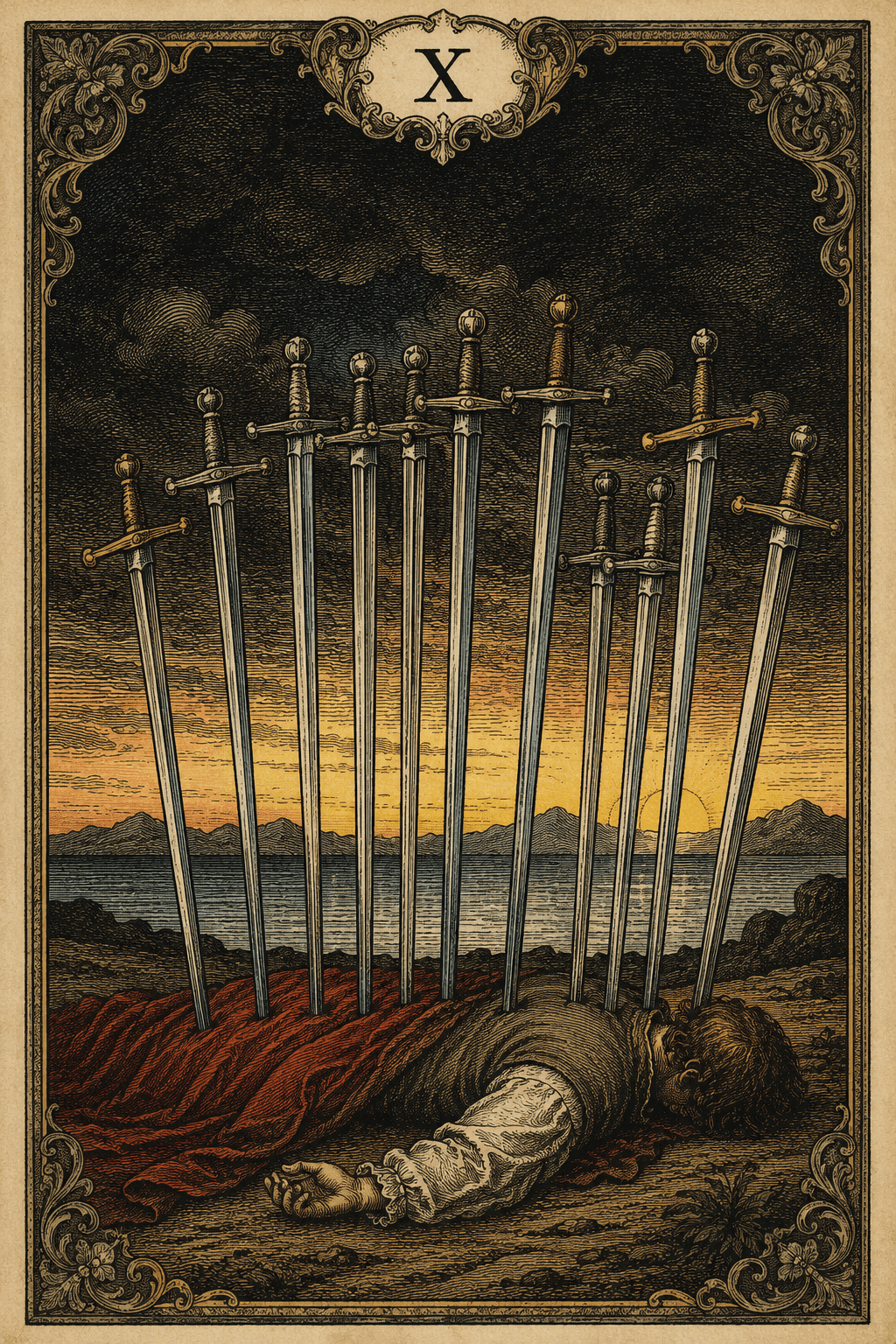
Every morning, I draw a daily card for myself—a card to accompany me through the day, reflect its mood, and sometimes show me something I’ll only understand in hindsight.
Yesterday, I drew the Ten of Swords.
At first glance, it’s one of the darkest cards in the deck. A figure lies on the ground, ten swords piercing their back, the sky above still dark.
It’s a card that speaks of pain, exhaustion, and the moment when we feel we’ve reached our lowest point.
But light is already beginning to appear on the horizon.
The Ten of Swords reminds us that even when we plunge into the abyss, at some point we reach the bottom. From there, we can go no lower. Something has to change, something begins to become clear, and out of what looks like an ending, a different reality can begin to emerge.
The card closely matched my state of mind.
I’d been through several days of a painful fight with my partner, and yesterday morning I woke up angry. Angry about what had happened, angry at everything around me, and perhaps angry at myself, too.
I was working in Jerusalem and drove in from the Rehovot area. The road was jammed, and traffic crawled at an infuriating pace.
Every time I stopped, my rearview mirror filled with a car edging a little closer. Whenever a small gap opened ahead of me, a car from the next lane slipped into it. Cars drifted from side to side, squeezed between lanes, and tried to gain a few more feet.
My eyes kept moving from the mirror to the road, then from the road to the side mirrors. My hands gripped the steering wheel a little tighter, and my shoulders stayed tense.
Every time it seemed I could finally move forward, someone had already filled the space that had opened up.
And so, before I even reached Jerusalem, I felt there wasn’t a single spot on the road where I could simply breathe.
At lunchtime, I went out to eat and took the light rail toward Mahane Yehuda Market.
I checked the time:
14:14.
I glanced at the phone of the woman next to me, and her screen showed the same time:
14:14.
Across from me, someone was standing, holding on to a pole. I glanced at his wristwatch, and there it was again:
14:14.
“Well, obviously,” I thought. That’s the time. Of course all the clocks would say the same thing.
And yet, for some reason, it stood out to me in a different way.
As though, for a moment, reality were repeating itself before my eyes, asking me to pay attention.
I got off near the market, hungry. I passed a little place that immediately caught my eye. People sat around simple tables, eating pitas and delicious-looking dishes from old enamel-coated metal plates.
Old rock music played in the background. Behind a wooden counter stood the owner—an older woman, tattooed and full of presence—trying to orchestrate the orders, the kitchen, the diners, and everything else happening around her, all at once.
The bar seating on the other side of the counter was empty, so I sat at the corner nearest the wide entrance.
I tried to catch her attention, settled on two dishes, and placed my order.
Meanwhile, three people arrived—a man the owner seemed to know well, a woman, and another man. I assumed he came there often, perhaps knew the neighborhood well or led tours there, and had brought some friends along.
I went upstairs to the restroom.
When I returned, one of their bags was on my seat, and the three of them had already taken up almost the entire bar. The place was small, and I didn’t like the feeling that they had simply taken over my corner.
I asked him to move his bag.
He did.
A little later, a delivery driver came in and stood very close to where I was sitting. I shifted a few things in front of me to claim a little more space, hoping he would take the hint and move away.
He moved a little farther away.
I thought how rude it was to stand right in someone else’s space like that, without even noticing.
After a few minutes, he picked up his things and left.
Then one of the diners got up, brought over his dirty bowl, and set it on the bar so close that it was actually touching my plate.
I looked up at him with an expression that said, without words:
“What?!”
He understood, moved the bowl a little, said something I didn’t quite catch, and went back to his seat.
While the people beside me continued chatting with the owner, I noticed something else.
She was constantly busy. Taking orders, calling out to the kitchen, answering questions, trying to keep the whole place running—and yet every person who came in for work immediately received the same attention from her.
A delivery driver, a kitchen worker, a technician—it didn’t matter who.
“Have you eaten?”
“Have you had anything to drink?”
“Would you like something to take with you?”
I watched her, not quite understanding how, amid all the pressure and chaos, she still found room to notice every person who walked in.
At one point, two young women came in to order. They stood right beside me. One woman’s bag brushed against my shirt, while the other talked with her face hovering directly over one of my plates.
I shifted my body and my plates a little, trying once again to create a few inches of space.
Every little thing irritated me.
The car squeezing in ahead of me.
The car riding my bumper.
The bag taking my seat.
The delivery driver standing too close.
The bowl touching my plate.
The bag brushing against me and the face hovering over my food.
Looking back, I understand that the anger was already there.
They say reality is a mirror of our inner state.
All these things simply gave it a new shape each time.
Meanwhile, the woman sitting with the two men began talking warmly with the owner, taking a genuine interest in her. Amid the Israeli rock music, the voices of the diners, and the jumble of thoughts running through my head, I heard her name:
Rotem.
“Great, Rotem,” I thought, and sank back into my phone.
A few minutes later, the owner turned toward the kitchen and called to her son to help with the orders:
“Rotem!”
So her son’s name was Rotem, too.
He came out of the kitchen—a young man with a cheerful smile—and approached the people sitting beside me. He gave them special attention, and his mother introduced him to one of the men, explaining that he came there often and always brought customers with him.
“Well, that makes sense,” I thought. Of course they would give him special treatment.
Rotem, the owner’s son, shook hands with the man sitting beside me and said with a smile:
“You’ve got a great name—Rotem.”
The man corrected him and gestured toward the woman beside him.
She was Rotem.
And once again, that name filled the room.
Rotem
The owner calls her son Rotem.
Rotem, the son, thinks the man’s name is Rotem.
The man points him toward the woman—who is also Rotem.
Rotem, Rotem, Rotem.
I wasn’t really listening to the stream of words around me. I just thought:
“Fine, he’s Rotem, she’s Rotem, practically everyone here is Rotem. Good for them.”
And I went back to my phone.
Then the woman got up to go to the restroom.
She took two steps, stopped, looked at me, and said:
“Shachar?”
I looked up.
“How do you know me?” I asked.
Then she reminded me who she was.
It turned out she was the wife of my brother’s best friend. And he was all the way over in the United States.
Of course.
Her name was Rotem.
How had I not recognized her?
Her name had been circling around me again and again, almost calling on me to lift my head, but I was so absorbed in my anger, my thoughts, and my phone that I hadn’t noticed someone I knew sitting right beside me.
Rotem asked what I was doing in Jerusalem.
I explained that the last time we’d met, I was still working at the bank. I told her that back then, I’d worked with a woman named Vered—and now Vered was my manager.
“Of course I know Vered,” she said immediately.
“Wait, I’m texting her to tell her I’m here with you.”
Then she added that she would send her:
“How does she always get to work with the best people?”
She took a picture with me and sent it to Vered.
And suddenly, I found myself smiling.
Then she told me she was now working at a large company.
“My best friend works there,” I told her.
“Dvir.”
“Of course I know Dvir,” she replied.
“I work with him.”
She opened WhatsApp and showed me a picture of him.
I told her that Dvir was from Safed—the city where I grew up, and where her husband grew up, too.
As the conversation unfolded, it turned out that Dvir knew her husband’s family and had even once been in love with her sister-in-law.
Rotem was stunned.
She had known someone for a while, worked with him, and thought of him as someone from a different world—without realizing how deeply he was connected to her life, her family, and her story.
As far as she was concerned, he was almost a stranger.
And suddenly, it turned out that he was much closer than she had imagined.
Then I realized I had done exactly the same thing.
I’d been sitting there surrounded by people, but mostly I’d seen strangers getting in my way.
I saw a bag taking my seat.
I saw a delivery driver standing too close.
I saw a dirty bowl touching my plate.
I saw people getting attention while I waited in the corner.
I hadn’t seen the connections.
I hadn’t seen that among all these apparent strangers sat someone who knew my brother, my manager, and my best friend.
I hadn’t seen that reality was already weaving a whole web of connections around me.
I was so closed off inside my pain that even the familiar looked foreign to me.
And then the day began to brighten.
Not because all the problems had been solved. The fight was still there. The pain was still there. Nothing had changed in an instant.
But something inside me was beginning to clear.
Just like the light beginning to emerge on the horizon in the Ten of Swords.
There are moments that come to teach you something—to show you reality in a different way, precisely when you insist on seeing it your own way.
Sometimes an entire stage set takes shape around you.
The road grows crowded.
People squeeze past.
Bags, plates, and bodies cross the boundary again and again.
And you’re certain you’re reading the story correctly.
Everyone is getting in your way.
Everyone is taking up your space.
Everyone is intruding.
But in the middle of it all stands a woman showing you that there’s another way to meet life—to see the people around you, enjoy yourself, laugh, and make room for others even amid all the demands.
And beside her are the first Rotem and the second Rotem—both open, warm, and at ease connecting with the people around them.
Then one of the characters in the play steps off the stage. Removes her makeup.
Rotem took two steps, looked at me, and called:
“Shachar?”
And in that moment, it was as though she had taken off her mask.
For a moment, she was no longer just another actor in the play. She stepped off the stage, out of the story, and spoke to me directly.
In an instant, she was no longer another stranger taking up space beside me.
It was as though she were saying:
You’re misreading the map.
You see people entering your space, but you don’t see the threads connecting you.
You see strangers, but some of them are much closer to you than you imagine.
You’re certain everyone is taking space away from you, while some are actually opening a door for you.
Then the mask slipped a little further.
Rotem knows Vered.
Rotem knows Dvir.
Dvir knows her family.
People who seemed to belong to different worlds turn out to be part of the same tightly woven web of connections.
Suddenly, it became clear that the play I had been watching wasn’t the one that was actually unfolding.
I saw crowding, intrusion, and disruption.
But beneath the scenery were generosity, joy, familiarity, closeness, and connections I hadn’t noticed.
For one moment, Rotem removed her mask and revealed the whole stage to me.
As though she were saying:
Lift your head.
Look again.
Reality is more than the story you tell yourself about it.
Instead of fighting for every inch, you can make room.
Instead of seeing every person as a threat, you can meet them.
Instead of closing yourself off inside your pain, you can take an interest, talk, laugh, and connect.
For a moment, that stranger whose presence had bothered me so much showed me another way.
How, instead of feeling that every person takes up your space, you can discover that they might actually open up a whole world for you.
Learn from me, the day seemed to say.
This way, you can accomplish so much more.
And perhaps none of it was a coincidence.
Perhaps even within a day that began with anger, traffic jams, and the feeling that everything was closing in on me—the sun had already begun to rise.