Two of Cups Tarot Card Meaning
שני גביעים
Also called: 2 of Cups
- connection
- reciprocity
- attraction
- fast
days to weeks
By its element: Water
Not a timing cardAbout a relationship.
Timedays to weeks
By its element: Water
Not a timing cardAbout a relationship.
Card Facts
2 = Chokmah · Cups = water · Cancer = Cardinal water — so the decans of Cancer are the 2, 3 and 4 of Cups.
Golden Dawn title: The Lord of Love
On the Tree of Life
2 · Chokmah
The first force out of the root: momentum, impulse, a direction not yet defined.
Water · Briah, the world of feeling
How the card sits on the treeThe Two of Cups tarot card stands for connection, reciprocity and attraction.
The Two of Cups describes a meeting of two people who choose each other: mutual attraction, affection, friendship and a partnership in which both sides offer and receive. Unlike the Ace, where feeling is born, here feeling becomes an agreement between two people standing at the same height. It is a card of reciprocity, listening and promise, and it also suits reconciliation, agreements and collaboration. The card invites a check on whether reciprocity exists in action: who offers, who receives, and whether each person keeps room for their own identity. It describes willingness to connect and the quality of a meeting; on its own it does not prove a particular person's feelings, exclusivity or a shared future. The two figures can stand for any two parties, not only a man and a woman or a romantic couple. Reciprocity also includes helping and being helped: needing another person can coexist with equality when both parties have a voice and consent. They need not give the same thing or the same amount at every moment; what matters is room for both sets of needs and the ability to shape what they build together.
Message
The Two of Cups speaks of a meeting in which two people truly see one another and are willing to build through reciprocity. It may concern romance, partnership, reconciliation, or a conversation that restores trust. Notice whether giving and receiving are balanced, and whether closeness leaves room for each person's identity. Express intention clearly instead of relying only on attraction or expectation. A meaningful bond grows when both sides arrive with presence, honesty, and a willingness to choose the connection. Core qualities of Two of Cups: reciprocity, connection, attraction, partnership and listening.
The light in the card
A genuine connection based on mutuality: attraction, affection, friendship or partnership in which both sides give and receive, and a conversation in which both feel seen.
The shadow in the card
An imbalance in which one side gives more, emotional dependence, idealization or a fusion that erases individual identity; attraction without commitment, or an expectation of reciprocity not yet expressed in action.
Psychological layer
Meeting another person through mutual openness and equality, including when help or closeness is needed. Needing another person does not cancel autonomy; consider whether there is room both to receive and to have a voice. The encounter is also a mirror: through the other we see ourselves and our capacity to give and to receive. The two figures can stand for two parts of the psyche, reason and feeling, or the part that gives and the part that receives. Idealization, fear of dependence or a tendency to merge and lose identity may be worth exploring when relevant to the question; the card does not attribute such a pattern to a person merely because it appeared.
Personal growth
Learn to give and receive in equal measure, and choose relationships in which both sides reach out. Ask: is the connection truly mutual, what does each side bring, and where does desire find a healthy place?
Love & relationships
The Two of Cups is among the most favourable cards for relationships: mutual attraction, an acquaintance in which both people draw closer willingly, the start of a bond built on respect, or a promise and commitment between equals. Venus in Cancer adds the quality of home: love that builds security rather than only excitement. The winged lion recalls that desire can have a place within the relationship without being suppressed or taking over. When the question asks about the chance of a relationship, the card invites taking the initiative rather than only waiting: a first step, reaching out, an invitation or gentle courtship. In the picture nobody stands and waits; both figures extend a cup. The initiative is an offer that leaves the other person room to reach back, not pursuit or pressure. Reciprocity shows in what comes back: the card describes openness to connection, and does not establish on its own what a particular person feels, whether there is exclusivity, or whether the bond will last. In an existing relationship, the card invites a return to the moment of mutual choice: listening, a conversation in which both feel seen, and balance between giving and receiving. When reconciliation or reconnecting is asked about, it describes the possibility of reaching out and a conversation that restores trust; reconciliation needs willingness on both sides, and the card does not determine that the relationship will resume. In friendship it points to an alliance and affection that do not depend on romance. For someone on their own, it can also be read as inner completeness: offering ourselves the same regard we give to others. In a question about intentions, the Two of Cups supports attraction, affection and a wish for closeness or continued contact. Distinguish wanting a connection from exclusivity, definition and the capacity to sustain it. In a person's position, it can describe that person's possible openness; in the connection position, it emphasizes meeting and reciprocity. Do not establish both people's wishes from one person's position alone; where the context and spread support it, mutual willingness can be offered as a hypothesis.
Career
At work, the Two of Cups describes a business partnership, a fair contract or agreement, collaboration between two people, a mentor or colleague with good chemistry, a successful hire, or a client relationship built on trust rather than only a transaction. Waite noted that the card is favourable in business as well as in love. Check whether the agreement is genuinely balanced: division of roles, reward and room for each side. Its shadow is choosing a partner for pleasantness alone without checking professional fit, or a partnership in which one side carries more. The card describes the quality of a connection; it does not promise a signature or a particular outcome.
Money & security
In financial matters, the Two of Cups points to a shared financial decision, an investment with a partner, the joining of two resources, or an agreement from which both sides gain. Make sure the terms are clear and that contribution and responsibility are divided fairly, so that closeness does not replace due diligence. Consider also what money symbolizes in the relationship: trust, dependence or equality. The card alone does not determine a financial outcome.
Family
In family matters, the Two of Cups describes an alliance between two members of a household: partners, a parent and child, siblings, or two relatives who find a way to talk. It suits reconciliation, a conversation that restores trust, and agreement about roles and boundaries. The house on the hill in the background recalls that something can be built together, and that balance between giving and receiving is what holds a home. Use the family lens according to the reader's account; the card does not establish that particular relatives are drawing closer or apart.
Spirituality
In the Hermetic tradition the Two of Cups is the 'Lord of Love': a harmonious union of two poles within the element of Water, and in Crowley's words love that restores unity through the mutual dissolution of separateness. Inwardly the card invites uniting the part that gives with the part that receives, and seeing the meeting with another as a mirror. It speaks of reciprocity and shared choice, not of a fate that compels: both figures reach out freely.
Mythic parallel
The first encounter of Eros and Psyche reflects the enchantment of the Two of Cups: attraction that seems to close two worlds around each other. Yet the myth continues, reminding us that attraction alone is not enough; trust must also survive truth, curiosity, and fear. This is an interpretive parallel intended to deepen the reading, not a claim that the myth is a fixed historical source of the card.
Symbols and their relationships
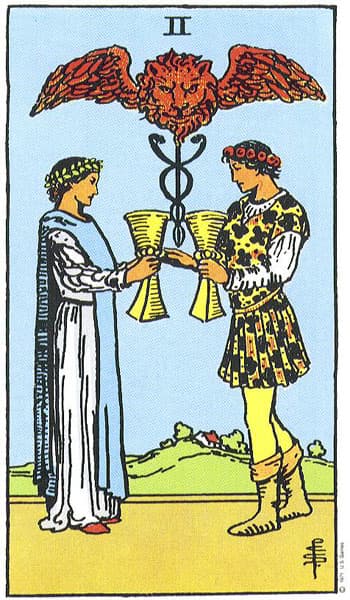
The caduceus is the staff of Hermes, messenger of the gods: two serpents entwined around one axis, a symbol of balance between opposites, communication and negotiation, and also of healing. It makes this a card of conversation and listening as much as of love. The winged lion's head above it is fire within the element of Water: desire and instinct not suppressed but lifted and consecrated; the wings raise the fire above the meeting. The two wreaths, flowers and laurel, suggest that each side brings something different to the bond: feeling and beauty beside achievement and honour. The figures stand at the same height, a partnership of equals rather than a rescue. The house on the hill behind them hints at a shared future that can be built, in keeping with Venus in Cancer, the sign of home and family.
Place in the arcana sequence
The Ace of Cups is feeling born, with no 'other' yet; in the Two of Cups two people choose to hold the feeling together, and in the Three the bond widens into community and celebration. Two is duality: mirror, choice and mutual recognition, and in Cups that duality is agreement rather than conflict. The card can be seen as 'the little Lovers': the choice of a relationship at the everyday, personal level, beside the Major Arcana's Lovers, a choice of value and destiny. Together with the Ace of Cups it points to the beginning of a new partnership with mutual affection.
Connections with other cards
Possible readings depend on the question and the cards' actual positions.
| Card | Possible connection |
|---|---|
| Ten of Cups | With the Two of Cups, the meeting of two who extend a cup to each other widens into a home and a circle. Emphasis: the home rests on the reciprocity at its base, on what each side gives and receives, not only on the picture formed around it. |
| Knight of Cups | A gesture meets possible reciprocity; check whether it is actually expressed. |
| Ace of Cups | With the Two of Cups, the feeling that woke in the Ace finds someone to hold it with: what was born in one heart now asks for reciprocity. Emphasis: a shared vessel in which both sides give and receive, not one heart overflowing on its own. |
| Three of Cups | With the Two of Cups, a bond between two opens to a wider circle: friends, community, the long table. Emphasis: shared joy that nourishes the relationship, while the couple still keeps a place of its own. |
| The Fool | With the Two of Cups, attraction and a wish for closeness meet freedom and spontaneity: an exciting beginning or continued contact in an undefined bond. Wanting to continue and readiness for commitment are separate. Mutual willingness is a hypothesis supported by context and positions, not a promise. |
| The Fool + Seven of Swords | With the Two of Cups and Seven of Swords, a desire for closeness or continued contact may coexist with an undefined or free-flowing bond and caution or incomplete transparency. Integrate attraction, relationship structure and communication into one account while preserving position ownership. Do not infer commitment, agreed non-monogamy or infidelity without context. |
| Wheel of Fortune | A mutual encounter or renewal; distinguish a moment of closeness from the ability to sustain a bond. |
| Justice | Reciprocity and agreement between two people. Emotional closeness and the terms of the relationship may differ. Interpret through the question and both fixed positions; co-occurrence is not a chronology or evidence of an event. |
| The Hanged Man | Connection meets limits on development; consider whether reciprocity is expressed in practice. |
| Temperance | Mutual encounter, emotional coordination and a relationship allowing giving and receiving. |
| The Tower | With the Tower the relationship is shaken, and the Two of Cups shows what is still worth building after the break. Emphasis: a renewed meeting on a more honest footing. Reciprocity is tested by upheaval; the capacity to meet one another, where that is present in practice. |
| The Sun | Mutual recognition and warmth; examine actual reciprocity rather than assuming destiny. |
| The Lovers | With the Lovers, the connection deepens into a choice: not only mutual attraction but a shared decision. Emphasis: shared values and a conscious choice of the relationship. Connection and reciprocity deepen choice. Support affection and attraction without treating potential as a completed decision or guaranteed marriage. |
| The Chariot | Progress meets mutual connection. In love, consider shared participation rather than determined pursuit alone; at work, partnership can support coordination. Is the wish to move forward shared? |
| Knight of Pentacles | Reliability meets reciprocity; friendship or romance depends on context and the people’s expressed relationship. |
| Queen of Pentacles | With the Two of Cups, mutual connection can take form in the body and shared life. Consider whether listening, giving and receiving work in both directions; closeness neither requires cohabitation nor guarantees a future relationship. |
| Six of Pentacles | With the Two of Cups, giving is weighed against the reciprocity of two people facing each other. Emphasis: moving from a relationship of giver and receiver to a meeting in which both reach out. |
| Nine of Pentacles | With the Two of Cups, independence meets reciprocity. Emphasis: a relationship chosen from abundance rather than hunger, and personal space kept within the connection, not against it. |
| Knight of Swords | Directness meets possible partnership; speed does not prove mutual attraction. |
| Three of Swords | With the Three of Swords, connection and hurt sit together: a real bond that was hurt, or closeness trying to exist beside pain. Emphasis: acknowledging the pain is part of the conversation, not an obstacle to clear away before coming closer. With the Two of Cups, the pain touches the relationship itself: a hurt between two people who are still connected. Emphasis: talking about the pain is part of the relationship, not a threat to it. |
| Knight of Wands | Chemistry meets the question of reciprocity; enthusiasm needs room for the other person’s response. |
Moment for reflection: Sit quietly and ask: What step today expresses the message “A heart-to-heart meeting created through genuine reciprocity”?
The image
Two figures stand facing each other at the same height and extend yellow cups toward one another; one wears a white robe with a blue mantle and a laurel wreath, the other a patterned yellow tunic and a wreath of red flowers. Between them, above the cups, rises a black caduceus with two entwined serpents, and above it a red winged lion's head. Green hills with a house, a blue sky and yellow ground lie behind them.
Two upright figures face each other, arms extended forward with the cups, their gazes meeting.