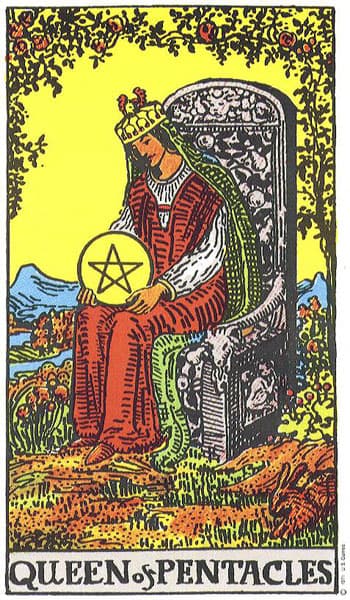
Queen of Pentacles Tarot Card Meaning
מלכת המטבעות
Also called: Queen of Coins · Queen of Disks
- nurturing
- domestic abundance
- connection to the body
- slow
months to years
By its element: Earth
Not a timing cardA court card: usually stands for a person.
Timemonths to years
By its element: Earth
Not a timing cardA court card: usually stands for a person.
Card Facts
Queen = ה (Heh) = water · Pentacles = earth — so Queen of Pentacles is water of earth.
Thirty degrees on the wheel, from 20° Sagittarius to 20° Capricorn. The three numbered cards in that span:
On the Tree of Life
3 · Binah
Formation: the force takes shape, limit and understanding.
ה — the second letter of the Tetragrammaton
Earth · Assiah, the world of matter
How the card sits on the treeThe Queen of Pentacles tarot card stands for nurturing, domestic abundance and connection to the body.
Warm, practical nurturing that creates tangible everyday abundance. This card invites you to examine how this message is operating within money, the body, work and security.
Message
The Queen of Pentacles reminds you that genuine abundance grows through attentive care for the body, home, resources, and close relationships. Join practicality with warmth: organize what needs stability while making room for comfort, beauty, and rest. Care for others should not erase your own needs, and giving should not become an invisible burden. The capacity to nurture grows stronger when the caregiver is nourished too. Grounding, boundaries, and balanced generosity transform ordinary life into a place where security and vitality can grow together. Core qualities of Queen of Pentacles: nurturing, warmth, resourcefulness, generosity and groundedness.
The light in the card
Practical care that creates abundance for those around you Core traits: practical common sense — she sees what needs doing and offers a workable solution; resourcefulness — she makes good use of what is available, even on a limited budget; reliability and consistency — she keeps her word and can be leaned on in hard times; discretion — others can confide without fear of exposure; generosity — she gives time, help, food and attention; nurturing — she notices needs and tries to meet them; warmth — approachable and welcoming, she creates belonging and lets others be themselves; naturalness — simple in approach, without pretence. Alongside these: responsibility and maturity, independence and the ability to provide, balance between achievement and care for people, building a secure material base, and the capacity to guide, advise and mentor. Through Taurus the emphasis falls on stability, perseverance, caution and judgment, restraint, a need for order and the familiar, love of simplicity, quiet conviction, an aesthetic eye, enjoyment of pleasures and the senses, and conservatism — a preference for what has proven itself.
The shadow in the card
Giving so much that your own needs are neglected Possible shadow traits, in the reversed card or a heavy expression of the archetype, which need not appear together: stubbornness and rigidity, fear of change and clinging to the familiar even when it limits, slowness, passivity and comfort that blocks action, a sense of scarcity, stinginess, possessiveness and jealousy, materialism and measuring worth through money and possessions, and excessive indulgence. The Taurus link especially stresses holding on to what exists, and the risk that the need for security becomes a limitation. Another side concerns caregiving itself: smothering care that leaves others no independence, control through giving, codependence and a need to be needed, over-giving to the point of depletion, self-neglect and burnout, work–home imbalance, neglect of the home or finances, and at times self-centredness and envy. These are possibilities to weigh against the context, not a description of the reader.
Psychological layer
Psychologically, this card reflects warm, practical nurturing that creates tangible everyday abundance. Emotionally she is described as caring, attentive to needs and calming, offering emotional support together with practical advice: she may notice that someone needs rest, food, help or security and respond through action. She is sometimes also described as emotionally restrained — listening and staying steady without displaying every feeling intensely — and that restraint can coexist with deep affection and devotion. Do not conclude that the reader is cold or repressed. Another possibility is self-worth tied to usefulness: feeling worthy of love only when providing, organizing or caring. This is a hypothesis only when the context supports it, not a claim about childhood or attachment style. Nurturing can express closeness, or occupy the space where feeling or receiving is difficult. Distinguish freely chosen care from a need to remain indispensable.
Personal growth
Nurture others without forgetting to nurture yourself Consider where the security that has been built still serves life and where it has started to limit it, and whether giving leaves room for personal needs and for others' independence. The capacity to nurture grows stronger when the caregiver is nourished too. Integration gives an insight a place in life over time: in the body, relationships, resources and a sustainable pace. The garden suggests growth through suitable conditions, repetition and enjoyment rather than a test of willpower. A habit that supports life today may need to change later; stability stays alive when it responds to changing needs.
Love & relationships
In Pentacles, relationship is tested through stability, reliability, embodiment, home, time, and resources — the things through which love takes everyday form. The Queen of Pentacles in love brings practical warmth: food, home, touch, order, and care that let people feel safe. Her shadow is becoming the person who holds the entire household and relationship until no one notices the cost to her. As a Queen, power works from the inside outward: maturity means holding the suit's quality without being ruled by it. Pentacles ask whether the bond merely talks about security or actually builds routine, reciprocity, and a life that can be inhabited. In relationships these traits may appear as devotion and sustained investment, seriousness and a wish for continuity, reliability and consistent presence, practical care that eases shared life, warmth and home-making, an expectation of reciprocity, sensuality and enjoyment of closeness, high standards in choosing a partner, and independence that lets her contribute from a base of her own. Love here shows in everyday conduct. Some interpretations also emphasize orderly courtship, romance, good taste, a wish to feel wanted and pampered, and attraction to a mature, responsible partner, alongside perfectionism and sensitivity to criticism — these are interpretive emphases, not a fixed description. The gaze toward the pentacle can open a distinction between loving attention and concentration on what is being managed. When the reader's words support it, consider whether caring for the home, children or a business leaves room for the partners to meet each other, or whether one feels like another task. A lowered gaze does not establish emotional neglect. Alongside giving, the seated posture and gentle hold also suggest feeling wanted, resting in closeness and receiving affection.
Career
At work, Pentacles emphasize professionalism, money, craft, results, routine, the body, and the ability to build something durable. At work, she represents wise resource management, stability, care for people, and the ability to turn an idea into a functioning system. Professionalism includes body, rhythm, and environment, not only output. As a Queen, the card emphasizes inner command, influence through presence, and the ability to create conditions in which others can function better. The measure is not only speed of advancement, but whether the path develops value, skill, and security that can still be trusted later. At work: business sense and management ability, organization, efficiency and planning, diligence and follow-through, responsible handling of resources, turning skills into income, measured evaluation of opportunities, and combining professional results with care for people — as a partner, colleague or mentor. Interpretations differ: some stress entrepreneurship and business talent, others a preference for salaried work because of the need for security and caution about risk. What they share is the wish to build a stable financial base.
Money & security
The Queen of Pentacles highlights the link between day-to-day management of resources and real well-being: covering the household's needs, keeping a financial margin, and weighing spending on care, comfort and quality of life. With money: seeking financial security and reliable income, frugality alongside willingness to pay for quality, financial independence, and using money to create a safe, comfortable life. On the challenging side, consider a sense of scarcity even when resources exist, saving that prevents enjoyment or generosity, or fear of being unable to meet needs.
Family
Within family life, this card brings forward the theme of warm, practical nurturing that creates tangible everyday abundance, and invites awareness of roles, needs and patterns within the household. At home: love of comfort, quality and beauty, caring for the home, hosting and cooking, fondness for children and animals, and a gift for plants and gardens. The garden and rabbit imagery is linked to fertility, abundance and creating conditions for growth. She can also represent the working parent who combines earning a living, caring for the family and caring for herself. Care can move between generations: an adult child supporting ageing parents, responsibilities being redistributed, or a role in a blended family when these are part of the question. Care may take the form of time, coordination and presence, beyond money. Family can also offer belonging and support to the person holding it together; do not assume that support exists or identify the Queen as a particular mother.
Spirituality
The Queen of Pentacles can describe the meeting of inner understanding and tangible life. Earth receives water and becomes a place for growth: spirituality embodied through attention, connection to the environment and the capacity to nurture. This is an image of receiving and developing, not a promise that every process is complete. Enjoyment, beauty and rest can also belong to integration without having to justify them solely through usefulness.
Mythic parallel
Demeter is the central parallel for the Queen of Pentacles: nourishing earth, cycles of fertility, and the ability to create conditions in which others grow. Her story also warns against losing oneself inside the caregiver role. The Queen reminds us that soil which yields crops also needs a season of rest. This is an interpretive parallel intended to deepen the reading, not a claim that the myth is a fixed historical source of the card.
Symbols and their relationships
The pentacle supported with both hands in the lap suggests a nurturing hold: something valuable receiving attention, beyond a possession to protect. Its place in the lap can evoke pregnancy or symbolic maturation without indicating an actual pregnancy. The fruit, small figures and goat head carved on the throne allow a reading of fertility and belonging; the idea that family also supports the caregiver is an interpretive parallel. The surrounding garden suggests authority that creates conditions for growth. Sitting does not prove that someone has already achieved material or emotional security.
Intimacy and sexuality
When the question concerns sexuality or attraction, the Queen can suggest embodied sensuality: touch, warmth, comfort, pleasure and receiving as well as giving. Caring can coexist with desire, but being needed is not proof of being desired. The lap and rabbit offer symbolic fertility, not evidence of pregnancy, sexual activity or another person's intentions. Mutual willingness and the actual context determine relevance.
Care after disruption
After disruption, the body and everyday life can have room again: food, sleep, a safe space and practical support according to what is available. These are images of support, not demands to resume full functioning or stop hurting. Caring for others may sustain someone or divert attention from personal needs; this is a possibility to explore, not a diagnosis.
When this meaning applies: When a crisis or disruption is already stated in the question; do not infer it from the card.
Care across generations
The Queen can illuminate responsibility moving from a parent to an adult child, coordination among caregivers or resources shared between homes. In a blended family, a parent from an earlier relationship is relevant only if already mentioned. The Queen does not identify a particular mother, establish children or indicate a romantic third party.
When this meaning applies: Only when the question concerns family roles, caring for parents or a blended family.
Care as skilled work
Grounded care brings warmth together with skill, time, tools and working conditions. This can echo care professions, hospitality, nutrition, gardening or practical support without prescribing a profession or promising medical competence. The recipient is more than a project, and the caregiver also needs sustaining conditions.
When this meaning applies: When the question already concerns care work, the body, food or a supportive environment.
Posture across decks
In Rider–Waite–Smith the pentacle is supported in the lap and the Queen looks toward it within a garden. The Golden Dawn description proposes a profile, one side of the face light and the other dark, with a sceptre and gold orb beside goat imagery. Thoth shows goat horns, armour, a sceptre and a disk; a calm river brings fertility to a desert and oases begin to appear. Marseille emphases vary by edition, sometimes showing a sceptre and a raised coin. No sceptre in RWS is a visible detail; relinquishing power for care is an interpretation. An unidentified deck variant is not presented as an established description.
When this meaning applies: For a question about symbolism or traditions; do not transfer details between artworks.
Earth qualities and integration
Virgo as mutable earth can suggest sorting and processing, Capricorn as cardinal earth forming a structure, and Taurus as fixed earth establishment and continuity. This is an interpretive model of integration, not stages everyone must undergo. Taurus and Venus can emphasize the body, senses and enjoyment without replacing the Queen's Golden Dawn span. Consolidation that supports continuity may become rigidity when needs change.
When this meaning applies: As a symbolic comparison, not a required astrological sequence or timetable.
Hebrew parallels for home and care
The woman of valour can echo resourcefulness, tending a field and home, and preparation for the future. The joyful mother can offer an image of belonging and life finding room; infertility is not a diagnosis supplied by the card. Reading the barren woman as the home's mainstay is wordplay rather than the verse's literal meaning. Counting the Omer can illustrate integration through repetition, and Iyar healing within a tradition using that association. These are parallels, not the Queen's timing window.
When this meaning applies: Only as a cultural or spiritual parallel, not a claim about the card's origin.
Gaia and living earth
Gaia as an image of living earth extends the Queen beyond biological motherhood: land and water participate in creating conditions for growth. Rivers meeting soil, illustrated by the Mesopotamian image, suggest fertility sustained by continuing nourishment. This is a mythological and cultural parallel alongside Demeter, not a claim about tarot's origin or a promise of bodily fertility.
When this meaning applies: When the question concerns mythology, earth and water, or the symbolism of nurturing.
The Hermit, Tower and Queen
One possible arc is inner reflection, disruption of a familiar order and nurturing a livable life. Do not infer secrets or a false household from every crisis or promise completed healing. In RWS the lantern star, lightning and pentacle star can be compared as an image of light becoming tangible understanding; they are different symbols, not one star travelling between cards. This does not replace the Star in the Major Arcana sequence.
When this meaning applies: Only if all three cards are drawn and the question and positions support the arc; co-occurrence is not an event sequence.
Astrology, Qabalah and number
In the Golden Dawn scheme the Queen is water of earth, Heh within final Heh: receiving and developing material life. Its span is 20° Sagittarius to 20° Capricorn, with Capricorn emphasis. AGAT's separate modern court scheme assigns Taurus, fixed earth; keep the schemes distinct. The Queen's Hermetic role is a receptive stage, not the final material product. Thoth's senior Knight and the RWS Knight are not interchangeable ranks. Symbolic correspondences do not establish a person's sign or an event date.
Reversed meaning
Possible expressions include fear and mistrust, dependence on being useful, or practical life becoming mechanical. Consider these only where the question and orientation support them; a reversal is not proof of a cold mother, manipulation, neglect or an attachment diagnosis.
Yes or no
Read the spread's supplied tendency through practical capacity, sustained care and reciprocity. The card does not independently guarantee a yes, a relationship, pregnancy or financial security; reversal is not an automatic yes either.
Connections with other cards
Possible readings depend on the question and the cards' actual positions.
| Card | Possible connection |
|---|---|
| Two of Cups | With the Two of Cups, mutual connection can take form in the body and shared life. Consider whether listening, giving and receiving work in both directions; closeness neither requires cohabitation nor guarantees a future relationship. |
| The Tower | With the Tower, nurturing can provide support within disruption: body, space and practical help according to what is available. Do not assume a family crisis, secrets or completed healing; read the difference between holding from fear and a livable foundation through the context. |
| The Sun | Bodily warmth, home and grounded enjoyment; care for others should leave room for personal needs. |
| The Empress | With the Empress, nurturing is emphasised twice: nourishing earth and an abundant garden in the same spread. Emphasis: the ability to create conditions for growth, together with the question of whether the one who nurtures is nourished too. |
| The Hierophant | With the Hierophant, values and traditions can take form in home and care. Consider which habits sustain belonging and which constrain independence. Marriage or a family ceremony is relevant only when it is the question's topic, not a promise from the pair. |
| The Lovers | Everyday nurture and security, including receiving rather than only giving. |
| The Hermit | With the Hermit, inner reflection meets close attention to the body and life. Solitude can support care or distance someone from connection when already stated. If the Tower is also drawn, consider an arc of reflection, disruption and renewed care only through the question and positions; co-occurrence does not establish chronology. |
| Ten of Pentacles | With the Ten of Pentacles, daily care meets continuity, belonging and responsibility across generations. Consider whether family also supports its caregiver. The pair proves neither inheritance, wealth nor a particular family structure. |
| Page of Pentacles | With the Page of Pentacles, attention to needs meets learning and a practical beginning. A child or family beginning is relevant only if already part of the question; the cards do not identify a child or pregnancy. |
| Knight of Pentacles | With the Knight of Pentacles, persistence and action meet conditions that allow effort to mature. Distinguish consistency from stagnation. Do not substitute Thoth's senior Knight for the RWS Knight or infer romantic commitment from pace alone. |
| King of Pentacles | With the King of Pentacles, the earth is carried from within and from without: nurturing that creates conditions, and leadership that manages resources for more than one person. Emphasis: two ways of carrying responsibility and stability that can complement each other, not a description of a couple or particular people. With the Queen of Pentacles, nurturing from within and leadership outward are present together. Emphasis: the two cards as two qualities of stability, responsibility for resources and attention to the body, the home and people, not as a couple or particular people. |
| Four of Pentacles | With the Four of Pentacles, consider the quality of holding: necessary protection of resources or difficulty releasing from fear. In relationships, care can leave room for independence or carry an unspoken expectation; the pair alone does not establish control. |
| Five of Pentacles | With the Five of Pentacles, tangible support can ease a stated sense of lack or difficulty. Wishing to offer security does not guarantee resources, and the pair establishes neither deprivation nor abandonment. |
| Six of Pentacles | With the Six of Pentacles, giving is weighed through the power relations in it as well. Emphasis: giving that leaves the receiver stronger and the giver whole, not control through giving or a hidden debt. |
| Seven of Pentacles | With the Seven of Pentacles, nurturing meets evaluation of time, conditions and results: is patience needed or a change in care? In RWS imagery maturation cannot be forced; when using Thoth, do not automatically turn failure into promised later success. |
Meaning by spread position
| Position | Possible meaning |
|---|---|
| Central message | Care that gives understanding tangible form while leaving room to receive support. |
| Present | How attention, resources and needs are held in everyday life. |
| Challenge | Responsibility filling all available space, or difficulty distinguishing care from control, if supported by the context. |
| Root | A view of home, belonging or worth through usefulness may underlie the question; this is a hypothesis, not revealed history. |
| Past | Care or a foundation established earlier may still support life or need adjustment to changed needs. |
| Awareness | Close attention to what is held: body, relationship and resources, beyond appearing orderly from outside. |
| Potential | Potential to create conditions for closeness, independence and growth through mutual support; commitment is not promised. |
| Near future | Care and integration may develop gradually within existing conditions, without assigning an event date. |
| Self | Consider the relationship between supporting others and being supported, without assigning the card's gender to a person. |
| Other | Consider practical expressions of care and consistency; the card does not establish another person's feelings. |
| Environment | The environment may offer conditions and support or expect more care; ground this in the question rather than inventing a family or caregiver. |
| Outcome direction | Potential for a livable foundation: sustained care, closeness and resources, subject to reciprocity and actual conditions. |
| Advice | Make room to consider what needs care and what needs space, including receiving affection and help. |
| Lesson | Worth and connection need not rest solely on useful performance; nurturing can include rest and enjoyment. |
| Support | Resourcefulness, the body, the environment and existing support can sustain a process, without assuming they are available to everyone. |
| Hopes and fears | A wish for home and security, or fear of losing one's place when no longer indispensable; this position describes a hope or fear, not an event. |
Questions for reflection
- Who supports you when you are supporting everyone?
- What room is there for the needs of the person offering care?
- What makes it possible to feel wanted without having to be useful?
- Does caring for shared life leave room for the people to meet each other?
- What is the difference here between attention and management?
- What kind of support creates more independence?
- What becomes possible when resting and receiving are allowed?
- What gives a home a sense of belonging beyond order and functioning?
- Has responsibility shifted between generations, and what needs to change with it?
- What turns a new understanding into something that can be lived with?
- What conditions allow what matters here to grow?
- What still needs time, and what needs different conditions?
- Where does enjoyment itself help sustain continuity?
- Does the existing habit still fit today's needs?
- What distinguishes a secure foundation from one that is difficult to move beyond?
- How can something precious be cared for without making it dependent?
- What does close attention reveal that cannot be seen from outside?
- What place do warmth, touch and comfort have in this relationship?
Moment for reflection: Sit quietly and ask: What step today expresses the message “Warm, practical nurturing that creates tangible everyday abundance”?
The image
In Rider–Waite–Smith, a crowned queen sits on a stone throne in a garden. Fruit, small figures and a goat head are carved on the throne. Both hands support a large gold pentacle in her lap, and her head inclines toward it. Rose branches appear above her, vegetation surrounds her, and a rabbit is on the ground in the foreground. She holds no sceptre.
Seated on a throne, head and gaze inclined toward the pentacle in her lap, both hands supporting it close to the body.