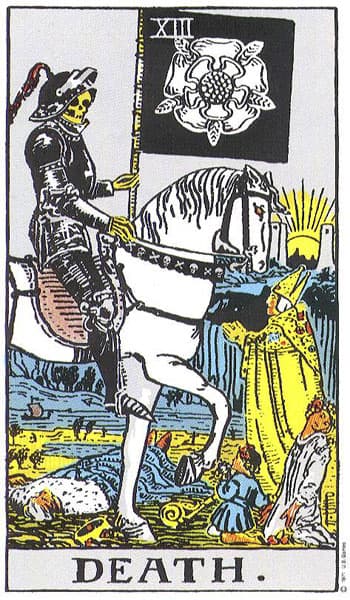
Death Tarot Card Meaning
מוות
- ending
- change
- renewal
- slow
weeks to months
By Scorpio
Only when asked whenTransition and ending; the timing is secondary to the meaning.
Timeweeks to months
By Scorpio
Only when asked whenTransition and ending; the timing is secondary to the meaning.
Card Facts
נ = Nun · Simple letter = Scorpio — so the path of Death runs from Tiferet to Netzach.
On the Tree of Life
Tiferet to Netzach
Path 24 of the 32 paths of wisdom
The letter Nun — simple letter
How the card sits on the treeThe Death tarot card stands for ending, change and renewal.
A necessary ending that makes room for something new. This card invites you to examine how this message is operating within the personal and inner path.
Message
Death makes room for endings and deep change without predicting physical death. A role, relationship, habit or sense of identity may be changing. A transition can be met before renewal is felt. Pain does not prove that someone is clinging, and acceptance need not end longing. There is no need to erase the past or immediately find a lesson in it. The message can be permission to acknowledge what has changed and give a personal response time. Core qualities of Death: release, renewal, completion, clearing and deep change.
The light in the card
Release, clearing and rebirth
The shadow in the card
Clinging to the past or fear of change
Psychological layer
The card invites reflection on accepting an ending and the possibility of renewal, without assuming every ending is necessary or renewal guaranteed. The walking horse can suggest change whose conditions are not entirely within someone's control, and a gap between recognizing an ending and being able to feel it. Pain need not come from clinging: real loss, circumstances and an individual pace also matter. The horse's movement does not establish whether an event will unfold slowly or suddenly.
Personal growth
Part from what has completed its role
Love & relationships
In relationships, Death may emphasize an ending or a deep change in the bond's form: communication, dependence, expectations or a shared identity. Consider what has ended and what remains alive through the question, positions and reported circumstances. Pain does not necessarily arise from clinging; real loss can hurt even when accepted. Impulsive cutting off or difficulty releasing are possibilities, not assumed facts. This is neither a prediction of physical death nor an instruction to end a relationship. When sexuality is explicitly the subject, explore changes in attraction, old roles or newly recognized needs. Do not infer the end of the relationship, absent desire or a particular sexual identity. The horse itself does not signify orgasm or physical functioning.
Career
In career matters, Death points to the end of a deep professional cycle: a role, field, company, work style, or identity that once fit and no longer does. It can appear before a major transition in which adding another task is not enough; something substantial must be released. Its shadow is remaining on a dead path because of sunk cost, or burning bridges without processing the transition. The card asks for a clean ending, preservation of what was learned, and the courage to stop trying to revive a structure that has completed its purpose.
Money & security
In financial matters, this card reflects a necessary ending that makes room for something new, and recommends choosing with awareness, stability and a long-term view.
Family
Within family life, this card brings forward the theme of a necessary ending that makes room for something new, and invites awareness of roles, needs and patterns within the household.
Spirituality
On a spiritual level, this card teaches: Part from what has completed its role. The horse carrying Death can symbolize passage between forms of life and identity: vitality continues while a familiar structure changes. A guide of souls is a possible mythological comparison, not proof of an afterlife or the origin of each detail. The pale horse does not promise that change is purifying or beneficial.
Mythic parallel
The myth of Inanna descending into the underworld and surrendering another symbol of identity at each gate is a deep parallel for this card. By the end of the descent she stands without the markers that once defined her, and only after symbolic death can a different return occur. The story shows that real transformation is not cosmetic; sometimes an old identity must be lost. Death reminds us that renewal does not erase grief — it grows through the passage of grief.
Connections with other cards
Possible readings depend on the question and the cards' actual positions.
| Card | Possible connection |
|---|---|
| Ten of Cups | Change in the picture of shared life, belonging or the family ideal. Explore what changes in the shared experience and what still connects. |
| Queen of Cups | Deep change meets sensitivity, longing and emotional receptivity. A relationship form can end while feelings remain. |
| Queen of Cups + Knight of Wands | Movement and drive meet transformation and sensitivity. An intense encounter may differ from the capacity to sustain contact and attend to changing needs. |
| Five of Cups | With Death, the ending and the sorrow over what was spilled reinforce each other. Emphasis: give mourning room before speaking of what remains or of what comes after. With the Five of Cups, the ending meets sorrow over what was spilled. Emphasis: give mourning room before speaking of what remains or of what comes after. |
| Six of Cups | A changing relationship to the past, a childhood role or a familiar bond. Memory and affection can remain without recreating an old arrangement. |
| The Fool | With Death, the beginning comes after an ending: something has finished, and the Fool is the step into what comes after it. Emphasis: honour the ending before rushing into the new, and see the beginning as its continuation, not an escape from it. |
| Wheel of Fortune | A substantial transition and the end of an old form; examine attempts to restore a finished stage, without a literal reading of death. |
| Justice | A clear ending, changed commitment or orderly transition. Consider rash cutting or recognition of an ending already described; never infer physical death. Interpret through the question and both fixed positions; co-occurrence is not a chronology or evidence of an event. |
| The Hanged Man | Suspension and ending meet. A pause may clarify what has ended, or difficulty letting go may preserve an unresolved state; positions govern, with no built-in chronology. Ending or change is read beside an unresolved state. Consider recognition of an ending or a condition still needed for transition; do not infer suspension came first, and never infer physical death. |
| The Hanged Man + Temperance | Suspension and reframing meet transformation and adjustment among what remains. An old arrangement may need to change before a different integration becomes possible. |
| Temperance | Assimilating change and rebuilding after an ending. |
| The Devil | Transformation meets strong attachment: release from dependence is possible, while holding on may preserve a burdensome situation. Explore what connects and what constrains. |
| The Tower | An ending or transformation meets disruption of a structure or plan. Clarify what ends, on what scale, and what remains available within upheaval. |
| The Sun | Vitality and clarity alongside an ending: joy and longing may coexist, and life may continue without restoring the past. |
| The High Priestess | Transition meets an inner sense or something not yet put into words. What is felt may differ from what can be confirmed in practice. |
| Judgement | With Death, the spread holds an ending followed by rising, in the symbolic sense of a process. Emphasis: what rises is made from the material of the old and is not a return of what ended; the ashes are not thrown away, they are what one rises from. |
| The Lovers | A deep change in how the bond exists: a habit, definition or relationship may end, as context clarifies. |
| The Chariot | Movement meets an ending or transformation. Do not assume a breakup; a relationship pattern may be changing. At work, one stage may give way to another. What needs to end for the direction to change? |
| Ten of Pentacles | Change in a long-term structure: assets, legacy, family business or intergenerational roles, only where relevant to the question. |
| Four of Pentacles | Holding security, resources or an identity meets transition. Holding on may protect a real need while also limiting change; what does each option cost? |
| Ten of Swords | With Death, two cards of ending appear together, and the risk of a literal reading grows. Here both speak of the end of a form, a pattern or a period, never of physical death. Emphasis: what has completed its course, and how the Ten of Swords adds to that ending the pain and exhaustion of the road to it. |
Moment for reflection: Sit quietly and ask: What step today expresses the message “A necessary ending that makes room for something new”?
The image
An armored skeleton rides a white horse carrying a flag with a white flower; figures fall or kneel around the rider while the sun rises between two distant towers.
Upright mounted posture, holding a flag while riding forward