Ruby (Odem) — The Stone of Life, Passion, and Inner Strength
Ruby is more than a red gemstone: chromium gives it an inner glow, while traditions link it to courage, passion, Reuben, and Cancer. A scientific and spiritual guide with practices and practical uses.
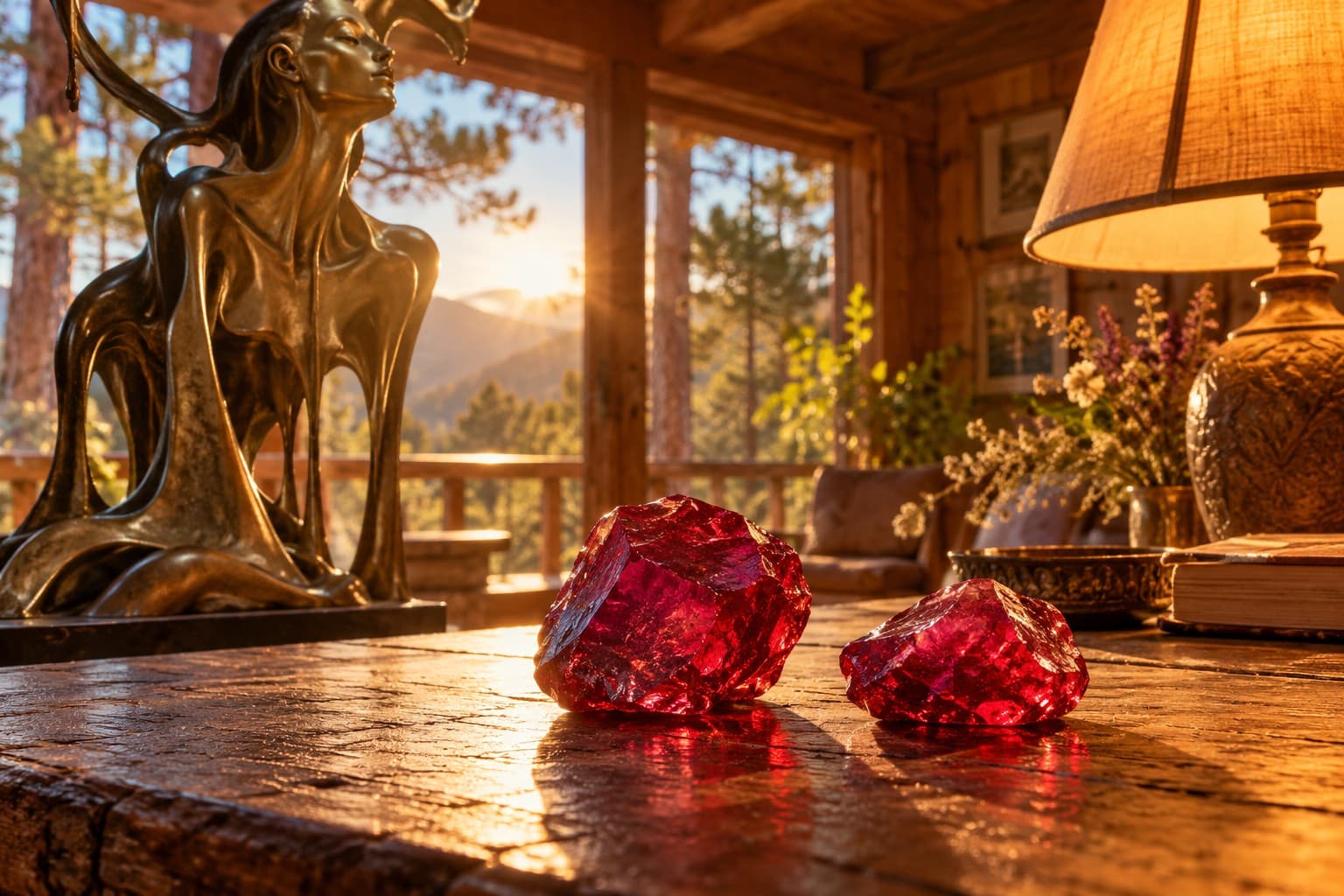
When you hold a polished ruby up to the light, its red sometimes seems less like a surface color than a glow rising from within the stone. This is part of its fascination: a crystal so hard and durable can appear alive, almost pulsing. For centuries, ruby has been associated with blood, royalty, love, and passion. But before attributing spiritual power to it, it is worth understanding what actually gives rise to that red.
Ruby is red corundum, a mineralogical relative of sapphire. Chromium within its crystal structure gives it color and can also produce red fluorescence. To me, this is a beautiful image of inner strength: something small within the structure changes the way the light appears. In this article, we will move from the crystal and its history to its symbolic meaning—courage, passion, responsibility, and the ability to hold fire without being burned by it.
Among its varieties and mineral combinations, Ruby in Fuchsite and Ruby in Kyanite are also worth knowing. These composite stones have distinct appearances and characters, and each has its own page in the library.
Mineral Identity and Formation
Ruby is the red variety of corundum, aluminum oxide (Al₂O₃). Traces of trivalent chromium (Cr³⁺) give it its red color; iron and other factors influence its hue and fluorescence. Corundum crystallizes in the trigonal system, has a hardness of 9 on the Mohs scale, a specific gravity of about 4.0, and a refractive index of approximately 1.762–1.770. It resists scratching but is not immune to fractures or impact damage. Corundum in other colors is generally called sapphire, and the boundary between pinkish ruby and pink sapphire may depend on the classification system.
Ruby forms under geological conditions rich in aluminum and relatively low in available silica. Some deposits are associated with metamorphosed marble, while others occur in metamorphic rocks of various origins. Inclusions, crystal structure, and trace-element composition help laboratories assess a stone’s origin, though it cannot always be determined with certainty.
Color, Light, and Optical Phenomena
Chromium absorbs certain wavelengths of light, producing ruby’s familiar red. Some stones exhibit red fluorescence under ultraviolet light and suitable lighting conditions. Synthetic ruby crystals were used in the first laser in 1960. This is a genuine optical property and should not be confused with claims about a spiritual “healing frequency.”
In star ruby, tiny needles aligned in particular directions reflect light in the shape of a star, usually with six rays, especially when the stone is cut as a cabochon. The trade term “pigeon’s blood” describes a vivid, highly prized red color, not a separate mineral; the criteria vary among laboratories.
Varieties, Mineral Combinations, and Treatments
Natural ruby may be transparent, translucent, or opaque, polished or rough. Ruby in Zoisite (anyolite) is a rock combining ruby and green zoisite; Ruby in Fuchsite combines ruby with green fuchsite mica; Ruby in Kyanite consists of ruby within a mineral assemblage that includes kyanite. These are mineral combinations, not chemically distinct varieties of corundum.
Synthetic ruby is laboratory-grown corundum with a composition and structure similar to those of the natural stone. It should be distinguished from imitations made of glass or other materials. Heat treatment to improve color and appearance is common in the industry; glass fracture filling and other treatments are also used, affecting durability, value, and care requirements. For an expensive purchase, it is advisable to request an independent gemological report stating whether the stone is natural or synthetic and whether any treatments have been detected.
Geographic Sources
The Mogok region of Myanmar is historically famous for marble-hosted ruby; Mong Hsu is another important source. The Montepuez region of Mozambique became a major commercial source in the 21st century. Other sources include Vietnam, Thailand, Cambodia, Sri Lanka, Madagascar, Tanzania, Kenya, Afghanistan, Pakistan, and Tajikistan. Country of origin alone does not guarantee quality: color, clarity, cut, weight, treatments, and documentation are significant factors.
Ruby in Culture and History
In India, ruby was called Ratnaraj—“king of gemstones”—and was associated with rulership, life force, and precious offerings. Burmese traditions tell of warriors who believed it could protect them from injury. In medieval Europe, it adorned crowns and aristocratic jewelry and was associated with wealth, love, and warnings of danger. Stories of an inner fire that never dies, or of a stone that gives off its own light, are historical legends, not descriptions of a physical property.
Ruby in the Bible and the High Priest’s Breastplate
Odem (OH-dem), the Hebrew name used for ruby, is the first stone mentioned in the description of the first row of the High Priest’s breastplate: “a row of odem, pitdah, and bareket” (Exodus 28:17). The names of the twelve tribes of Israel were engraved on the breastplate’s stones (Exodus 28:21). In a familiar interpretive tradition, odem is associated with Reuben, the firstborn son of Jacob and Leah. In his commentary on Exodus 28, Rabbeinu Bahya discusses odem, its color, and the properties attributed to it, connecting it with Reuben. Reuben’s stories contain themes of being first, impulsiveness, remorse, and making amends; “unstable as water” (Genesis 49:4) suggests a tension between strength and self-regulation.
Importantly, there is no certainty that the biblical “odem” is ruby in the modern mineralogical sense. Scholars have also proposed carnelian or other red stones as possible identifications. The biblical association therefore belongs to the stone called “odem” in tradition and should not be presented as proof of its gemological identity.
Reuben, the Month of Tammuz, and Cancer
In traditions that associate the tribes with the months, Reuben is linked with Tammuz. In commonly used versions of Sefer Yetzirah, the month of Tammuz is associated with the zodiac sign Cancer and the sense of sight. This creates a symbolic chain: odem—Reuben—Tammuz—Cancer. This is not an explicit statement in the Bible itself, and other systems of association may yield different correspondences.
In Western astrology, Cancer is associated with the element of water and the Moon, symbolizing home, motherhood, memory, protection, and emotion. In crystal traditions, ruby is associated with fire, blood, vitality, and passion. On an interpretive level, this meeting of fire and water symbolizes the courage to express feelings without being ruled by them, and the ability to protect loved ones without becoming possessive. The connection with Reuben and the sense of sight invites a question: Am I seeing reality as it is, or through the memory of being hurt?
Rabbeinu Bahya also records traditional properties associated with pregnancy and childbirth. Alongside Cancer’s symbolic connection with motherhood and home, it is important to emphasize that there is no medical evidence that ruby improves fertility, prevents miscarriage, or helps with childbirth.
Chakras, Elements, and Astrology
In modern crystal traditions, ruby is associated primarily with the root chakra (Muladhara): stability, survival, security, and connection to the body. Other associations include the heart chakra, through love and devotion, and sometimes the solar plexus chakra, through will and leadership. Its most common symbolic element is fire. In Vedic astrology, ruby is associated with the Sun (Surya), while its connection with Cancer comes through a different Jewish-astrological framework; the two systems should not be merged as though they were a single tradition. The stone has no medically established “energy frequency” or one measured in hertz.
Working with Ruby’s Energy—What We Seek in the Stone
In crystal traditions, ruby is not regarded as a stone of cool tranquility. It symbolizes warmth, a pulse of life, determination, and presence. When I think about working with it, the question is not how to feel more powerful at any cost, but where I lack the courage to express a clear desire. Sometimes that means starting something I have put off; at other times, it means ending a struggle that has become a battle for control.
What You Might Feel When Holding the Stone
In the hand, polished ruby may feel cool and smooth, while rough ruby has a coarser texture. Some people describe feeling alertness, emotional warmth, or a desire to act when meditating with it; these are personal experiences, not proven physiological effects. It is worth noticing what the stone stirs in your imagination rather than assuming that everyone will experience the same thing.
Wearing It as Jewelry or Carrying It in a Pocket
A ruby pendant or ring can serve as a reminder of a single intention: to speak clearly, set a boundary, dare to offer an idea, or choose closeness. Each time you touch the jewelry, you can ask whether your next action comes from courage or fear. There is no proven medical significance to where the stone is placed on the body.
Meditating with Ruby
Place the stone where you can see it or hold it in your hand, sit comfortably, and breathe at your usual pace. Look at the red light and ask, “What truly matters to me right now?” After a few minutes, identify one small, achievable step. In this way, the stone serves as a focus for attention, not a promise of external change.
At Home and in the Workplace
On a desk, it can bring to mind a decision that is ready to be acted on; in a creative corner, a connection with enthusiasm; and in a space shared by a couple, warmth balanced with listening. In places where tension runs high, you might instead choose a stone that symbolizes calm, such as Blue Lace Agate, to balance the imagery of fire.
Working with the Chakras
Within the modern tradition, you can place ruby near the pelvic area as a symbol of the root chakra, or near the heart as a symbol of emotional courage. Choose one focus and stay with it for a few minutes, without pressure or expectations of a medical outcome.
In Tarot Readings and Therapeutic Work
Before laying out a tarot spread, ruby can serve as a reminder to ask a courageous question, not merely one whose answer feels comfortable to hear. For example: “What choice am I putting off because I fear its emotional cost?” During a reading, you can place the stone beside the deck as an anchor for honesty and intention, while respecting the other person’s boundaries. In energy healing, it may serve as a symbolic object, not a diagnostic tool.
Symbolic Cleansing and Charging
Those who practice crystal cleansing can choose sound, moonlight, or a moment of intention-setting. There is no physical need for “energetic charging.” When actually cleaning jewelry, the stone’s treatments must be taken into account; glass fillings and fractures are especially sensitive to heat and cleaning agents.
When Ruby May Not Be the Right Choice
If the aim is to slow down, listen, or regulate emotions during a turbulent moment, ruby’s fire symbolism may be less suited to the practice you need. There is no obligation to work with a stone simply because power is attributed to it. Sometimes the right choice is to set it aside.
Energetic and Spiritual Meanings
In crystal healing, ruby symbolizes life force, courage, the awakening of desire, passion, loyalty, perseverance, creativity, and presence. It reminds us that love calls not only for feeling, but also for choice and action. The shadow side of this symbolism includes jealousy, possessiveness, competitiveness, anger, impulsiveness, and control. The spiritual work is not to “turn up the fire” without limit, but to learn how to direct it.
On a psychological-symbolic level, we can consider three stages: survival—the desire to feel safe; passion—the ability to want and create; and sovereignty—consciously choosing how to use one’s power. This is a framework for self-reflection, not a psychological diagnosis or a scientific claim.
Love, Relationships, and Sexuality
In various traditions, ruby represents passion, attraction, devotion, and emotional courage. It can serve as a symbol for exploring how to sustain warmth and closeness without confusing love with ownership. In relationship work, we might ask: What am I really asking for? Where am I afraid of rejection? When does protecting the relationship become an attempt to control the other person? There is no evidence that wearing ruby changes sexual attraction, another person’s feelings, or bodily functioning.
Spiritual Uses and Stone Pairings
You can hold ruby during meditation as an anchor for focusing on courage, place it in a workspace as a reminder of perseverance, or use it in a personal intention-setting ritual. In Reiki and crystal traditions, it is sometimes placed near the body, but this is not a proven medical treatment.
Common symbolic pairings include rose quartz—passion and tenderness; amethyst—enthusiasm balanced with discernment; garnet—vitality and perseverance; black tourmaline—boundaries and grounding; emerald—growth and compassion; and clear quartz—focused intention. These are traditional interpretations, not measured therapeutic interactions.
Physical Associations, Safety, and Stone Care
Over the centuries, ruby has been credited with properties related to blood, the heart, fertility, and protection. There is no reliable clinical evidence that ruby heals disease or changes physiological processes. Do not ingest mineral powders or insert stones into the body. Untreated natural ruby is relatively durable in ordinary use, but stones with filled fractures or other treatments may be damaged by heat, chemicals, or ultrasonic cleaning. Gentle cleaning with lukewarm water and soap, depending on the stone’s condition and treatments, is generally the cautious choice; consult a jeweler about valuable jewelry.
The Emotional Dimension—Between Passion and Control
Not every strong desire means we should act immediately. Sometimes a person who loves deeply is also afraid of loss and begins checking up on someone, holding on tightly, or demanding proof. Ruby invites us to ask where the fire warms and where it burns. In emotional terms, it can serve as a symbol for distinguishing a genuine need for closeness from an attempt to manage another person’s response.
A brief exercise: Write one sentence beginning with “I want…” and a second beginning with “I am afraid…” Then formulate one request that is neither an accusation nor a demand for control. The stone does not change the other person’s response; it can only remind us to choose how we speak.
The Spiritual Dimension—Three Levels of Fire
The first fire is the fire of survival: feeling that I am allowed to take up space. The second is the fire of passion: wanting, loving, and creating. The third is the fire of responsibility: knowing when to act and when to stop. Reuben’s symbolic story—firstborn status, impulsiveness, and repentance—gives this progression a Jewish depth. Power alone is not enough; the question is what we do with it.
How to Work with Ruby in Daily Life
Choose an intention: Courage, presence, being true to yourself, or a healthy boundary. Hold the stone: Feel its weight and texture for one minute. Name an action: A small step you can take today. Reflect in the evening: Did I act from conscious choice or reactivity? You can repeat the practice for a week, not as a way to measure the stone’s effects, but as a consistent practice of paying attention.
What Science Does—and Does Not—Say
Chemical composition, chromium-induced color, hardness, inclusions, and fluorescence are scientifically measurable subjects. By contrast, there is no clinical basis for claims that ruby improves fertility, balances chakras, or changes a person’s mental state through an inherent power of its own. Using the stone as a meaningful object, a sensory anchor, or part of a personal ritual may have subjective value, but it is not a substitute for medical or mental health care.
How to Choose a Ruby
An even, vivid color may be appealing, but it is also worth examining inclusions, cut quality, fractures, and the setting. High-quality natural ruby can be very expensive; unusually inexpensive stones may be synthetic, heavily treated, or imitations. There is nothing wrong with a synthetic stone if it is represented as such. For a substantial purchase, request a report from a gemological laboratory and ask whether the stone has undergone heating or fracture filling.
Cleaning and Storage
Untreated ruby is relatively scratch-resistant, but it is not immune to impact damage. Keep it separate from other jewelry that it could scratch, and avoid sudden temperature changes. Gentle cleaning with lukewarm water and soap is suitable for many stones, but if fractures have been filled or the treatment is unknown, consult a jeweler before using ultrasonic cleaning, steam, or chemicals.
The Stone as a Metaphor
Ruby does not ask us to burn brightly all the time. It reminds us that strength has value only when we can choose how to use it. Red can be the color of love and courage, but also of warning. Perhaps this is why the stone continues to fascinate: it asks whether we are tending the fire within us or allowing it to rule us.
Ruby Varieties in the Library
Ruby in Fuchsite · Ruby in Kyanite. Alongside these, ruby in zoisite, star ruby, and rubies in various shades are available on the market. It is important to distinguish among varieties, mineral combinations, optical phenomena, and trade names.
Questions for Reflection
- Where in my life do I need courage rather than more effort?
- Does my passion come from love or from fear of loss?
- How can I turn an impulsive reaction into a conscious action?
- What does it mean to feel at home within myself?
The energetic and spiritual information in this article describes beliefs and traditions. It is not medical advice or a substitute for professional diagnosis and treatment.