Citrine
Citrine is known as a stone of abundance, but its connection to the solar plexus opens up a broader story about will, boundaries, anger, fulfillment, and our ability to express ourselves in the world.
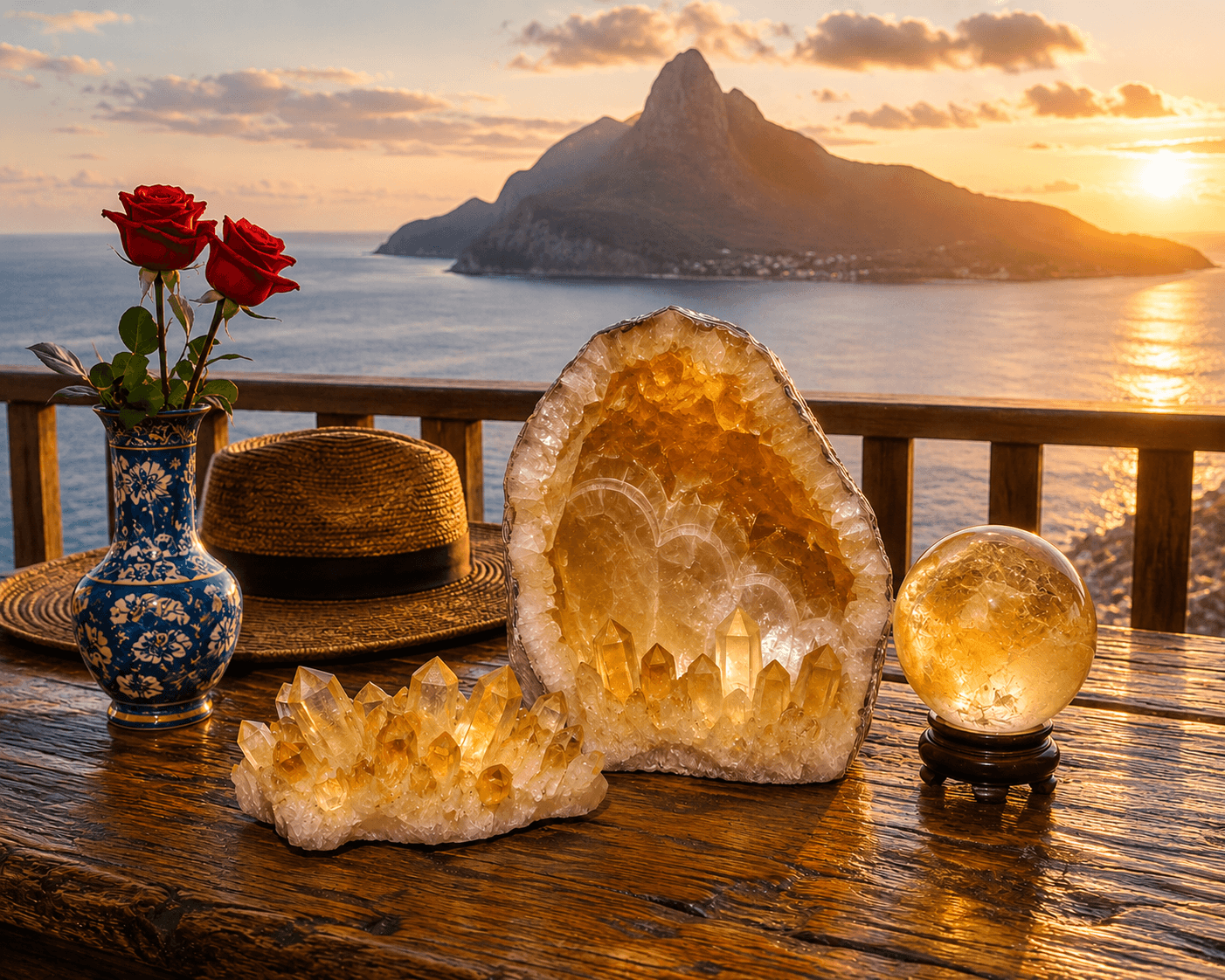
You can find citrine on the shelf of any crystal shop, and most of the time it will be introduced right away as “the stone of abundance.”
Abundance, success, money, opportunities.
But to me, its story becomes much more interesting when we understand its connection to the solar plexus chakra.
Citrine is a yellow variety of quartz. Natural citrine is relatively uncommon, and its colors tend to be subtle—ranging from pale yellow and champagne to honey, gold, and slightly smoky shades.
Many of the stones sold in shops as citrine are actually natural amethyst that has been artificially heat-treated. Heating changes its color to yellow, orange, and sometimes deep brown. It is still natural quartz, but its color comes from heat treatment rather than the natural process that forms citrine.
Looking at the stone’s yellow and golden hues, it is easy to understand why it has become associated with the solar plexus over the years.
The solar plexus chakra, Manipura (mah-nee-POO-rah), is the third chakra. Associated with the color yellow and the element of fire, it relates to will, personal power, confidence, boundaries, and the ability to put things into action.
For me, this is also where the interesting connection between the solar plexus and abundance lies. Abundance is not just something we want to receive from outside ourselves. For an idea, a talent, or a desire to find expression in the world, we need to make choices, take action, persevere, and be willing to let others see what we have to offer.
We can understand this process through the first four chakras.
The root chakra gives us solid ground—I exist, I am safe, and I have a place in the world.
The sacral chakra brings emotion, desire, creativity, and potential—I feel, I want, something within me wants to be born.
The solar plexus takes that potential and turns it into action—I choose, I can, I do.
And the heart chakra brings in our connection with others—how do I remain myself, with my own desires and boundaries, while still loving, connecting, and seeing the person in front of me?
Lately, I have found myself returning to the solar plexus again and again through sessions that actually began with questions about romantic relationships.
For one person, anger was erupting within the relationship, with an underlying feeling that their partner did not see them or their needs.
In another case, crises were being created, and the relationship was even being deliberately sabotaged, to test whether the other person would fight for them.
Beneath these different behaviors were some very simple needs:
I want to feel seen.
I want to know that I matter.
I want to express myself.
With another person, I encountered the quieter end of the spectrum. They described a period of deep depression, withdrawal, and a loss of the energy needed to act and get things done.
Depression, of course, is not a “blocked chakra” and requires appropriate professional care. But within a holistic perspective, an interesting question arose for me: What happens to our will when it finds no expression in the world?
Sometimes the fire comes out as anger.
And sometimes it seems simply to fade.
Anger can also be a messenger. It can tell us that someone has crossed a boundary, that we are not getting something we need, that we are doing something we do not want to do, or that we feel powerless in a situation we want to change.
The difficulty begins when, instead of putting the need into words, we expect the other person to recognize it on their own.
“If you really loved me, you would know.”
And when they do not know, the anger grows.
We may shout our need, pull away, punish, or set up a test to see whether the other person will come after us.
But the work of the solar plexus is not just about knowing what I want. It is also about taking responsibility for that desire—understanding what I need, asking for it, setting a boundary, and taking action.
This is as true in relationships as it is in work, creative pursuits, and business.
The abundance citrine symbolizes does not have to be money. For one person, finding expression in the world might mean starting a business and being able to earn a living from it. For another, it might be a creative endeavor, a career, a project, or an idea they want to bring to life.
The sacral chakra holds the potential. The solar plexus allows it to find expression in the world.
And above it is the heart chakra.
A heart without a steady solar plexus can turn toward people-pleasing—I love, so I give myself up.
A solar plexus disconnected from the heart can turn toward control—I want, so you need to change.
The connection between them allows me to know who I am and what I need, while also seeing the person in front of me.
Perhaps this is why citrine’s connection to abundance goes deeper than “attracting money.” It symbolizes the movement between the potential within us and our ability to give it form in the world.
And there is something else worth remembering, precisely because of how people use it.
Many people place citrine in their business, on the counter or near the cash register. Because of its reputation as a stone of abundance, it is often kept somewhere visible and accessible, where customers pick it up, hold it, and pass it from hand to hand.
If we work from the understanding that crystals absorb and hold energy, it is worth considering that a stone kept in a public space and touched by many people may also absorb energies that do not necessarily align with the intention behind placing it there.
That is why, especially with a stone I have placed with the intention of abundance, success, and fulfillment, I like to cleanse it from time to time and renew the intention I bring to working with it.
I wrote about the different ways to do this in my previous post on cleansing crystals.
The fire is already within us. The question is how we choose to express it in the world.