Dendritic Agate (Dendrite)
Dendritic agate's branching mineral patterns evoke growth and belonging. Explore its origins, chakra associations, meditation uses, and differences from moss and tree agate.
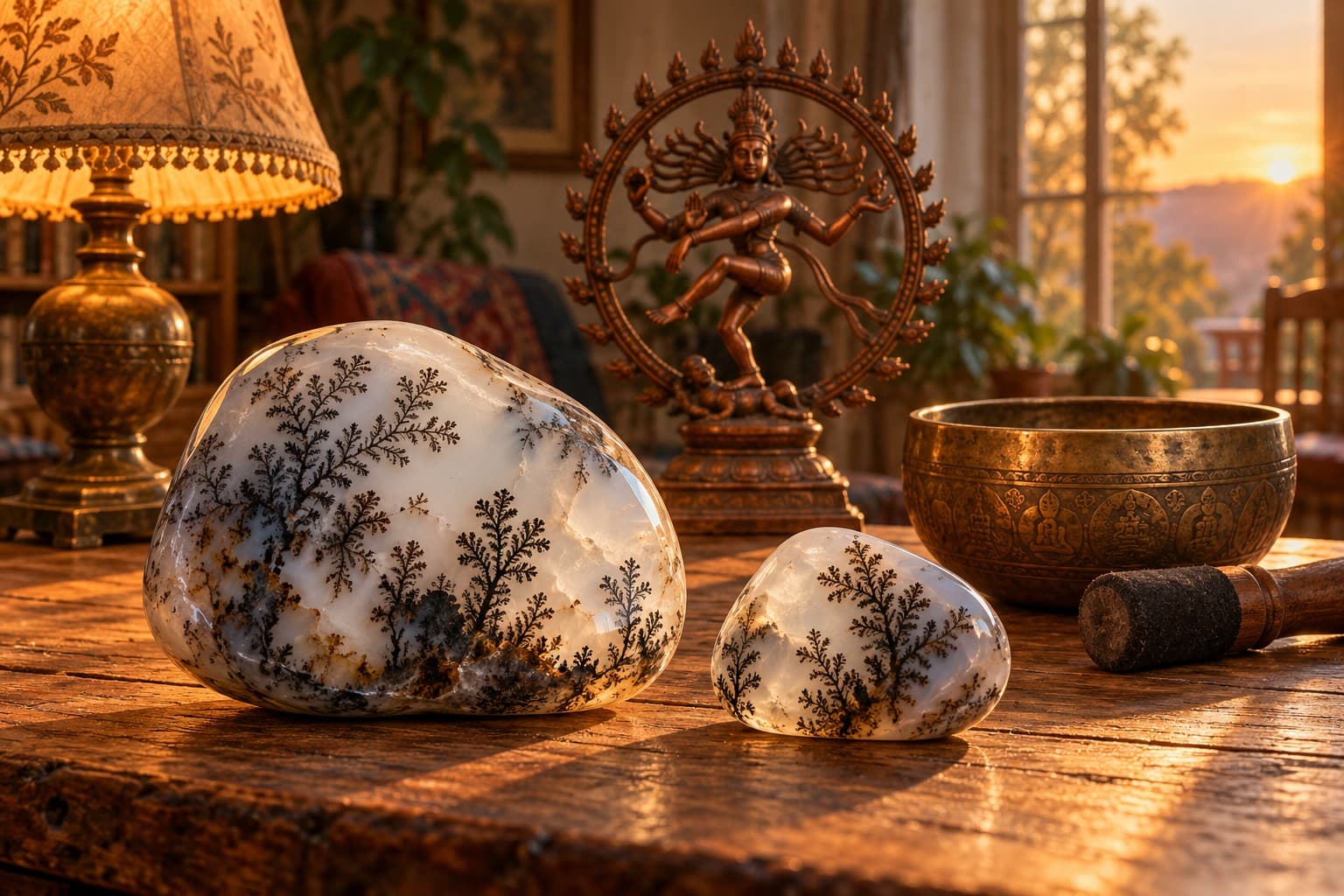
In Dendritic Agate, you can discover an entire landscape within a single stone: a dark branch spreading across a milky background, the silhouette of a tree, or a delicate pattern resembling a fern. Sometimes, simply turning the stone is enough to transform the tree into a river or a road map. This is part of its magic—the ability of mineral matter to awaken a vivid imagination.
In the language of energy work, it is associated with growth, patience, abundance, and a sense of belonging in nature. The branches within it give shape to the idea of development: there is a foundation from which to expand, and room for life to move in several directions. Alongside these meanings is an intriguing geological story, because the “plants” visible in the stone are actually mineral formations.
What Is Dendritic Agate?
Dendritic Agate, also called Dendrite, is a trade name for chalcedony with branching inclusions. Chalcedony belongs to the quartz family and consists of tiny silica crystals. The dark inclusions usually contain manganese or iron oxides and may resemble roots, branches, or ferns.
The term “dendritic” comes from the Greek word dendron, meaning tree. It describes a branching form, not a particular plant species or a single mineral. Dendrites can also appear in other materials and rocks.
The name “agate” is used here in its broad commercial sense. Many specimens lack the banding characteristic of agate under its narrower definition, so you may also encounter the name dendritic chalcedony.
| Property | Description |
|---|---|
| Material family | Chalcedony, part of the quartz family |
| Main component of the host material | Silica, SiO₂ |
| Characteristic pattern | Branching mineral inclusions |
| Common colors | A translucent, milky, gray, or pale base with brown and black patterns |
| Typical hardness of chalcedony | Approximately 6.5–7 on the Mohs scale; the stone’s condition and any treatments also matter |
| Uses | Pendants, rings, pocket stones, polished slabs, and collectible pieces |
For an introduction to the broader family, see the guide to Agate.
How Do the Branches Inside the Stone Form?
Fluids containing mineral components can move along tiny cracks and planes within the material. Under suitable conditions, the precipitation and growth of mineral deposits create branching patterns. The precise processes and components vary among specimens.
Polishing reveals the relationship between the inclusions and the stone’s layers. Sometimes a lone tree seems to emerge; at other times, there is a dense network of branches or a landscape that appears three-dimensional. The cutting orientation matters a great deal: a thin inclusion at a particular depth can disappear if too much material is removed.
These are not plants, roots, or fossilized ferns. Their resemblance to vegetation arises through a mineral process. This is a fundamental difference between Dendritic Agate and Turritella Agate, whose natural material does contain fossilized snails.
How Does It Differ from Moss Agate and Tree Agate?
Trade names sometimes overlap, and suppliers do not all draw the same boundaries between them. The distinctions below describe common uses of these names and offer a guide to their appearance; they are not a substitute for gemological identification.
| Trade name | Common appearance | What to know |
|---|---|---|
| Dendritic Agate | Brown or black branches, sometimes fine and distinct, against a pale or translucent background | The name emphasizes the branching form |
| Moss Agate | Inclusions resembling moss, thickets, or vegetation, often green | Its appearance may overlap with material described as dendritic |
| Tree Agate | Green patterns on a relatively opaque white base | Sellers may also use this name alongside “dendritic” |
In all three cases, the plantlike appearance does not indicate a living plant trapped inside the stone. You can explore Green Moss Agate and Tree Agate to learn more about their visual and symbolic differences.
Dendritic Opal may also display dark branches against a pale background, but its host material is opal rather than chalcedony. A similar pattern does not make the materials identical, and their care requirements may also differ.
Where Does Dendritic Agate Come From?
India is one of the well-known sources of this material. Specimens from India are documented in natural history collections and gemological literature, including stones with fine, distinct branches. Agates with inclusions that create landscape-like and plantlike scenes are also documented in Brazil.
The name describes an appearance, not a single place of origin. The shape of the tree inside a particular stone cannot establish its country, mine, or age. When origin matters, ask the supplier for provenance details and distinguish documented information from a general trade name.
In the Ancient World: A Stone of Trees and Landscapes
The fascination with these patterns is not new. In Book 37 of Natural History, written in the first century CE, Pliny the Elder describes a type of agate with markings resembling small trees, called dendrachates. He also mentions agates from India whose appearance evokes rivers and forests.
This is an intriguing historical account of seeing landscapes within a stone. Ancient stone names, however, do not always correspond to modern gemological classifications, and we cannot assume that every specimen sold today as dendritic is identical to the material Pliny saw.
Agate and chalcedony more broadly also had practical and ritual uses in the ancient world, appearing in seals, jewelry, and amulets. Agate cylinder seals from Mesopotamia and Egyptian agate amulets are known. These finds attest to the importance of this family of stones, but they do not establish that every such amulet was made of Dendritic Agate.
Crystal literature also connects these patterns with dryads, the tree spirits of Greek mythology, and describes an association with blessings for the land and harvest. This can be understood as a symbolic tradition. Stories about burying Dendritic Agate in fields should not be presented as established archaeological fact without appropriate documentation.
Energetic Properties Attributed to Dendritic Agate
In contemporary crystal work, it is sometimes known as the “Stone of Plentitude.” Abundance here can encompass material resources, relationships, creativity, and the ability to feel that life has room to unfold. The descriptions below belong to the energetic tradition and symbolic interpretation of the stone.
- Growth and development: The branching pattern is associated with expansion from an existing foundation. You can work with it with the intention of opening up possibilities while sustaining what nourishes them.
- Patience and perseverance: It is said to have a quality that supports processes that unfold gradually. Its symbolism lends itself to learning, nurturing, and maturation.
- Grounding and belonging: Connection with the body, home, and nature, along with a sense of having a place to stand even when the full picture is not yet visible.
- Abundance and gratitude: Recognizing what is already present and what can grow from it. Its association with abundance is not a promise of income, winnings, or success.
- Recognizing patterns: A single branching point can lead in several directions. This offers a starting point for symbolic work with habits, choices, and the possibility of responding in a new way.
- Harmony and connection: Some approaches emphasize its association with easing tensions and fostering a sense of belonging. In personal practice, the intention can focus on listening and making room for different needs.
What Does Its “Frequency” Offer?
In the language of energy work, Dendritic Agate is described as having a gentle, steady, and supportive quality. Spending time with it draws attention to the pace at which something can take root and branch out. It is an image of development that allows for pauses, reorganization, and repetition.
In the interpretation offered here, the branches and the open background matter equally: there is a form seeking to grow, and there is space around it. This can be seen as an invitation to direct energy toward what matters while also leaving room for rest and a change of direction.
“Frequency” is used here as a spiritual description of the quality of an experience. There is no agreed-upon, verified value in hertz that defines a healing frequency for Dendritic Agate.
Which Chakras Is It Associated With?
Contemporary sources do not offer a single, consistent association. Some emphasize the root chakra, while others include the heart or crown, depending on color and approach. These are symbolic correspondences within the chakra framework.
| Chakra | Context for working with the stone |
|---|---|
| Root | Grounding, foundation, belonging, and perseverance; a central association in approaches that emphasize connection to the earth |
| Heart | Connection, acceptance, and growth within relationships; emphasized in some approaches, especially for green material similar to Tree Agate |
| Crown | Contemplation, seeing the bigger picture, and belonging to a greater whole; appears in some mappings for stones with a white base |
Choosing a chakra can begin with the intention of the practice, without assuming that the stone diagnoses a “blockage.” You can hold it in your hand or place it nearby; there is no requirement to position it according to its color or chakra association.
Uses in Energy Work and Meditation
Meditation with the branching pattern: Choose one branching form and follow it with your eyes, from its base to its tips. Your attention can remain with the shape, your breath, and the spaces within the image.
Accompanying a new beginning: Place a stone beside a study notebook or project to represent one intention: giving something new the conditions and continuity it needs. This is a suggestion for symbolic work, not a way to guarantee an outcome.
A nature corner at home: Place it beside a potted plant, another stone, or an object from nature. Within the energetic tradition, it symbolizes growth and harmony. Caring for the plant itself still depends on light, water, soil, and conditions suited to its needs.
Working with abundance: Place it somewhere you reflect on resources and consider what actually nourishes your life: income, time, knowledge, support, or the ability to accept help. The intention can be to cultivate a particular resource rather than wait for a general promise of abundance to come true.
A crystal grid: Choose it as a central stone with an intention of gradual growth, or include it in a circle representing connection and support. The arrangement is part of your personal interpretation and practice; there is no single required layout.
Carrying and wearing: A pocket stone or pendant can serve as a reminder of something you have chosen to nurture. You can return to its appearance throughout the day without needing an elaborate ritual.
Personal Growth: What Needs Different Conditions?
One of the stone’s richest images is the relationship between a single branch and the larger system it belongs to. In life, a recurring difficulty can be explored in the same way: is it connected only to a particular choice, or also to the environment, habits, and available resources?
This interpretation does not assume that something is “wrong” with anyone drawn to the stone. It invites curiosity about the conditions in which we develop. Sometimes perseverance is needed; at other times, what is needed is support, a lighter load, or room to try a different direction.
The branches can also remind us that identity does not have to follow a single path. We can add an interest, a relationship, or a form of expression while retaining a familiar foundation.
Relationships, Family, and a Sense of Belonging
In a romantic relationship, Dendritic Agate can represent a bond that develops through repeated gestures, shared time, and growing familiarity. The image of two branches emerging from one trunk suggests a closeness that also accommodates differences.
Symbolic work can focus on the balance between “us” and personal space: what do you want to invest in together, and what is important for each person to have room to develop independently? Even during a quiet period, you can explore what still invites curiosity and connection.
Within a family, the pattern may evoke a family tree or a community. You can reflect on what passes from one generation to the next and what you choose to create now. The image also lends itself to chosen family and nonbiological bonds. The stone cannot determine how another person feels, bring someone back into a relationship, or replace a conversation.
Work, Creativity, and Practical Abundance
In a work setting, dendrites can be interpreted as an image of a network: skills connecting, people supporting one another, and a single idea giving rise to several possibilities. A stone on a desk can represent an intention to work consistently, share knowledge, or build relationships over time.
For those who create, the landscape within it can inspire visual imagination. The same pattern may appear as a tree, a river, or a coastline, revealing how a change of angle changes the story. There is no need to find a fixed “message” in the shape of the inclusions.
Symbolic abundance becomes useful when it can be named: more time for creative work, a stable work system, a livelihood that honors the effort involved, or professional relationships built on reciprocity.
A Brief Reflection with the Stone
Hold the stone, choose one area of the pattern, and notice what draws your eye. Is it the base, the branching form, or perhaps the pale, open space?
One question can accompany the reflection:
What in my life is already beginning to grow, and what conditions would allow it to continue?
You can also simply stay with the shapes without interpreting them. The encounter with the stone’s beauty is complete even without an answer or a particular insight.
Pairing It with Other Stones
The following suggestions are symbolic pairings based on shared themes, not claims that combining minerals has a proven effect:
- Tree Agate: Contemplating branching forms alongside an image of growth within a living environment.
- Green Moss Agate: A distinct branch beside a thicket-like pattern; an intention of personal development and belonging to a greater whole.
- Blue Lace Agate: Nurturing a connection alongside the wish to express a need, an idea, or a new direction in conversation.
- Turritella Agate: Traces of past life alongside a mineral image of growth. You can dedicate time with the two stones to the question of what to carry forward and what you want to develop.
Choosing, Wearing, and Cleaning
Choose a stone whose pattern feels pleasing and intriguing even without the promise of a particular property. The clarity of the inclusions, the quality of the polish, the condition of the surface, and information about the material’s origin matter more than an impressive trade name.
You can ask whether the stone is natural and whether it has been dyed, coated, or filled. Sharply defined branches alone are not proof of an imitation, but a beautiful photograph is not confirmation of the material’s identity either. For a significant purchase, professional identification may be helpful.
For routine cleaning of a polished stone, use a soft cloth, or lukewarm water with a little mild soap, then dry it. If the stone has cracks, is set in jewelry, or has undergone unknown treatments, seek care instructions appropriate to the piece. Avoid extreme heat, harsh chemicals, and ultrasonic cleaning without a suitable assessment.
Store it in a separate pouch to reduce scratches and impacts. Good hardness does not guarantee that the stone will not break.
If you practice energetic cleansing, you can devote a moment of intention to the stone and let it rest on a clean, dry surface. This symbolic ritual does not require salt, soaking, or prolonged exposure to sunlight.
Frequently Asked Questions
Is There Really a Tree Inside the Stone?
No. In the natural specimens described here, these are mineral inclusions with a branching shape, not the remains of a tree. The visual resemblance to a plant is part of the stone’s beauty.
Is a Dendrite a Type of Mineral?
The term describes a branchlike form. The minerals and host material can vary, so a dendrite in one stone does not necessarily have the same composition as a dendrite in another.
Does Dendritic Agate Bring Abundance?
“Stone of Plentitude” is a name used in crystal traditions. You can draw on it with an intention of growth, gratitude, and cultivating resources, without any promise of a financial outcome.
Is It the Same Stone as Tree Agate?
The trade names overlap. “Tree Agate” usually describes relatively opaque white material with green patterns, while “Dendritic Agate” is associated with brown or black branches. It is best to examine the piece itself rather than rely on the name alone.
Does It Have Any Proven Medical Effects?
The energetic associations in this article are part of a spiritual tradition and symbolic practice. They should not be taken as evidence of an ability to treat disease or as a substitute for professional care.
Dendritic Agate holds an image of branching within a solid material. It brings foundation and movement, form and space, into the same encounter. From that meeting, a reflection may emerge on growth that fits our lives—and on the room we are willing to give it.